
Word should have gotten around that the American, Mormon-run film production and distribution company Angel Studios doesn’t just offer Christian propaganda – for example, the company was able to surprise people last year with the monster film “Sketch”. But that doesn’t mean that there aren’t always failures – and so one could rightly be skeptical when the animated adventure musical “David” was announced.
The story, known from the Book of Samuel in the Old Testament and often made into a film, about the simple shepherd boy David, who becomes king of Israel with God’s support and help, is of course ideal material for extensive indoctrination of the audience. But “David” is not only a surprise in this respect: Of course, advertising for the Almighty is occasionally a little too intrusive, but overall the surprisingly well-made production, which does not have to hide behind Pixar & Co. in terms of form, is relatively restrained. Instead of pulpit sermons, the film focuses more on a family-friendly, if not always completely balanced, mix of action, adventure, drama, gags and snappy songs.
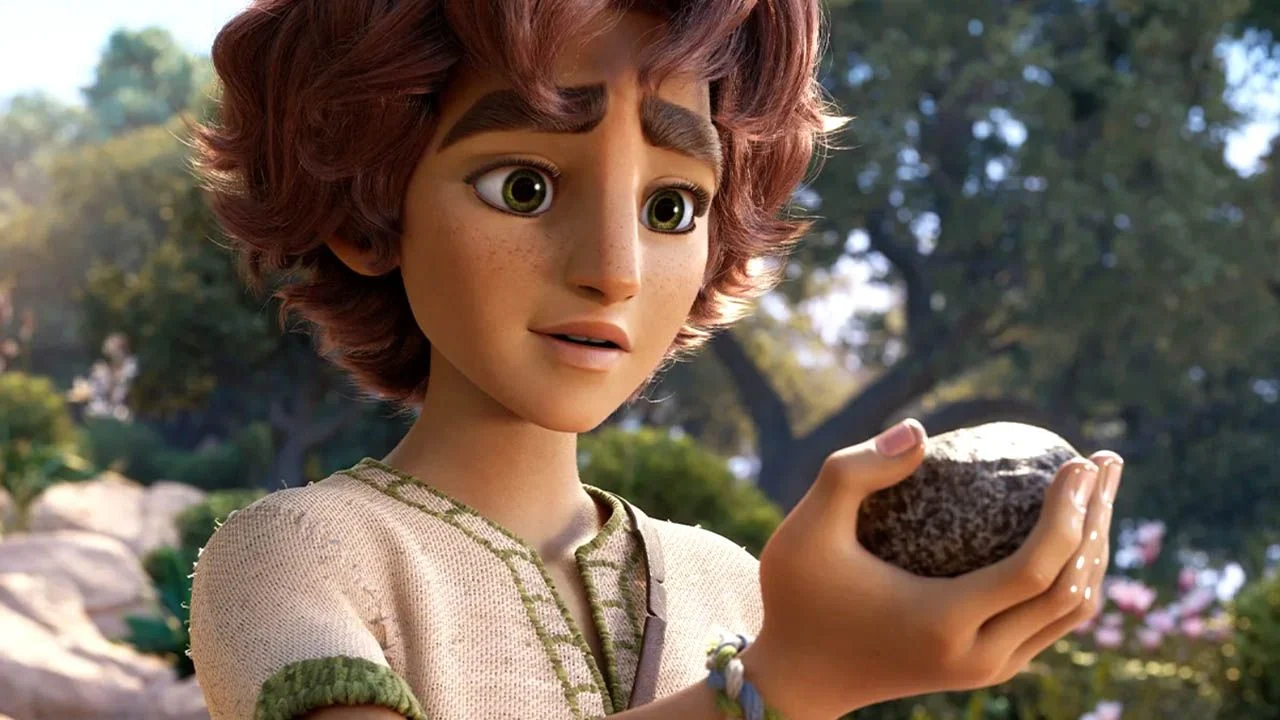
Shepherd boy David still has no idea that one day he will be king of Israel.
“David” follows the five-part series “Young David” (2023/2024), which has not yet been exploited in Germany and sheds light on David’s childhood. The film now begins with his youth in the hills of Bethlehem and ends with his appointment as king. While many Bible adaptations often come across as stiff at the hips out of reverence for the text, the makers of “David” strive for maximum accessibility for a young audience. This is particularly evident in the fact that a core that already exists in the template is being significantly expanded.
In the Old Testament, David was ultimately a forerunner of modern superheroes, a chosen one with superpowers (not only does he receive support from above, but he is also a master at using a slingshot) – and so it is not too far-fetched that the two directors Brent Dawes and Phil Cunningham are based on the comic blockbusters of recent years.
The fight between David and Goliath is a (too) early climax
“David” tells an origin story that could theoretically come from Marvel or DC. The main character begins as a normal young man who one day discovers his abilities, is given a kind of mentor, performs heroic deeds and at the end receives a costume to round it off. Here, too, it’s not about the protagonist alone, but about much more – namely the fate of the entire Israeli people.
The famous giant Goliath is not the main villain of the film, but is portrayed as a classic supervillain. It’s not just huge, but downright gigantic – a mountain that makes the shepherd boy seem really tiny. Of course, David’s victory only seems even more superhero-like and unfortunately also like a climax too early, because the spectacular confrontation (including the patented Zack Snyder slow motion) is no longer topped.

Basically, David goes through a classic superhero development.
The film is also weak when it comes to character development. Of all people, the fuzzy-headed David is a rather pale hero – far too generic, too smooth and without any real breaks in development. The efforts to finally add some complexity to it come far too late. Far more successful is the quick-tempered King Saul, a tragic figure who sees his power waning with the appearance of David and therefore struggles with pride and insecurity, but also has a human side. A fascinating character who proves to be much more of a driving force in the film than the title hero.
The script does have dents, which also affects the songs, which are good in themselves but often slow down the pace. But the technical implementation is flawless. “David” was produced in collaboration with the South African animation studio Sunrise Productions, which is particularly successful thanks to the children’s series “Jungle Beat,” and it flexes its muscles in a colorful way. No matter whether it’s about the imaginative character designs, the finest details and textures (the hair and fabrics are particularly notable here) or the amazingly realistic landscapes – the makers don’t reveal themselves in the slightest. This is a remarkable leap forward, especially for Angel Studios, whose animated films have so far been of mixed quality!
Conclusion: Angel Studios’ missionary agenda occasionally takes precedence over the plot, and the script isn’t entirely successful either – but anyone who can overlook that and perhaps even watch the film with children will certainly have fun.