
In 1919, Virginia Woolf published perhaps her most accessible novel, “Night And Day.” In it, the feminist writer addressed patriarchal structures, but concentrated on a fairly traditional love and marriage story. She later described her work, which was often compared to Jane Austen (“Pride & Prejudice”), as insignificant.
Director Tina Gharavi has now filmed the book for the first time under the title “Virginia Woolf’s Night & Day” – and is making a fundamental change to the material: While the novel only briefly mentions that Katharine Hilbery (Haley Bennett) is very fond of astronomy, screenwriter Justine Waddell expands this detail into a central thread – and uses it to knit a story about a woman who, with discipline, iron will and a lot of ingenuity, finds her own way pursued. Despite an excellent cast, the spark doesn’t really catch on. Many of the characters are too flat, solutions to Hilbery’s problems present themselves too quickly. And so the “unromantic comedy”, as one of the advertising slogans for the film, causes boredom at times.
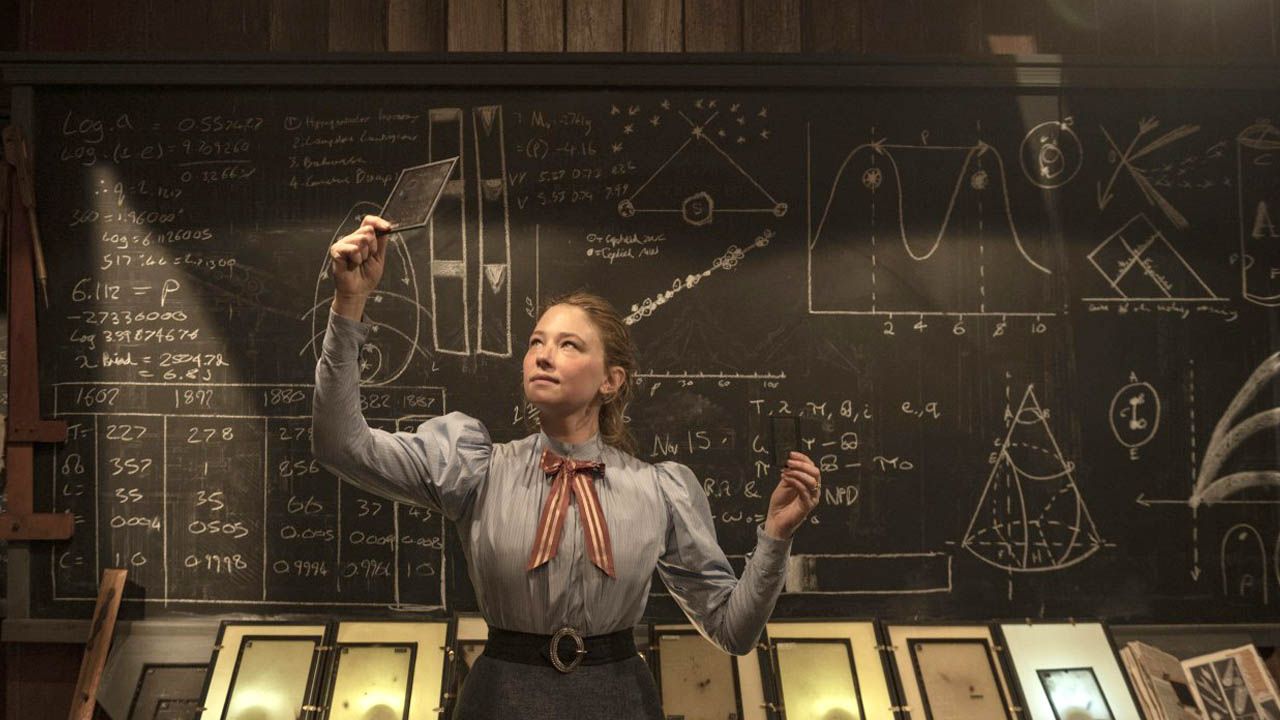
Katharine Hilbery (Haley Bennett) lives for science – but as a woman in the early 20th century she is hardly given a chance.
Katharine Hilbery (Haley Bennett) lives in London and comes from a wealthy family. Her father (Timothy Spall) has little understanding of his daughter’s career ambitions and arranges a marriage with childhood friend William (Jack Whitehall). As a woman in the early 20th century, Katharine has little chance despite brilliant research discoveries – but she is determined not to give up! Haley Bennett, known from “Girl On The Train” and “Swallow” among others, plays the energetic scientist in the costume drama adorably.
Thanks to cameraman Sebastian Edschmid, Katharine is already able to be characterized in the poetic introduction: the young woman takes a nighttime swim in the Hampstead Ponds, looks at the stars and ponders the universe – she almost disappears into the darkness. However, together with Simon Goff’s electronic-atmospheric score, the film makes a big promise here, which it fails to keep in the following. Although Katharine is drawn lovingly, the other characters definitely lack depth.
The supporting characters remain pure staffage
This applies, for example, to the women’s rights activist Mary (singer Lily Allen in her first film role), who supports Katharine in her projects. Together with other women, she prints leaflets in a huge factory hall. But although the suffragette movement is just emerging, like Mary, it remains only a side note. Instead, the film focuses throughout on Katharine. The enthusiastic astronomer is always looking for new ways to advance her research, sneaking into an Astronomical Society event with her cousin (Misia Butler) in men’s clothing and talking to him about her discoveries using vivid pictures. It is precisely these moments that make them approachable, while the rest of the staff remains staffage.
A big plus point, however, is the charming production design by David Hindle, who, among other things, also designed the Oscar hit “The King’s Speech”. For example, there is Katharine’s father’s study with an oil lamp, reading magnifying glass – and a striking number of dog portraits. A small but nice swipe at the patriarch, who always sees women as accessories. He even laughs at his own wife’s (Jennifer Saunders) ambitions to finally finish the biography of her famous poet grandfather.

The German audience favorite Elyas M’Barek (“Fack ju Göhte”) is also there.
Her editor is audience favorite Elyas M’Barek (“Fack ju Göhte”), who takes on his first major international film role in “Virginia Woolf’s Night & Day”. He acts as a gentleman who understands women, which suits him very well. But sentences like “Is it so absurd for you to imagine that a man would want to support a woman’s success?” are too obvious and seem clumsy in the modern film adaptation of Woolf’s second work.
Katharine’s fiancé, on the other hand, is drawn like a caricature through his tireless courtship and the lyrics in which he adores his beloved. While this makes for some amusing moments, it does come across as clumsy at times. And if Katharine wants to turn an entire century upside down with a fiery speech, then it ultimately becomes completely unrealistic.
Conclusion: “Virginia Woolf’s Night & Day” is truly beautiful to look at, but the plot is too pleasing – and so the film is disappointing despite a fascinating look at the stars. The material would have offered more than a pure romantic comedy.
We saw “Virginia Woolf’s Night & Day” at the Munich Film Festival, where it celebrated its German premiere as part of the CineCoPro competition series.