
As we all know, life writes the most beautiful stories. This is also the case with the true story of Agnes and Amir, who, with an age difference of 73 years, have formed what is probably the most unusual shared apartment in Berlin. Director Helena Hufnagel (“Generation Incapable of Relationships”) has now made a film about the touching friendship: “Favorite People – The Extraordinary Friendship of Agnes and Amir” is a feel-good comedy with believable characters that shows how integration works.
Although the film doesn’t get along entirely without Berlin clichés – long queues when looking for an apartment and hedonistic party people included – but all in all it’s a pleasure to follow the opposing duo. Amir makes his new shared partner more mobile and goes on trips with her; Meanwhile, Agnes is at her best as Amir’s matchmaker. It all started so bleakly…
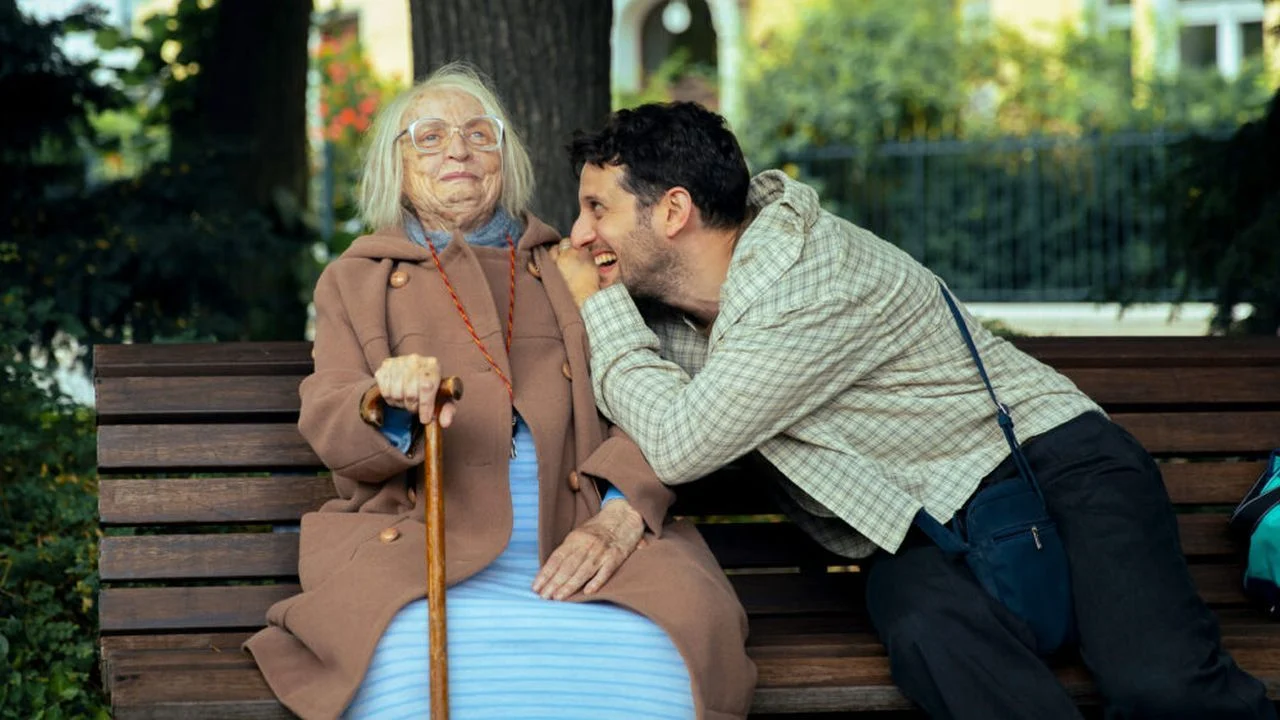
Agnes (Katharina Thalbach) and Amir (Bardo Böhlefeld) form what is probably the most unusual shared apartment in the nation.
101-year-old Agnes (Katharina Thalbach) leads a lonely life with a goldfish in her apartment in Berlin-Schöneberg, which she moved into over 60 years ago. She doesn’t have any children. A few photos and a gramophone on the window tell of times long gone – when Agnes was still happy and dancing. Old film reels preserve the memory of her first husband. She had taken him to the platform, but he never returned from the war. Agnes carefully keeps the old platform ticket in her bedside table. This is what is said to have happened to the real Agnes.
“Favorite People” is of course also a story. What is significant in the film is the imagined park bench in front of the apartment with the plaque “For Agnes forever – Georg 1992”, a souvenir of her second husband. Day in and day out, Agnes watches over the seating area with binoculars. If she spots someone who wants to sit down on “her” bench, Agnes rushes out of her apartment with her walker squeaking angrily. It’s images like these that entertain, but also make you think. Agnes’ entire purpose in life is to watch over this bank.
Harsh, but warm
It’s all the nicer that she meets Amir (Bardo Böhlefeld) when she wants to chase the newly homeless Iranian from her park bench. When Amir surprises her with his courteous manner, he is allowed to sit for a while. Agnes is a cynic with a sure point and doesn’t shy away from Amir’s knowledge of German. Amir shouldn’t believe everything they tell him: “Everyone says I’m sprightly. Spongy basically means dead, but still twitching.” That’s the same with his knowledge of German, it’s not that good.
The film’s Agnes appears much harsher than the fun-loving, sociable Berlin original, but forms a nice contrast to the rather quiet Amir, who moves in with the nursing home refuser as an emergency solution. Katharina Thalbach embodies the hundred-one-year-old Agnes – with an impressive age mask and huge glasses on her nose – absolutely believably. Lying in bed, she is so pale that she blends in with the inventory – but her alert eyes speak volumes.
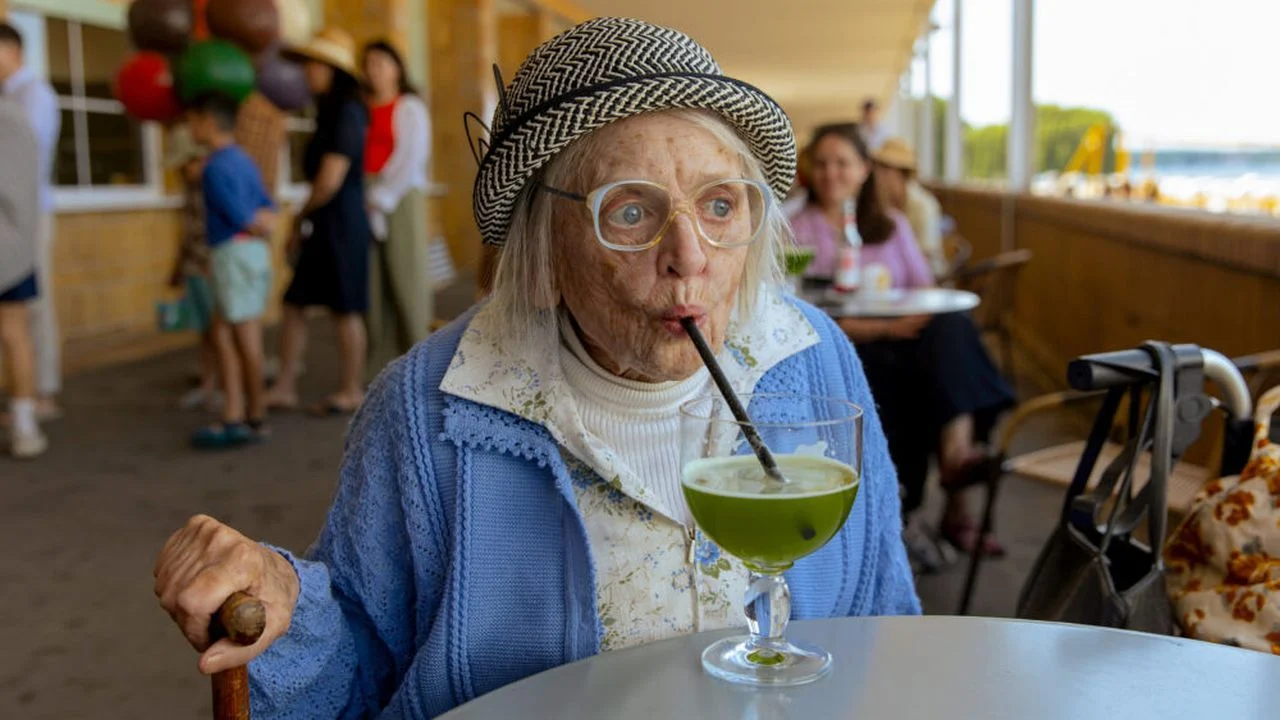
Even at 101 years old, Agnes doesn’t let herself get down!
When Amir moves in, he initially causes a bit of unrest – a typical shared apartment life, where everyone first has to find their place, in the bathroom as well as in their hearts. But Amir slowly cooks his way into the world of the old Berliner with delicious saffron rice and flatters her when he explains that elsewhere the old people are the bosses. Musically, “Lieblingsmenschen” is also diverse, ranging from the 1920s to the present day. The oldest song is Alice Babs & Paul Kuhn’s lively dance café hit “Fräulein, Pardon” (1929), which is matched by Max Raabe’s cover version of the French chanson “La Mer” (2023).
But Queen’s “Who Wants To Live Forever” (1986), classical music, electronic music and pieces from a very well-known Persian label can also be found in the playlist. The main character Bardo Böhlefeld, whose mother is Iranian and whose father is German, even sings the song “Lullaby For Bunnies” himself. The use of the songs is clever, as the human contrasts are also recreated musically. The script by Malte Welding (“A Million Minutes”) also gives Amir’s story enough space. Until now he lived in the container village, where the space was very small. Aline László’s camera is also quite intrusive, which changes later.
Friendship as home
She likes to show him sitting at the window of Agnes’ apartment with a view of the sky. When Amir picks up his cell phone, it’s to contact his family in Iran, whom he had to leave behind. He brings up the same photo of his friend again and again, as if time had stood still. Amir is gay and is seeking political asylum in Berlin. Only later do you learn the full, sad dimension of his story. The asylum discussions with his lawyer are also repeatedly woven into the plot. You understand how difficult it is for Amir to prove his homosexuality to the authorities, which is why his stay is in jeopardy. Agnes, on the other hand, is having discussions with her family doctor (Rainer Bock) about her placement in a home. It is parallels like this that give the film a depth, as both Agnes and Amir fear for their home and ultimately find it in their friendship.
The story gets rolling through Amir’s plan to enter Agnes into a dance competition because he still sees a youthful spark in her. This is how Agnes transforms from a quirky old woman with a tired look into an adventurous senior citizen with a fast electric vehicle and sparkling, bright blue eyes. When she rushes off, Agnes fills the entire screen in the generous Cinemascope format. Anyone who doesn’t smile doesn’t have a heart for crazy grandmas. “We get along like two left-wing lads,” is how the real Agnes Jeschke described their friendship. And if you look closely, you will discover the real Amir in the film, who gave Agnes Jeschke the wonderful last years of her life until her death at the age of 104.
Conclusion: Despite some clichés, the quirkiest, likeable couple with a record age difference since “Harold and Maude”, which shows how much love can be in friendship!
We saw “Favorite People” at the Munich Film Festival, where it celebrated its world premiere.