
Mala Emde (“And Tomorrow the Whole World”) is one of the greatest acting talents in German film: At the age of eleven she appeared in front of the camera for the first time for various TV series. At the age of 19, she was awarded the Bavarian Film Prize’s Young Talent Award for her first leading role in the documentary drama “My Daughter Anne Frank”. Further honors followed, most recently the German Acting Prize for “Köln 75”. For the first time, the versatile young character actress can now be seen in a comedy – and then with Christoph Maria Herbst as her counterpart. Can this work?
To put it bluntly: Yes, and Mala Emde does it brilliantly in “Summer on Asphalt”. Not only does she perform well, but she gives her role a wonderfully realistic and at the same time tragicomic momentum – from the fast-paced opening to the almost contemplative end.
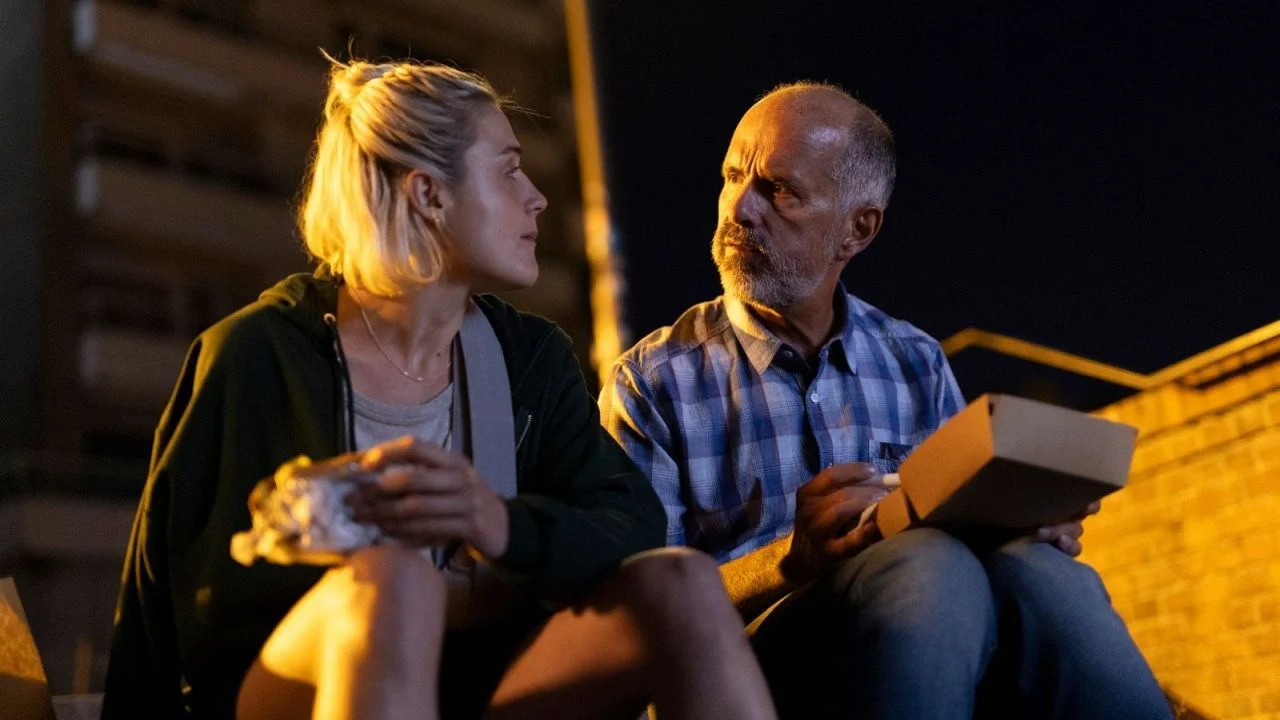
Les (Mala Emde) just needed that: Suddenly father Bert (Christoph Maria Herbst) shows up at the door unannounced!
Les (Mala Emde) is the only woman among the Hamburg pedal pilots. During the day she races madly through the city on her racing bike, and at night she celebrates – including the odd one-night stand, although gender doesn’t matter. But then she not only becomes pregnant unintentionally, but suddenly her father (Christoph Maria Herbst), with whom she has had no contact for a long time, is at the door. He has come to stay, but doesn’t say why. He initially packages the actual reasons in the vague formulation that “something isn’t so good” for him. But even before Les could throw the uninvited guest out the door, he makes himself useful: after a fall, the bike courier can no longer work – and dad Bert, actually Norbert, takes over her job.
He does his job well and even makes friends with his colleagues. Above all with the unconventional boss Maniok (Leon Ullrich with a mop-like old-hippie hairstyle) and the cute Tyler (Aaron Hilmer) – exactly the guy with whom Les fathered the child that wasn’t actually supposed to be born. Finally she finds out that her father is seriously ill and urgently needs to undergo a risky operation…
A lot comes together!
Drama, love, pregnancy, accidents, illness and family problems – and yet Simon Ostermann stages his cinema debut as a brisk comedy with lively, often laconic dialogue (screenplay: Brix Vinzent Koethe). There is also a beautiful sensitivity to the pitfalls of life, which, as we all know, can sometimes be more, sometimes less comical or tragic or both. To achieve this, Koethe redesigned the novel “Pedalpilot Doppel-Zwo” by Wolf Schmid and increased the drama factor even further by transforming the male main character into an unplanned pregnant woman.
The father-son relationship became a father-daughter relationship – a rarely seen constellation in the cinema. The contact with the mother (Jenny Schily) is also discussed later, but is much less in focus: she is a successful best-selling author, and Les has a difficult relationship with her, as does Bert, who has been separated from her for a long time. And while a complicated but somehow just believable family story unfolds very slowly and casually in the film, Bert gets sicker and sicker and Les gets more and more pregnant.
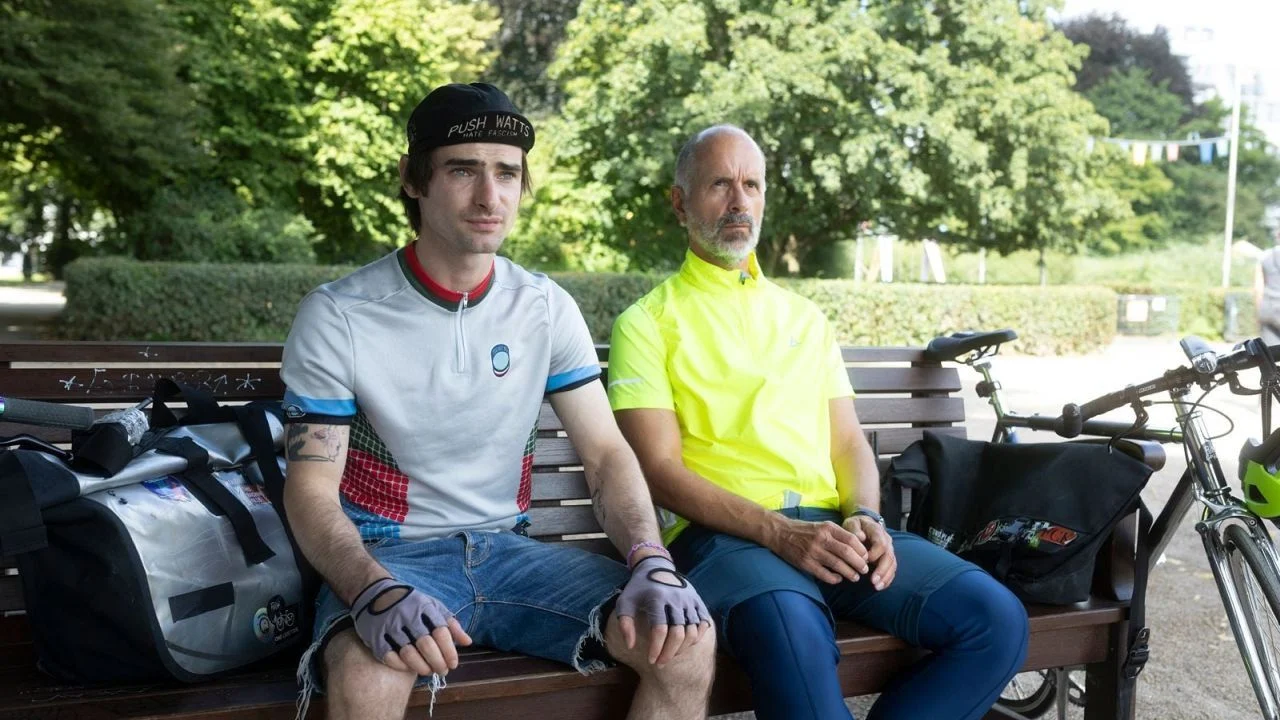
Bert becomes friends with his new colleagues – including Tyler (Aaron Hilmer), his daughter’s ex.
Mala Emde seems to feel really at home with the busy and still great comedy titan Christoph Maria Herbst (“Extrawurst”). The funny, ironic dialogues fly around like ping-pong balls: “Yeah, I know: first pregnant, and now this too… but table tennis just doesn’t sound fun enough!” Similar to “Die Mittagsfrau”, Mala Emde’s performance seems very reserved, unpretentious, so to speak, as if she wasn’t acting at all, but simply always being herself. Her supposedly inconspicuous acting is very striking, especially in the humorous passages – and makes her a very special actress.
In football you call something like that a difference player – and yes: Mala Emde is a difference player. She can do everything, one moment she’s really cute and the next moment she’s a puke. But her character always remains lovable, not because she speaks such friendly texts, but because she is so damn authentic and sometimes just spits out a cool saying. A little like the master of laconicism himself, Christoph Maria Herbst, who is so good, among other things, because he occasionally hides big truths between all the ironic rants that then hit right at the heart.
Conclusion: Together with Christoph Maria Herbst, Mala Emde succeeds in turning this script, which is full of problems and could have become an overloaded big-city schmo, into a relatively light and quite entertaining summer comedy. The film was directed by Simon Ostermann in a lively and even a bit profound way – it sometimes becomes directly touching without losing the relaxed tone.