
How much you know what to do with John Carney’s films probably depends on how you look at music yourself. Since the Irishman scored an incredibly profitable surprise hit with “Once” almost 20 years ago – the street music romance grossed 140 times its slim budget of 112,000 euros – he has been constantly making films about music as an engine for self-discovery, a bearer of truth and a community builder. Although this statement needs to be specified: Carney, who is also part of the rock band The Frames along with “Once” lead actor Glen Hansard, is in films like “Can A Song Save Your Life?” or now “Power Ballad – The Song of My Life” is not just about music. He is interested in “real”, “honest” music.
For him, a song is only worth something if it flows directly from the heart into the hand. If his characters lack the right words, they express their feelings in the form of earthy, intimate singer-songwriter folk, and sometimes they even score a global hit in passing. After all, people secretly long for emotional and acoustic purity. Accordingly, producers and other representatives of the music industry usually appear in his films as antagonists who corrupt the ideal of immediacy.
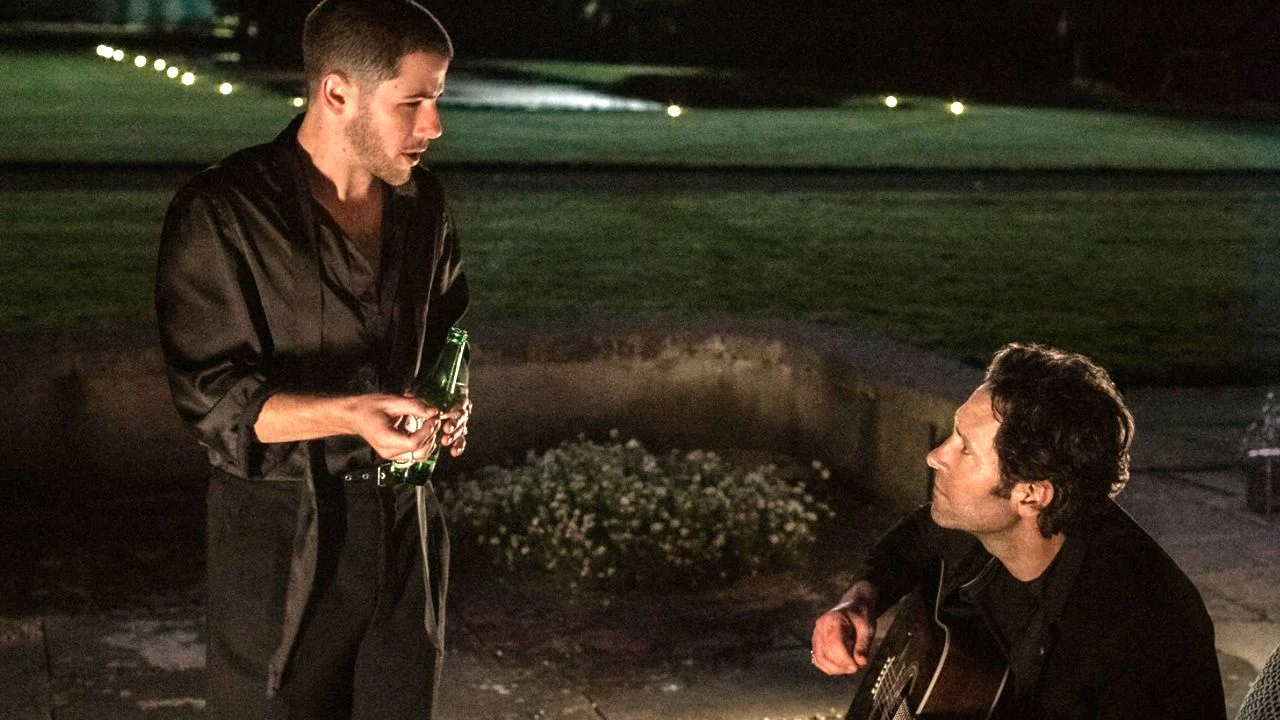
Rick Power (Paul Rudd) is surprised: boy band star Danny Wilson (Nick Jonas) really knows something about music!
In the 2000s and 2010s, Carney hit a nerve with this essentially essentialist form of indie romance. However, by the time of “Power Ballad” at the latest, the director’s dogged attitude only seems antiquated. Consequently, his protagonists have also gotten older: Rick Power (Paul Rudd) is probably well over 50. In the film, it takes a maximum of ten minutes before he and his band colleagues – all cranky Irishmen with Manchild attitudes – lament together about the death of rock music. The bone of contention is the news that pop star Danny Wilson (Nick Jonas, one third of the Jonas Brothers) is to be a guest at the wedding, where they are to perform in their capacity as the rental band The Bride And The Groove.
“Today, music is just content,” they say as they watch, perplexed, a video of his hugely popular ex-boy band. Rick’s initial surprise is all the greater when he comes face to face with Danny Wilson in the flesh. At first he is anything but happy about having to share the stage with the teen idol at the bride’s express request – but the two quickly find a common groove to Stevie Wonder’s “I Wish”. A shared joint later, Rick and Danny bond over guitar models and Tom Petty, and in Danny’s luxurious accommodation they spend half the night working on new songs.
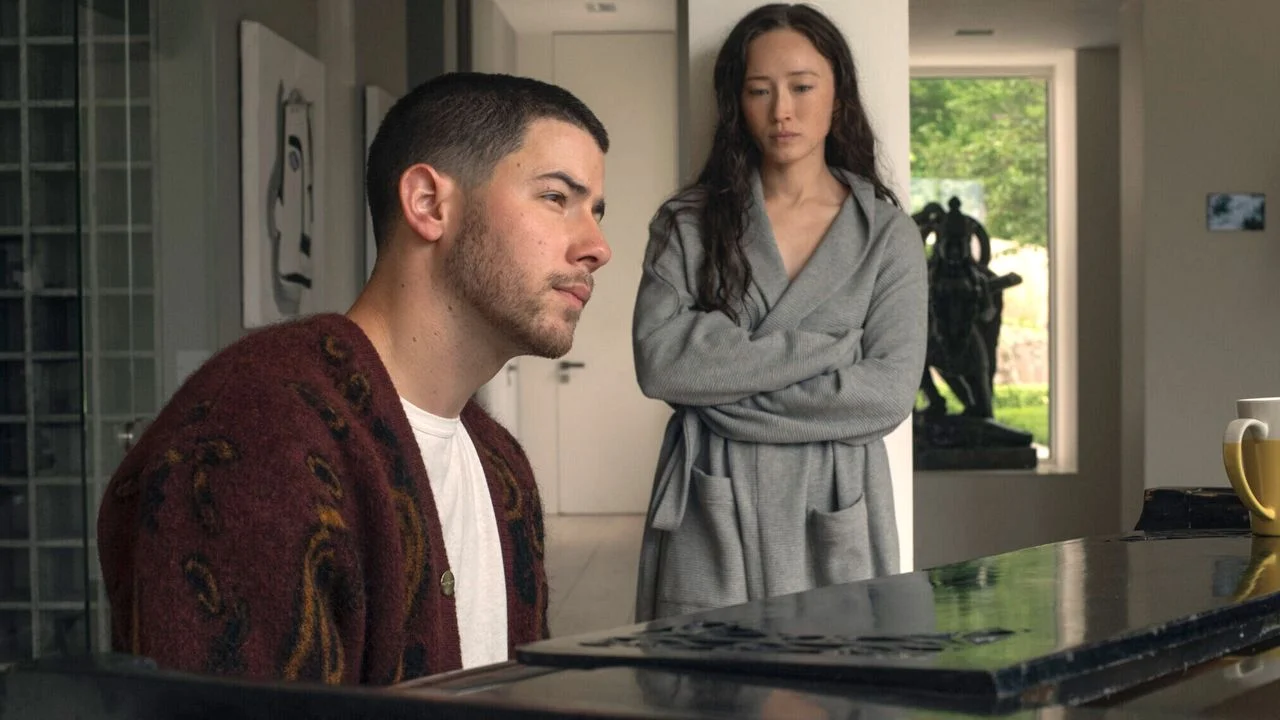
Marcia (Havana Rose Liu) is deeply touched by Danny’s new song. What she doesn’t know is that he didn’t write it himself.
It could be the start of a wonderful big boy friendship, but Rick should have trusted his original gut instinct. Because the song that plays some time later from the loudspeakers of the local shopping center immediately sounds familiar to him for good reasons. It’s the power ballad “A Song (Without You)”, which Rick played to the global star in private at their nightly jam session. So while Danny is storming the charts, Rick – whose own musical ambitions have never led to great success – is once again left empty-handed.
The problem: There are no recordings that would prove that Rick, rather than Danny, wrote the song – and neither his wife Rachel (Marcella Plunkett) nor daughter Aja (Beth Fallon) really want to believe Rick, who is in the middle of a midlife crisis. If Danny gets a guilty conscience from time to time, manager Mac (Jack Reynor) and the record company act as whisperers. Nevertheless, Rick is determined to get the stolen songs back with the support of his bandmate Sandy (Peter McDonald)…
This song definitely wouldn’t be a global hit
The fact that “Power Ballad” is as disconnected as its father-leather-jacket-wearing protagonist can be clearly seen in the song at its center: It is at least unlikely that such an interchangeable piece of lighter-swinging pop rock would have what it takes to become a global phenomenon today. The pop music present is not only more diverse than ever in terms of sound aesthetics, pop can be the subject and trigger of discourses, conceptual and performance art, personal and artificial at the same time. But none of this happens with John Carney: even two decades after “Once”, for him there is only true emotional craftsmanship and the cynical calculation of the industry. Of course, there are several criticisms of how Danny’s song was distorted and watered down by sterile overproduction.
There are moments that at least hold out the prospect of a more attractive film: When Danny sings “A Song (Without You)” at home and his girlfriend Marcia (Havana Rose Liu) tears up over the supposed authenticity of what he heard, a possible approach to questioning one’s own authenticity kitsch arises. But Carney, of course, means something different: Although Danny misunderstood the piece as a love song, it is inherently authentic because Rick once wrested it from his growing fatherly feelings. Even though Rick eventually descends into a full-blown meltdown and even trespassing, “Power Ballad” remains consistently in the mode of sniveling middle-aged men.
Even Paul Rudd can’t do anything here anymore
This is particularly a shame because in Paul Rudd he has a leading actor who we would urgently like to see a good comedy for. But Carney is definitely the wrong person to be able to do something with the very specific qualities of the “best man wanted!” actor – somewhere between self-deprecating everyman appeal, effortless agelessness and a touch of classic Old Hollywood charm. Casting Nick Jonas is an interesting meta-casting move on paper, but ultimately his character has too much of an agenda to shoulder.
“Power Ballad” also lacks the punchlines and drive to pass as a comedy – before the film even gets to its core conflict, a rather slow first three quarters of an hour passes with band performances and songwriting montages. The second half isn’t much more dynamic, however, until “Power Ballad” ends on a sweet and somewhat indecisive note: Real wealth lies in remaining authentic and being loved by your family – but money is also really cool.
Conclusion: Of course, it is every director’s right to take a consistently subjective perspective – but John Carney’s stubbornly conservative view of (pop) music only seems anachronistic in 2026. Not even the otherwise great Paul Rudd can prevent “Power Ballad” from sinking into backwards midlife harrumph.