
Two men are driving in a car along a country road at night, only sparsely lit by headlights – nothing around them but dense rows of trees and darkness behind them. Pee break: While one of them is pursuing his needs in the forest, the car’s horn suddenly starts and doesn’t stop. When he gets back to the car, his friend has disappeared – until his blood-covered body is thrown with full force through the windshield and shortly afterwards pulled out again by an invisible force. The survivor then runs away, and the same man keeps appearing to him on the side of the road. A plaque warns: 130 million people go on a road trip every year. 15,400 never come back.
The only trailer that was supposed to fuel the hype about “Passenger” begins with this scenario – and so, with a bit of shit talk and a more extensive build-up, does the finished film start. Although the trailer in question was shown exclusively in cinemas for around three months, the mystery surrounding the fourth US production by Norwegian director André Øvredal (“Trollhunter”) didn’t really get caught up. The competition from the genre works “Obsession” and “Backrooms”, which were released soon and received a lot of praise, was simply too great to leave room for a horror film that was much less conceptually concise and largely made up of well-known set pieces. If you look at “Passenger,” this impression solidifies.
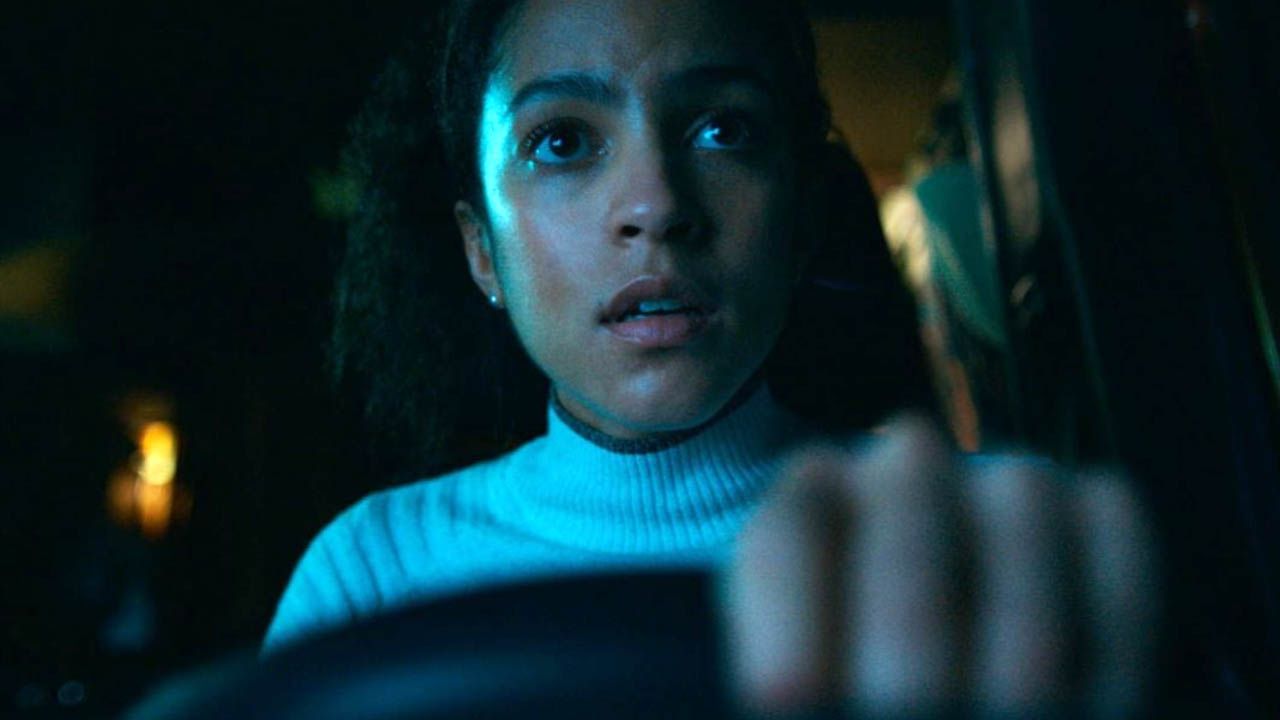
Maddie (Lou Llobell) is uncomfortable with life on the road – for good reason.
After the described cold open, Tyler (Jacob Scipio) and Maddie (Lou Llobell) are introduced as protagonists – a young couple who want to give up their New York city life and from now on travel around the country in a van converted into a camper. While he enjoys van life, Maddie quickly begins to have doubts about his new lifestyle. Then the two come across a wrecked car in the woods at night, which we quickly identify as the car from the opening sequence – whatever is haunting the two men is soon after Tyler and Maddie too.
The combination of road trip and supernatural horror is immediately reminiscent of the “Jeepers Creepers” franchise, in which a winged monster stalks travelers on remote highways. And other films often come to mind here: the motif of the impossible recurring figure on the side of the road, for example, is borrowed from an old “Twilight Zone” episode that was also based on a radio play – later it appeared prominently again in films such as the low-budget classic “Dance of Dead Souls” or John Carpenter’s “The Forces of Madness”. Of course, the horror genre thrives not least on the variation of tried-and-tested images and formulas, but Øvredal doesn’t find a compelling twist of his own.
Too many explanations slow down the film
The problems begin with the main characters: Tyler and Maddie remain pale and functional, yet the script spends a disproportionate amount of time letting them renegotiate their new life plan in awkward, overly clear dialogues. Sentences like: “People lead lives that they don’t really want – living in a van was my way of escaping from that.” Or: “What you ran from is what I have been looking for all my life.” What did the two of them talk about before they exchanged their spacious New York apartment with a brick wall for a temporary solution measuring just a few square meters?
Meanwhile, the film knits a somewhat twisted mythological framework around the titular Passenger (Joseph Lopez), a demon with long, matted hair, a lined face and empty eyes. So – analogous to the Christian dualism between God and Satan – he is positioned as a kind of antagonist to Christopher, the patron saint of travelers. Diana, played by Oscar winner Melissa Leo (“The Fighter”), whom Tyler and Maddie meet at a kind of vanlife festival, has already gained experience with the “Highwayman From Hell” in her 20 years on the road and is therefore in a position to explain exactly which rules the curse works according to. “Passenger” starts again and again in its short running time of around 90 minutes and slows itself down with long explanatory passages.
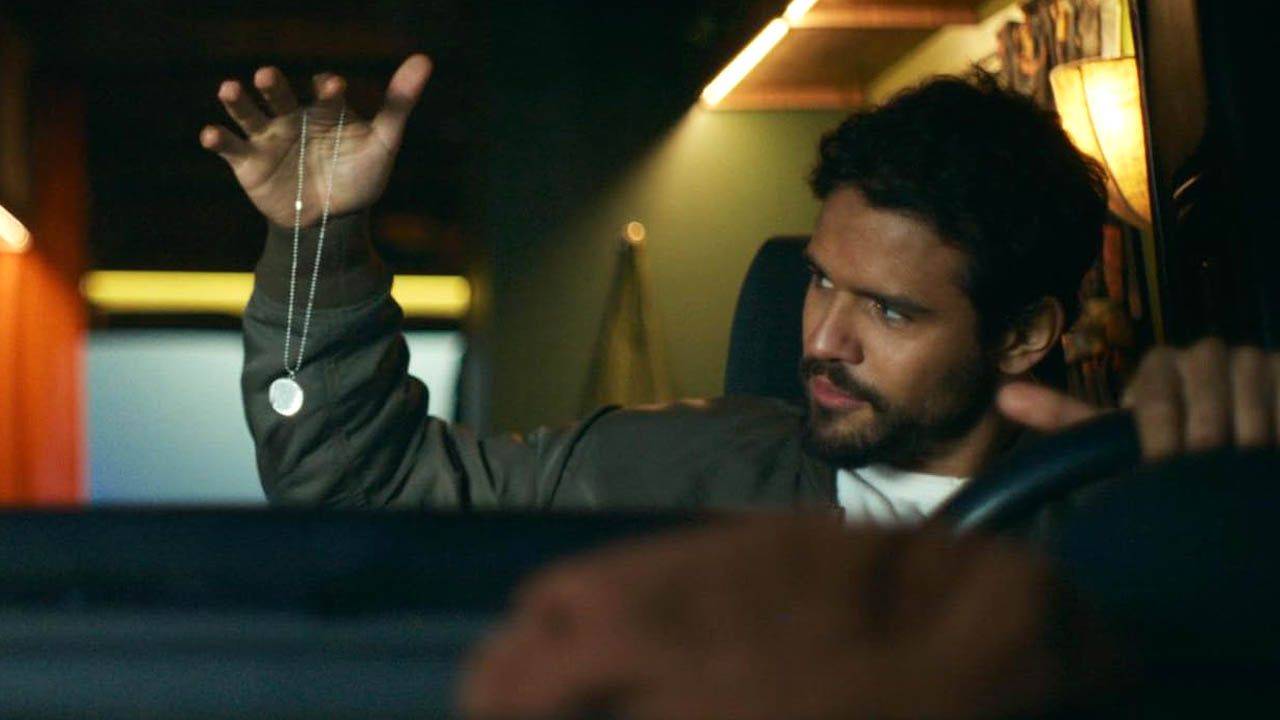
Can Tyler (Jacob Scipio) stop the demon with a follower of St. Christopher?
But the film also has, at least occasionally, scenic qualities: When Maddie runs alone across a dark parking lot and Øvredal takes several minutes to build up a threatening backdrop using unlocatable footstep noises and disorienting camera angles, it is a thoroughly effective moment of suspense and paranoia – until “Passenger” resolves it with a jump scare of the rather generic variety. In another scene, however, Øvredal actually manages once to wrest a visual idea from the realities of mobile life – basically you have everything, only more complicated:
Tyler surprises Maddie with an improvised home theater setup, projecting the rom-com masterpiece “A Heart and a Crown” onto a sheet stretched between tree branches. When they are besieged by the Passenger again, they quickly use the projector as a flashlight, so that close-ups of the faces of Audrey Hepburn and Gregory Peck waft through the darkness. It won’t be as good again afterwards – which doesn’t even mean that “Passenger” is bad. One is even inclined to find it at least likeable as a B-movie without any false bottoms or greater ambitions. But in a genre environment that is more exciting than it has been in a long time, it offers too little in its derivative form – and is simply not fun enough.
Conclusion: Between “Jeepers Creepers”, “Twilight Zone” and a multitude of other genre pieces, “Passenger” never really finds its own profile.