
The setting is reminiscent of the Charlotte Brontë classic “Jane Eyre”: a governess with vivid dreams and visions leads us through her working days on a remote estate in a first-person narrative. There are also the secrets of the upper class and a dark family history. But the protagonist in “Victorian Psycho” is not a moral observer, but a monster who – in keeping with the title of the film and the novel – is a serious competitor to the “American Psycho” serial killer Patrick Bateman. This combination actually has what it takes to become a cult – and with the casting of “It Follows” and “Longlegs” star Maika Monroe in the lead role, the most important ingredient is right there.
But in the end, Zachary Wigon’s gothic horror slasher still doesn’t quite take off. In his third feature film after “The Heart Machine” and “Sanctuary,” the former critic simply relies a little too much on his promising scenario. Together with the best-selling author Virginia Feito, who was responsible for adapting her novel, he eventually gives up on building up macabre suspense. Instead, the production relies on Metzel excesses that are not consistently carried through, as well as a wealth of visual gimmicks that at some point tire rather than entertain.
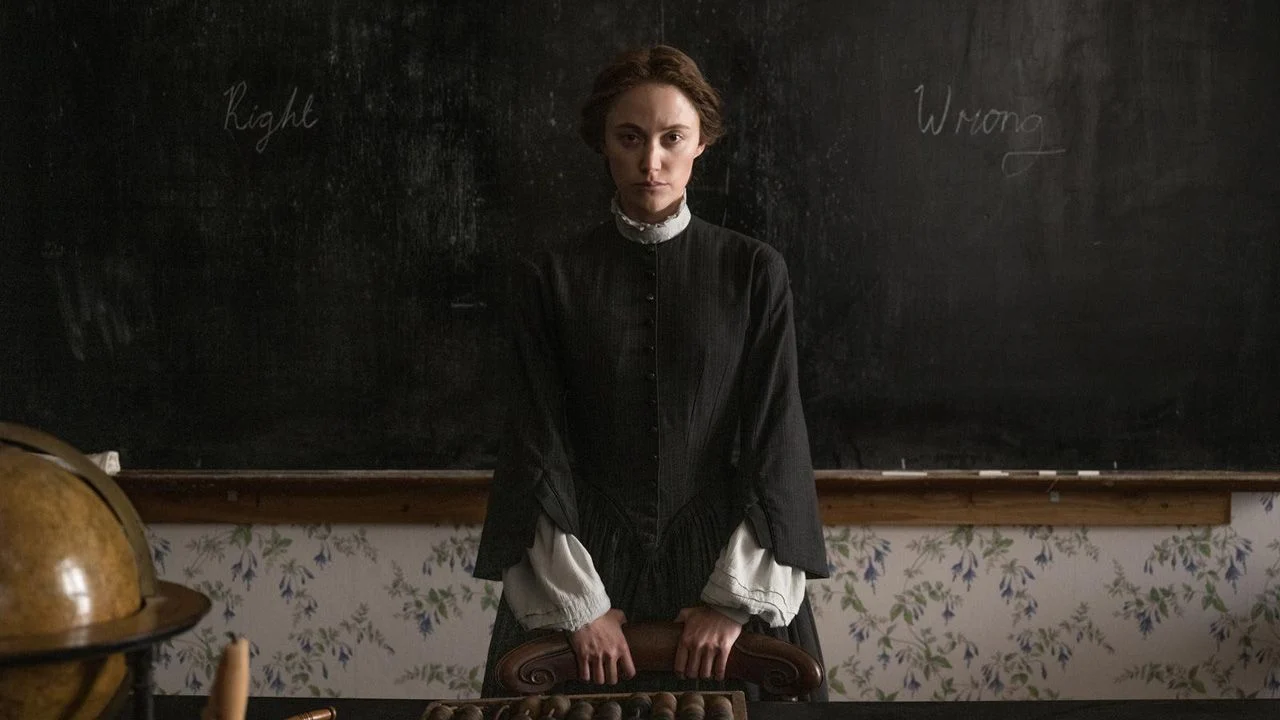
Maika Monroe as Winifred Notty: It’s better not to learn anything about “right” and “wrong” from this governess!
“I’m the only sane person I know,” explains Winifred Notty (Maika Monroe), addressing the cinema audience as she takes up her new job. Of course, you already suspect that the new governess, who is supposed to look after the children of Mr. Pounds (Jason Isaacs) and Mrs. Pounds (Ruth Wilson), is anything but mentally stable. Little Andrew (Jacobi Jupe) and his older sister Drusilla (Evie Templeton) quickly realize that their guardian, who constantly hears voices, could be dangerous to them.
Only the kind-hearted, naive servant Ms. Lamb (Thomasin McKenzie) seems completely blind to the dark side of her new colleague. Nothing changes even when she catches Winifred that night with her clothes covered in blood and the next day the gardener has disappeared without a trace. But the fact that the newcomer is secretly murdering his way through the stately property in Victorian London is not the biggest secret. Finally, the question arises as to why the governess ended up with the Pounds family of all people…
Bloody grotesque in Victorian garb
While unpacking, a severed ear falls out of Winifred’s luggage. Shortly afterwards, she smashes the skull of a deer while walking with the children. “Victorian Psycho” never makes it a secret that there is something fundamentally wrong with this governess. So it’s not a question of whether Winifred is dangerous, but rather a question of when her facade finally breaks. The killing begins quickly – and from then on Wigon doesn’t even try to build tension throughout. Instead, he relies on the fact that the audience will be looking forward to the next step in the escalation scale anyway.
The way courtly etiquette and Victorian morality increasingly turn into a bloody grotesque has a certain charm, which, despite the crisp 90 minute running time, wears off as it progresses. The fake blood is allowed to flow, but then curtains sometimes cover the action – or it fades out (too) early anyway. Although the horror film certainly crosses boundaries in terms of narrative (for example in the selection of some victims), it also tones down these provocative passages visually. This creates a strange disproportion when “Victorian Psycho” seeks to break taboos, but then stages it with surprising caution.
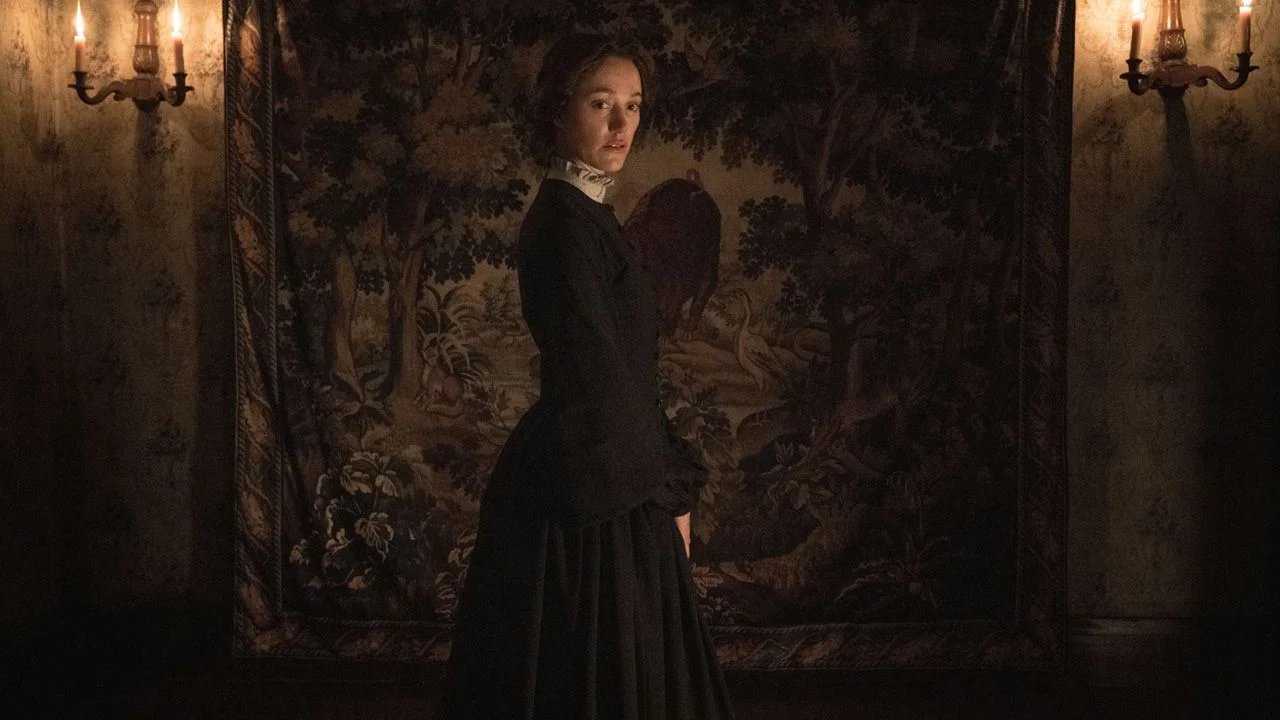
Winifred Notty looks innocent, but could mutate into a murderer at any second.
Maika Monroe plays a strong role as a psychopath. You never know whether it’s a macabre threat or the pure truth when she tells little Andrew about a demon named Fred who lives inside her. This gives the character a wonderfully mysterious aura, which is then not sufficiently fueled. Director Wigon focuses more on supporting the performance of his leading actress as she jumps back and forth between murderous diabolism and lamb-like innocence with wide-eyed eyes and an exaggerated grin.
The camera repeatedly takes on the perspective of the child’s counterpart, so that Monroe’s face, which fills the screen, leans slightly forward and towers menacingly above the audience. In any case, there is a lot of visual experimentation going on. While the restless visuals at the beginning fit perfectly with the introduction of the protagonist, these antics seem arbitrary as the film progresses. Even the SnorriCam, made famous by Darren Aronofsky’s “Requiem For A Dream,” is used – the device attached to the body that rigidly fixes the face in close-up. It just remains unclear what this effect is supposed to tell us about the characters.
Misplaced humor and feminist approaches
The numerous jokes interspersed are very varied. A funny remark from Mr. Pounds, which suggests rape by his own father, even hangs in the air completely empty. Much more exciting is the running joke that the nobles expect their children to have a good education, but that doesn’t mean they should become too smart. This would ultimately be a hindrance to the rest of her life, especially for the girl Drusilla. This is a bit trite, but it opens up an interesting foundation for the feminist revenge fantasy that lies in “Victorian Psycho”. Although the film further contributes to this reading with its final twist, Wigon does not take it to the extreme consistently enough here either.
Conclusion: Despite a strong idea, a great performance by Maika Monroe and successful individual images, “Victorian Psycho” does not go to the fullest extent either as a gothic slasher, social satire or as a feminist revenge fantasy. All of this is supposed to be cult, evil and taboo, but in the end it is above all a promise of an even better film, which is actually contained in the material.
We saw “Victorian Psycho” at the 2026 Cannes Film Festival, where the film had its world premiere in the Un Certain Regard section.