
You keep looking through the treetops at what’s happening. But not all trees are in the forest. Some are also located between Berlin prefabricated buildings, in the Brandenburg water park Tropical Island or directly in the block world of Minecraft, the most successful video game of all time with more than 350 million copies sold. But the dreariness of the big city, the place of longing and the pixel universe do not exist neatly separated next to each other, but are increasingly becoming blurred. Very similar to the present, memories and possible futures, when the most diverse filmic forms – from digital family videos to sudden drone sequences – seemingly seamlessly merge into one another.
This was similar in Sandra Wollner’s highly acclaimed debut “The Impossible Picture”, where the 13-year-old protagonist films her grandmother’s – surprisingly shady – cooking club with her father’s Super 8 camera, but even this supposedly documentary gesture does not mean that absolutely anything still remains possible. After the more formally reserved “The Trouble With Being Born”, a profound arthouse variant of Steven Spielberg’s “AI – Artificial Intelligence”, the director, who comes from Austria but now lives in Berlin, takes her already unmistakable style to the extreme with “Everytime”. It is therefore only right that she was invited to the world’s most important film festival in Cannes with this masterpiece, which is infinitely surprising in every shot.
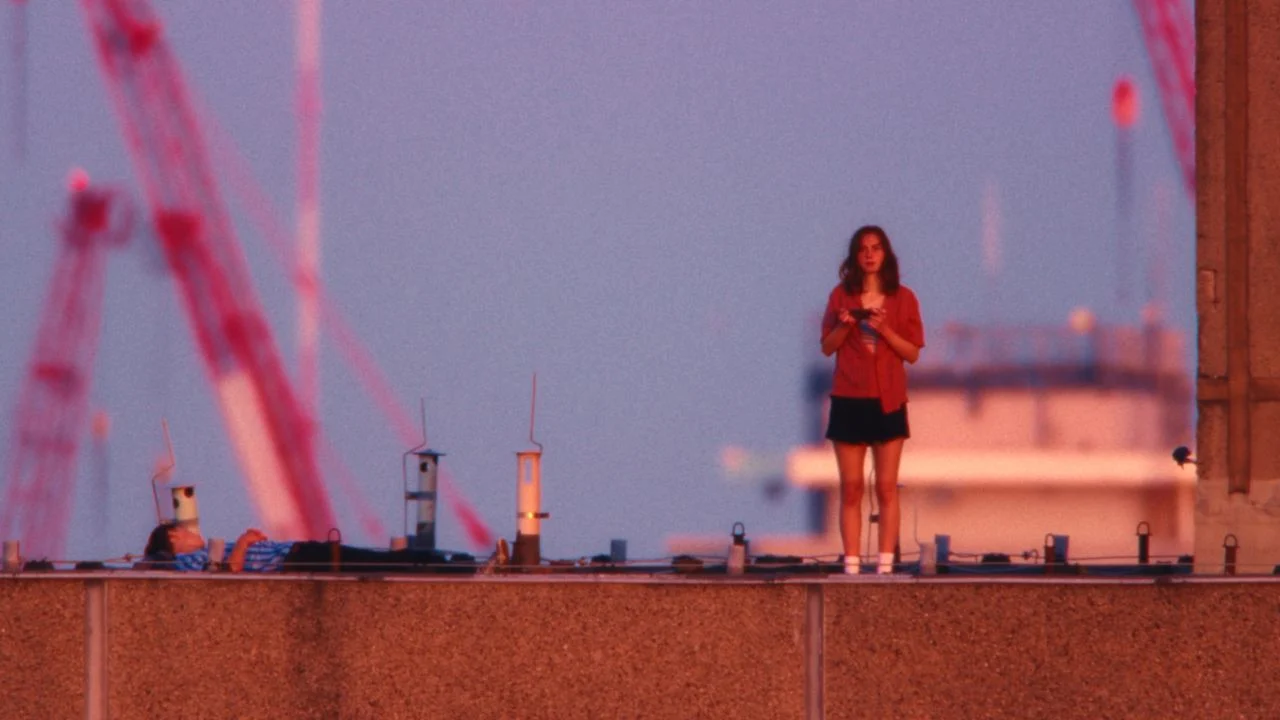
Early in the morning over the rooftops: Already one of the outstanding cinematic shots of the year!
But it starts with a punch in the stomach. For her third feature film, Wollner has secured the collaboration of cameraman Gregory Oke, who captured some of the most wistful, sunniest 35mm shots in cinema history for Charlotte Wells’ indie sensation “Aftersun” a few years ago. This may be exactly why Wollner came up with the British, after all, suns in various forms also play an important role in “Everytime”. But more on that later. First of all, the two of them manage to create one of the most beautiful shots in a long time: a very early, but still light-filled morning in Berlin. Young, in love, dancing hard and now with just the right amount of drugs in her blood. Only from a distance do we recognize the young couple Jessie (Carla Hüttermann) and Lux (Tristan López) on the roof of a house in front of the logo of the Park Inn Hotel on Alexanderplatz.
You probably wouldn’t be able to stand it any closer, the happiness at this moment is just too perfect. The metropolis down there is still asleep, it’s completely quiet, even the fall doesn’t make a sound, you can only hear a few early risers among the birds. A year later, visits to the cemetery have become somewhat routine for Jessie’s mother Ella (Birgit Minichmayr) and her younger sister Melli (Lotte Shirin Keiling). But then they meet Lux, who, at least through the flower, is repeatedly told by people that maybe he is to blame for everything. The meetings become more frequent and less random until the trio spontaneously sets off on their family vacation to Tenerife, which was originally planned with Jessie…
The ground beneath your feet is only slowly coming back
The one-year jump into the next summer, especially right after the soundless shock effect, is at least an astonishing ellipse. In addition to the protagonists, the audience is initially on – literally – shaky legs before they slowly find their footing again. Although you should never be completely sure about it later on: While Melli keeps watching old pixelated videos of her sister, Wollner and her editor Hannes Bruun (“Funeral Casino Blues”) cut short views of Tenerife into the film like flashes of lightning – and once a drone of unknown origin even appears right in front of Ella’s face, whirring away deep into a dark shaft.
Rarely has the idea that the world can feel unreal after a tragic loss been implemented in such a relatable and immersive way. The family vacation together between mother, sister and boyfriend, decided upon by Ella in a cloak-and-dagger campaign, naturally has something utopian about it. But even though the three of them are closer to each other than all the others who can’t understand it at all, they also grieve alongside each other to a certain extent. When Melli freaks out after losing her cell phone, her mother can’t understand the turmoil at all – even though the phone was her only remaining connection to her sister, to whom she still diligently sends emojis and wishes her a happy birthday.

Of course you also fly to Tenerife because of the sun. But you probably haven’t seen them so angular there very often.
“Everytime” is observed and played with extreme precision and is guaranteed to be 100 percent kitsch-free. At the same time, it also presents itself as a strange puzzle – and a sloshing water bottle on the chest of a sleeping girl in a yellow T-shirt is just one of many possible keys. You can feel that something is “off” here right from the start, even if you certainly can’t predict the full extent of it. Because by the time the square block sun rises on Tenerife (also the motif of the first promo poster), it is finally clear: we have never seen anything like “Everytime” on the big screen. It really was high time!
Conclusion: A mysterious and tender cinematic miracle that just doesn’t stop surprising its audience again and again until its final shot.
PS.: We all know the brief endorphin rush when the three dots flash in a chat and indicate that the other person is typing a reply. This exact moment has often been used for tension peaks in the cinema. But what Sandra Wollner does with it here in “Everytime” – old Swede!
We saw “Everytime” at the 2026 Cannes Film Festival, where the film had its world premiere in the Un Certain Regard section.