
He used mathematical logic to determine the most likely farm for the Jewish family’s hiding place. He doesn’t search like a hawk, like most German soldiers who only see the obvious, but like a rat who asks himself: “Where would I hide?” And then there is the precise switch from French to English in order to exclude the family cowering under the floorboards from the conversation. The opening scene of “Inglourious Basterds” is a masterpiece in itself – and Christoph Waltz has relished taking the archetype of the eloquent, highly intelligent but psychopathic Nazi villain to the extreme. He quite rightly received his first Oscar for this.
But if a similar character is to appear in a film after such an iconic role, then there needs to be a damn good reason for it; after all, one can hardly help but compare him directly to Quentin Tarantino’s Jew Hunter. And to get this straight away: In his superbly filmed resistance heroic drama “Moulin”, which plays artfully with light and shadow, the Hungarian director László Nemes actually has no reason to turn the Butcher of Lyon into an interrogation genius of Lyon – especially since his groundbreaking and acclaimed feature debut “Son Of Saul” from 2015 proves that he should actually know better.
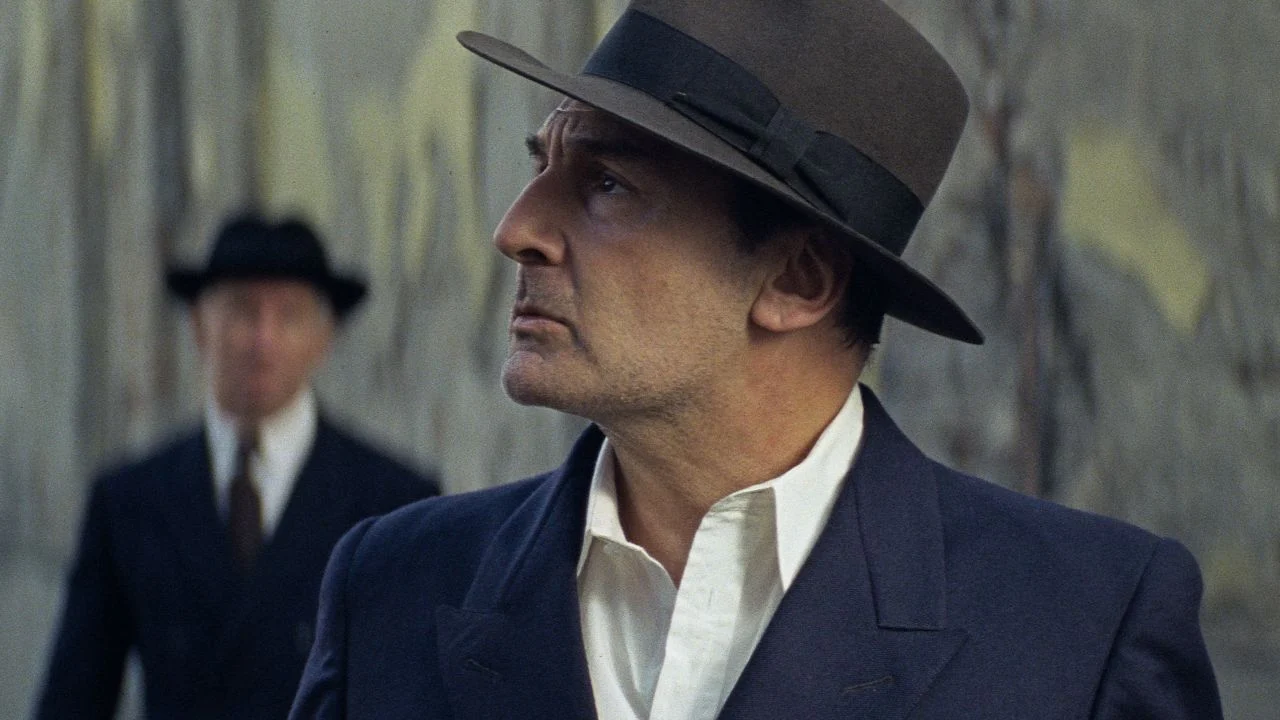
The eulogy for Jean Moulin (Gilles Lellouche) given by the then Minister of Culture André Malraux is still one of the most famous speeches in French history.
The eponymous Jean Moulin is an undisputed national hero in France as a key leading figure in the resistance during the Second World War. However, the film only begins shortly before his arrest: in 1942, Moulin (Gilles Lellouche), who had fled to London a year earlier, returns to his homeland by parachute jump on behalf of General Charles de Gaulle in order to unite the divided resistance groups.
But shortly after he succeeded in doing this in May 1943, the Resistance chief, who lived as an interior decorator under the cover name Jacques Martel, was arrested by the Gestapo in Caluire near Lyon: During the interrogations, the senior SS Obersturmführer Klaus Barbie (Lars Eidinger) did everything he could to find out which prisoners belonged to the resistance leadership. But he seems to be cutting his teeth on Jacques Martel alias Jean Moulin…
Die in beauty
With “Son Of Saul”, László Nemes immediately won the Oscar for the best foreign language film – and also made one of the outstanding Holocaust films of the last 25 years: throughout the entire running time of 107 minutes, the camera stays close to the back of the head of the title character, a Jewish prisoner in Auschwitz who, as a member of the “Sonderkommando”, is responsible, among other things, for dragging the corpses from the gas chambers to the crematorium ovens. Everything outside of his immediate radius of action is shown out of focus, the piles of corpses can only be made out dimly in the background – so, similar to later in “The Zone Of Interest”, it was primarily the sound design that conveyed the actual horror. Nemes himself explained that he did not want to “aestheticize” the Holocaust or show it as a voyeuristic spectacle.
But ten years later he no longer seems to necessarily hold this view. His second and third films, the analog historical epics “Sunset” and “Andor Hirsch”, looked damn good. But now he really shoots the bird: Projected at its world premiere in an analogue 35mm copy in the 2.35:1 Cinemascope format, “Moulin” is certainly not the best, but is almost certainly the best-looking film of the 2026 Cannes vintage. First of all, a spy thriller in which Moulin confidently moves through the French art high society and on the way to conspiratorial meetings with everyone As much caution as possible, “Moulin” presents itself as an exquisite feast for the eyes right from the start. But nothing changes after the arrest: What a play with light and shadow when the SS cars drive up to pick Moulin up from prison for torture interrogation – this scene could have come straight from “The Third Man”.
Cat and mouse in the Gestapo headquarters
But it’s not just aesthetically that the elements no longer fit together at some point. There is also the figure of Klaus Barbie, the infamous Butcher of Lyon, who was (partly) responsible for a five-figure number of murders. Instead of using dull sadism, the screen Barbie initially tries to get the answers out of Moulin with a brilliant sense of words and Viennese waltzes. This is so obviously a cinematic stylistic device that it falls apart as a cliché before Lars Eidinger even really starts milking every single scene to the hilt. Here Nemes and Eidinger have fallen for the fascination of evil together.
When at some point he proudly talks about SS atrocities in Ukraine, where babies were not herded into churches with their parents to be burned, only to later throw them into the fire because they then made a noise like a champagne cork when they burst, then you almost no longer know whether to laugh or cry. There’s no question: In James Gunn’s “Superman 2: Man Of Tomorrow” he will make an excellent psychopath villain with blockbuster format as Brainiac. But for “Moulin” he and his role are a real problem.
Conclusion: “Moulin” looks absolutely fantastic – but with his decision to turn the dull, sadistic butcher Klaus Barbie into a highly intelligent psychopath somewhere between Hannibal Lecter and Hans Landa, László Nemes has done himself and his audience a disservice.
We saw “Moulin” at the 2026 Cannes Film Festival, where the film had its world premiere in a 35mm analogue screening as part of the official competition.