
Last year, Mascha Schilinski not only made it into the Cannes competition with her second feature film “Looking into the Sun”, but also attracted more than a quarter of a million viewers to the cinemas thanks to the festival hype (including submission as a German Oscar candidate). An incredible result for such a challenging film, which experimentally and disturbingly tells of all the (female) pain that accumulates over the course of 100 years in a four-sided courtyard in the Altmark. The protagonist is the place itself – and this has been the case for an entire century. Exactly one year later, another German film celebrated its world premiere in Cannes…
… and he makes it clear in his subtitle that he obviously has something similar in mind: “Visitation – A Story of the Century” also tells the story of 100 years of German history based on a single location – but this time not in the Altmark, but on a lake property on Scharmützelsee. Nevertheless, Golden Palm winner Volker Schlöndorff (“The Tin Drum”) was not inspired by his young colleague. Instead, “Visitation” is based on one of THE German novels of the last 25 years – and 18 years after its first publication, it is experiencing a huge boost in attention for a very practical reason.
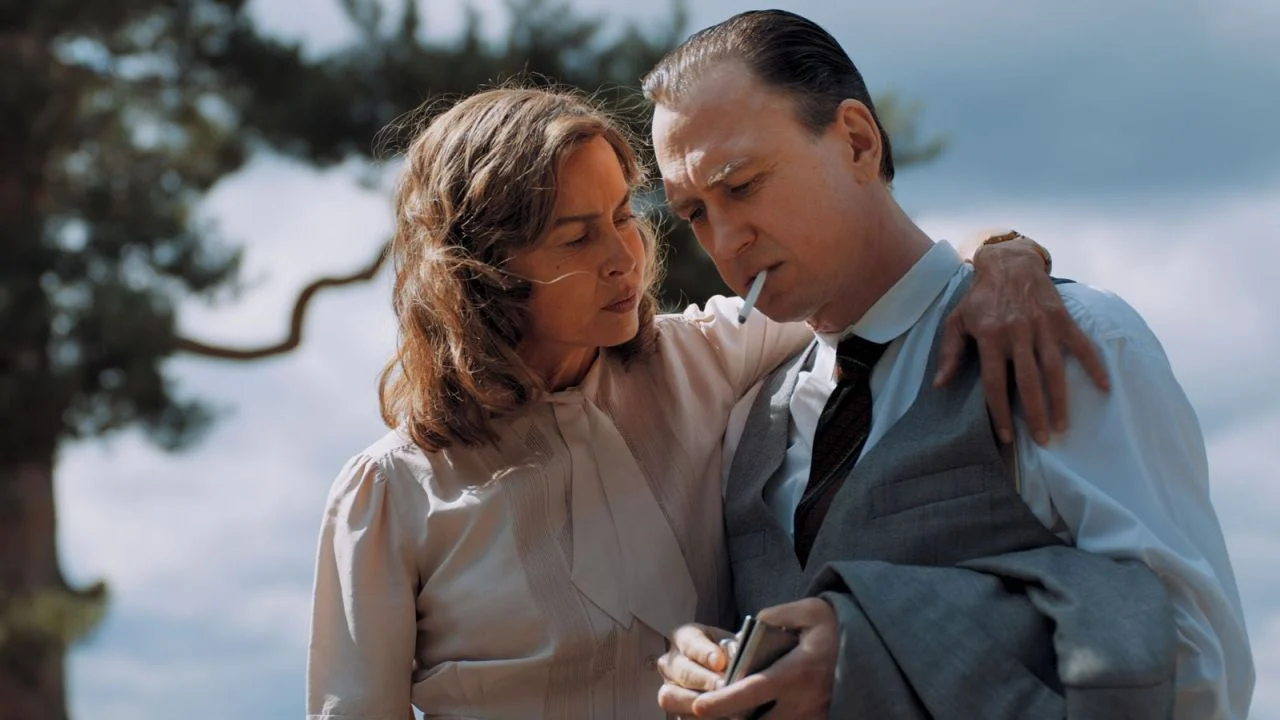
The architect (Lars Eidinger) would like to design a new Berlin for the National Socialists, but for now he has to make do with his house by the lake.
At the beginning of the 20th century, a large farmer (Detlev Buck) actually wants to pass on the property on the Märkisches Meer to his daughter Klara. But when she becomes pregnant before the marriage, he divides it into two plots and sells them. An architect (Lars Eidinger), who would like to design a new Berlin together with the Nazi architect Albert Speer, builds a house on the site for the first time 30 years later for his fiancée (Susanne Wolff). At the same time, the neighboring property goes to a Jewish cloth manufacturer (Ulrich Matthes), who bought it primarily as an investment for his family, but still has at least a small bathhouse built for summer trips.
After the end of the Second World War, the architect was initially able to make a career under Soviet leadership, but then fell into disgrace. In the GDR, a successful writer (Martina Gedeck) finally moves into the house, which her granddaughter Marija (Maria Matschke Engel), the narrator and alter ego of “Visitation” author Jenny Erpenbeck, would later like to take over. But after the fall of the Berlin Wall, the former owner’s community of heirs suddenly comes forward…
School quotes that everyone remembers: “Can’t we just watch the movie instead?”
You would have to have slept hard on literature for the past 20 years not to have noticed the legendary rise of the East Berlin author Jenny Erpenbeck. Her novel “Visitation” in particular was widely celebrated even in the USA – and was later even chosen by the British Guardian as one of the 100 best books of the 21st century. In addition, Erpenbeck won the renowned International Booker Prize in 2024 – and was the first German author ever to do so. But that’s not the only reason why “Visitation” is currently experiencing a revival on German theater stages – and is now also appearing on the big screen for the first time.
The education ministries of the federal states have jointly decided on “Visitation” as compulsory reading for the German Abitur in 2026, 2027 and 2028. And because the novel, despite its deceptive brevity, can be linguistically quite overwhelming, especially when one of the most striking passages spends ages philosophizing about the geological layers of the property, many students take the opportunity to get an overview of the plot beyond the pages of the book: I personally haven’t seen as many teenagers in the theater for ages as I did at a “Hheimsuchung” performance at the Deutsches Theater a few weeks ago.
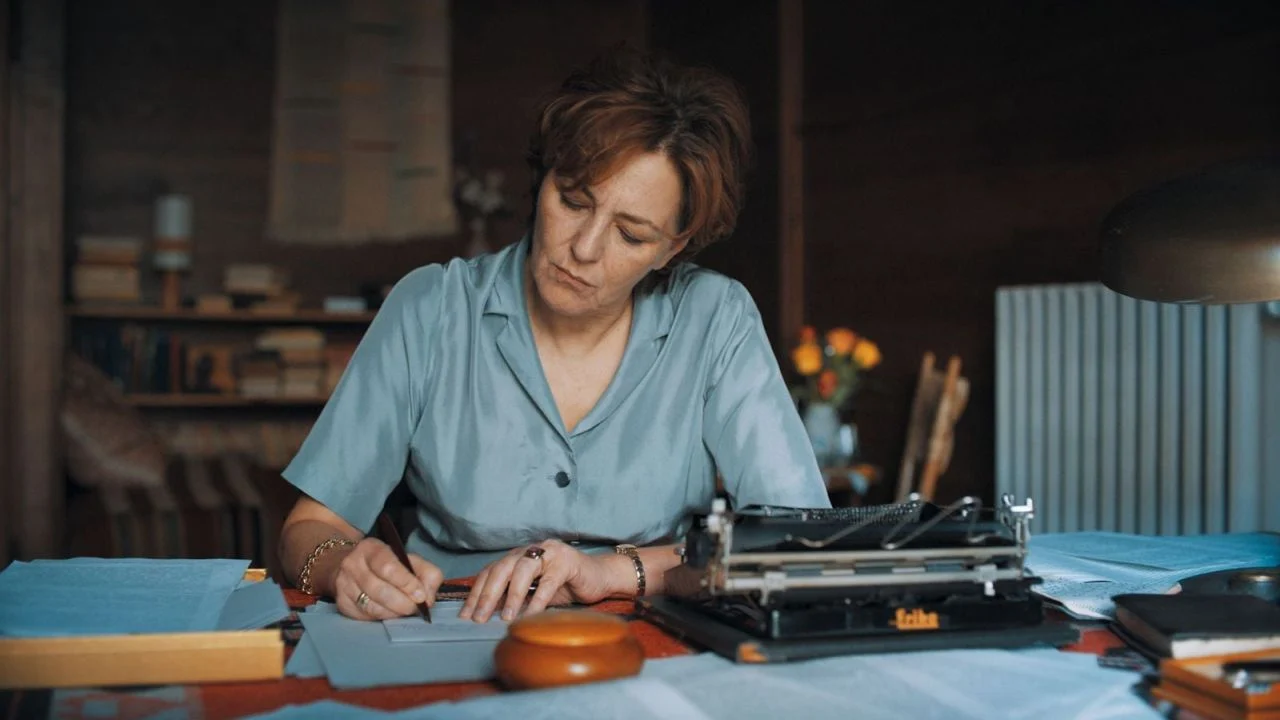
Although the writer has enough money, she refuses to buy her house because, as a staunch GDR socialist, she rejects private ownership of land.
At least in this respect, “Visitation” fully meets the requirements: Lars Eidinger only has two or three short sentences left of the paragraph-long soil analysis in the film adaptation. Instead, it is shown particularly clearly when stamps with the likenesses of Adolf Hitler or Erich Honecker are stuck on. An old “Don’t be angry” game board and other time markers are also featured as prominently as possible. Schlöndorff is anything but subtle about the furnishings, especially the stately house, which is built at the beginning and then torn down again at the end. This means no one will miss the central themes – even if it’s just because of the (overly) clear film music…
… or the edited original footage of Nazi parades, bomb ruins and wall knockers, which only unnecessarily weakens the one-place concept. Major deviations from the novel are still rare, but in some places they are noticeable enough to create a separate task for the high school exam: The most striking is certainly the scene that is central to the novel, in which the architect’s wife is raped by a young soldier in the Red Army. In the cinema adaptation she gets it – also thanks to the fantastic acting by Susanne Wolff – a completely different note. By far the most psychologically exciting – and certainly the most daring – sequence.
To everyone who looked at the sun disappointed: Please, dare to go to the cinema again!
Like “Looking at the Sun,” “Haunting” is in some ways a ghost story. Already in the first scene, whose faded black-and-white camera work is based on historical photographs, the wafts of fog rising from the lake are almost reminiscent of a representative of the Gothic horror genre. And the figure of the mysterious, apparently non-aging gardener (Wigand Witting) does the rest. But ultimately, “Visitation” is simply the film that most people probably wanted to see last year.
Because let’s be honest: “Looking into the Sun” was so hyped by (international) film critics – myself included – that in the end many people went to the cinema who were simply hooked on the 100-year idea, but then couldn’t do anything with the film. “Looking into the Sun” is one of the top 3 films when it comes to “How can you recommend something like that?” emails to the FILMSTARTS editorial team – and at least that won’t be the case with the much more arthouse-compatible “Visitation”!
Conclusion: Volker Schlöndorff largely limits himself to illustrating the epic novel with an absolutely star cast as well as elaborate historical costumes, sets and cars, while he reduces the language power of the original, which is not always easy to digest, to a much less complex level. The high school graduates who are forced to be exposed to the material in the next three years will certainly thank him – and that’s not meant to be as hateful as it might sound at first.
We saw “Visitation: A Story of the Century” at the 2026 Cannes Film Festival, where the film celebrated its world premiere in the official program.