
With “Train To Busan,” South Korean filmmaker Sang-Ho Yeon proved that even zombie films can still be developed further. In his global super hit, which grossed more than ten times its budget in the cinema alone, he skilfully varied well-known genre pieces and at the same time underlined that in extreme situations, people are often the real monsters. Above all, however, he presented undead that could move at breakneck speeds and literally became an unstoppable avalanche in the masses. In the animated prequel “Seoul Station” and the action sequel “Peninsula,” the director expanded his franchise, but lacked comparable innovations. That should change now.
Exactly ten years after the greatest success of his career, Sang-Ho Yeon, who has since also been responsible for the Netflix series “Hellbound”, is returning to the zombie myth – and he has a fresh approach with him: While the whole world is discussing artificial intelligence, he gives the undead plague in “Colony” a collective intelligence – and thereby makes it particularly dangerous. In addition, as with “Train To Busan”, he once again pushes the mobility options of the infected people, who are used here as a terrorist weapon, to the extreme. The result is gripping horror action, but as a genre fan you have to forgive the very woodcut-like characters and a fairly predictable story.
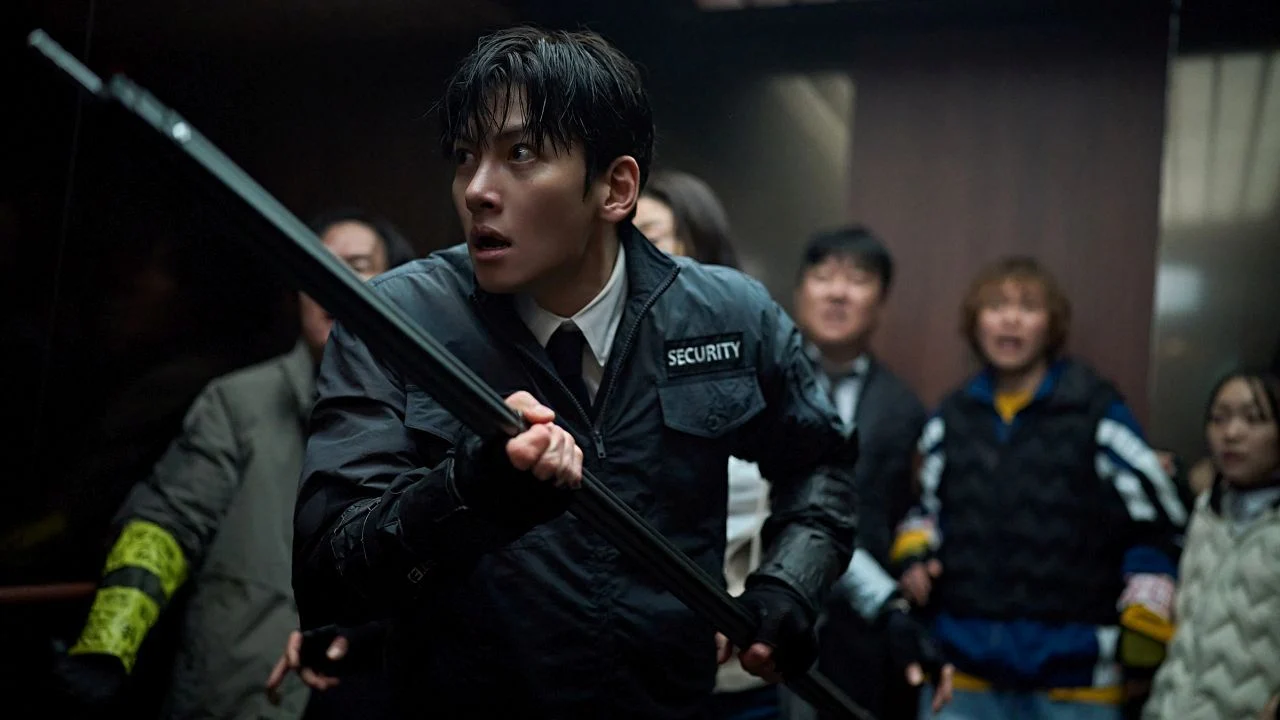
Security guard Choi Hyun-seok (Ji Chang-wook) is one of the few who survived the first wave of zombies in the high-rise building.
At the request of her ex-husband Han Gyu-seong (Go Soo), who wants to get her a job before he emigrates to the USA himself, biotechnology professor Kwon Se-jeong (Gianna Jun) attends a pharmaceutical company’s conference – and ends up in the middle of a terrorist attack. The mad scientist Dr. Suh Young-chul (Koo Kyo-hwan) spreads a virus that turns infected people into zombies. The police barely manage to cordon off the entire complex and thus limit the outbreak to one – unfortunately quite huge – building.
While Han Gyu-seong’s second wife Gong Seol-hee (Shin Hyun-been) and her team of biotechnologists are looking for a solution outside, inside a small group of survivors around Professor Kwon are on their own. But there is hope. The person responsible, Suh, who wants to create a new humanity with the outbreak, must still be in the building – and could be the antidote himself. If they find him and get him to one of the exits, a rescue team will respond there. In view of the threat, which, with their collective intelligence as a whole, is significantly more dangerous than any undead alone, this seems to be a suicide mission – but it is their only chance…
We had to wait ten years for her return!
After only a short preliminary skirmish, the virus makes its way through the dozens of floors. The huge high-rise complex, which is home to a department store in the lower part – greetings from “Dawn Of The Dead” – quickly becomes swarming with blood-hungry undead. However, the small group of survivors that we are supposed to root for consist of the usual genre characters such as the arrogant businessman or a bullied student and her tormentors, for whom the only question is in which order they die. The fact that you still don’t care about them is largely thanks to Gianna Jun (“My Sassy Girl”), who suddenly left the screen in 2016 as one of the best and most famous Korean actresses. After a decade with only a few TV and streaming roles, she is making a brilliant cinema comeback as a fierce heroine.
Otherwise, only Ji Chang-wook (“Fabricated City”) is remembered as a department store security guard who primarily wants to protect her sister (Kim Shin-rok), who is in a wheelchair. After a twist, the character he plays is one of the few characters who gets a development and becomes a berserker, who slashes his way through the hordes of opponents in a long hallway fight in “John Wick” mode. The twist mentioned is one of the few cleverer moments in a script that usually announces its surprises very clearly early on. Finally, director Sang-Ho Yeon briefly leads us on the wrong track, that the characters are simply acting stupidly, only to then reveal to us that people often become monsters even without a virus.
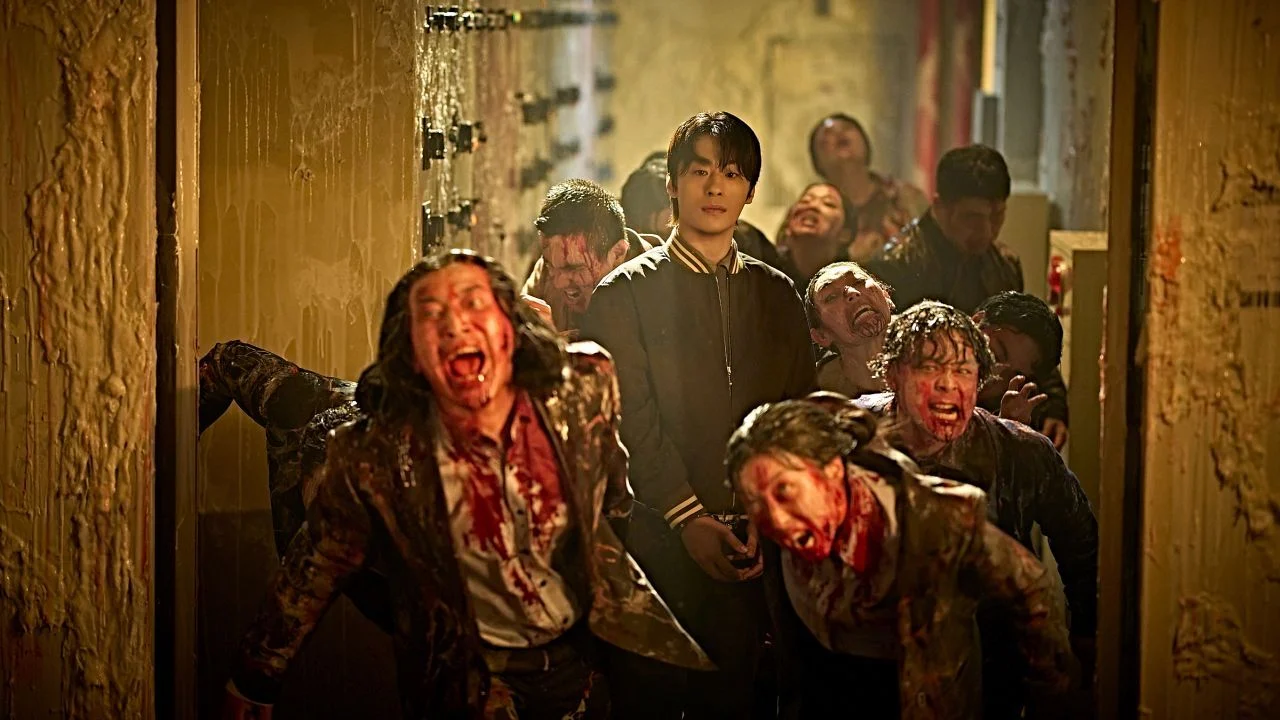
Dr. Suh Young-chul (Koo Kyo-hwan) rules over his undead swarm.
The South Korean filmmaker is much more interested in his zombies than in his human characters – and they are the undisputed highlight of “Colony”. The undead have a common mind. If an infected person learns something, the entire collective will soon have this knowledge. At first, the zombies can’t even distinguish between Styrofoam mannequins and real flesh-and-blood people. But it doesn’t stay that way for long – and the increase in intelligence doesn’t stop there. So the survivors always have to find new ways to sneak past the undead. Her movements are also evolving. While they initially crawl on all fours like predators, they can soon sprint upright and then even merge several bodies into one.
With “Train To Busan,” Sang-Ho Yeon was inspired by various dance styles to make his zombies contort in ways that were both eerie and unnatural. The filmmaker and his choreographer Jeon Yung are now expanding this approach, which was already visually fresh and disturbing back then. Thanks to the outstandingly eerie use of sound, it is absolutely terrifying how the undead repeatedly break and reassemble their bones – or grind their jaws when they bite. This is supported by great make-up work, which makes it possible that real physical acrobats are at work here and there is no need to resort to CGI effects – which is particularly clear in contrast to a scene with infected monkeys, which were of course animated.
Conclusion: With “Colony”, “Train To Busan” mastermind Sang-Ho Yeon delivers another worthwhile contribution to the zombie genre. The human characters remain one-dimensional clichés and the story is quite predictable, but the underlying monster idea and, above all, the disturbing, choreographed physicality of the undead ensure gripping action horror.
We saw “Colony” at the 2026 Cannes Film Festival, where it had its world premiere as a midnight film.