After more than three hours in the cinema, there were two main themes among those attending the world premiere at the Cannes Festival: how incredibly happy the film makes you – and of course the whiteboard! About halfway through “All Of A Sudden,” one of the two protagonists gives a late-night keynote speech about why capitalism can’t help but devour itself in the end. Really with whiteboard markers, concept diagrams and everything that goes with them. It sounds terrible (or worse, like work), but it’s not. Quite the opposite:
As with his three-hour Murakami film adaptation “Drive My Car” (5 stars from FILMSTARTS), which first became an arthouse favorite with sensational box office results and was then awarded the Oscar for Best International Film, Ryūsuke Hamaguchi (“The Wheel of Fortune”) once again manages to captivate the audience with pure humanity. He didn’t use a short story or a novel as a model for his latest work, but was loosely inspired by a very special non-fiction book.
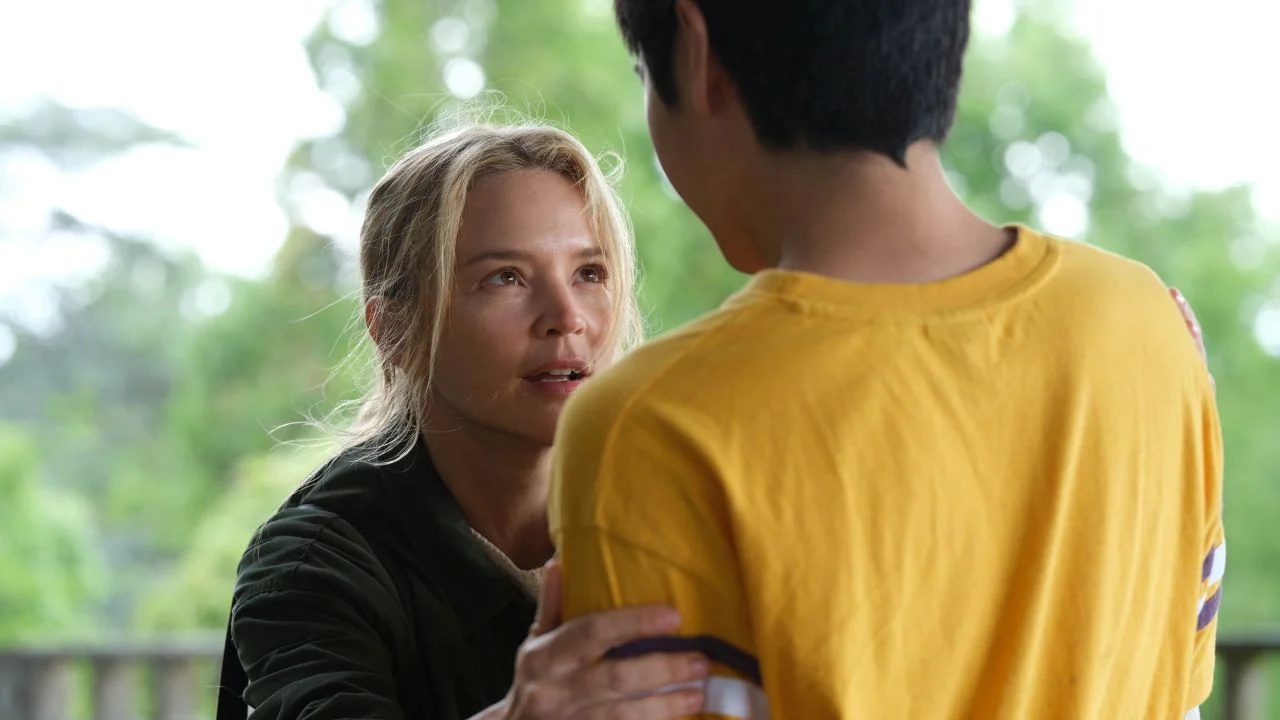
Since the field of perception of people with dementia is severely limited, Marie-Lou (Virginie Efira) has gotten into the habit of meeting everyone very close and at eye level.
Published in Japan in 2019 and not yet translated into German, “Kyū Ni Guai Ga Waruku Naru” (translated: “Suddenly the illness gets worse”) comprises 20 letters that the terminally ill philosopher Makiko Miyano and the medical anthropologist Maho Isono sent to each other. It is a profound philosophical and personal exchange about mortality and the meaning of life, which Hamaguchi and his co-author Léa Le Dimna have translated into a feature film plot: Marie-Lou (Virginie Efira) runs a nursing home in Paris and fights fervently to convince her team of her vision.
With the Humanitude method, she wants to radically focus on the autonomy and dignity of patients with severe cognitive impairment, which, however, also means more time, openness and risks. One day she meets the theater star Gorō (Kyōzō Nagatsuka) and his director Mari (Tao Okamoto). The two are on tour with a play about the abolition of psychiatric hospitals. Many of the ideas discussed speak to Marie-Lou on such a personal level that she and Mari discuss them further while taking a walk. Marie-Lou also learns that her new friend is terminally ill with cancer…
Dare to be more human!
“All Of A Sudden” first takes a lot of time to give us insights into the private nursing home “Le Jardin Des Cyprès” (in German: “The Cypress Garden”). Marie-Lou is 100 percent convinced of her method, but she also encounters resistance, especially from the experienced sisters who have been there for a long time. Every four months there is Humanitude training for ten employees: always make eye contact with the patients, talk to them, touch them – and put them in an upright position as often as possible, which at the same time increases the risk of a fall. Some people see this as impractical and far removed from everyday life: those who come out of training can no longer complete their workload in the morning shift – and the afternoon shift then has to suffer as a result. Humanitude (a word created from the terms “humanity” and “attitude”) is simply too slow, they say.
Hamaguchi would do well not to label the resisters as villains, but to take their objections seriously. Nevertheless, Virginie Efira (“Parallel Tales”) as Marie-Lou is an absolute force of nature, where you immediately understand why not only her deputy Vincent (Jean-Charles Clichet) would follow her everywhere for her vision. But “All Of A Sudden” really finds itself when she strolls with Mari from Théâtre 13 to the Seine after the piece. As I said, the film is based on an exchange of letters – and in the dialogues you sometimes get the feeling that the characters are actually telling each other the entire contents of the documents. And that’s not just incredibly impressive because it’s hard to believe that Virginie Efira only learned Japanese for this film.
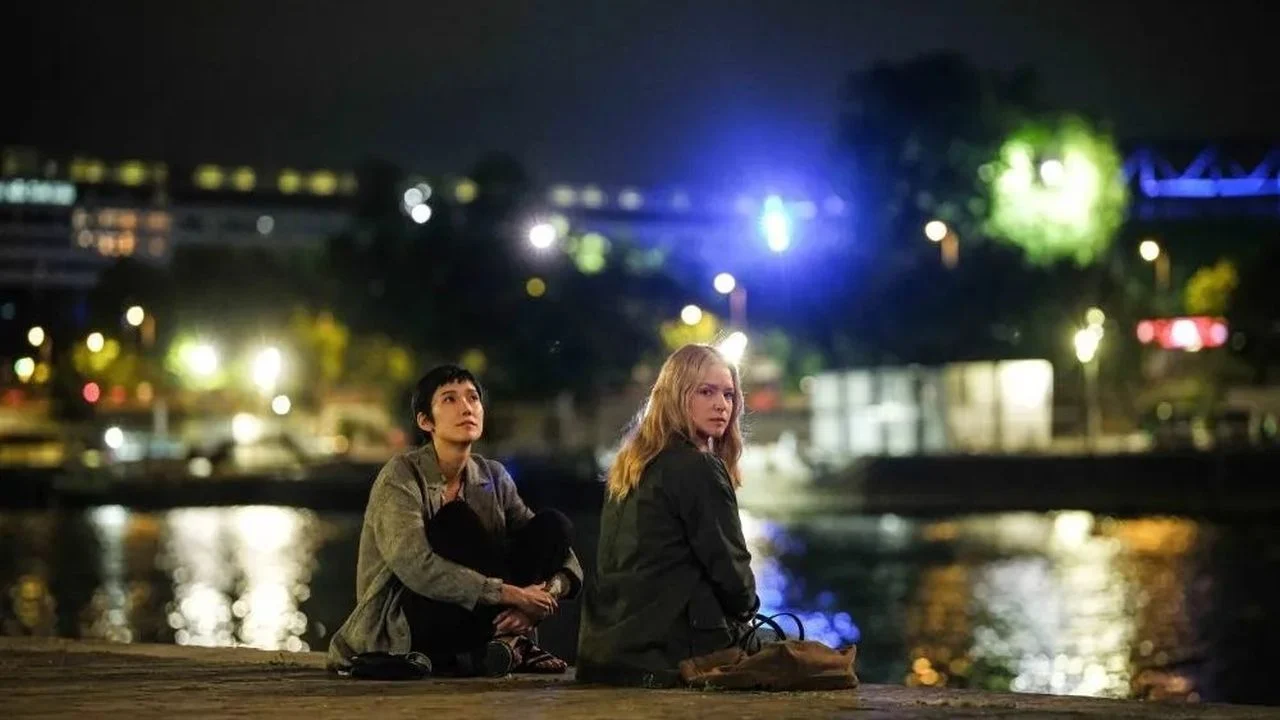
Not only Marie-Lou and Mari (Tao Okamoto) will probably never forget this night, it will also have a long-lasting effect on the cinema audience.
The discussions between the western anthropologist (who studied in Japan) and the eastern philosopher (who studied in France) are full of wisdom, empathy and openness – and you immediately understand (as they probably do) that two kindred souls have found each other here. You almost wish it would never stop – and luckily Mari joins in when Marie-Lou has to take over the night shift for a colleague who is unable to attend. The conversations of this evening take up almost half of the entire running time of “All Of A Sudden” – and yet it is never boring for a second, but is always deeply moving. Not even the whiteboard can shock you.
After that night, something like humanity finally seems tangible again. Not just for the two women or the staff in the nursing home, but directly for the audience in the cinema. Anyone who looks at the clock at this moment is definitely not panicking that there are still 90 minutes left, but rather is enjoying the warm feeling of being able to continue spending time with these people despite the cancer and the dying. “All Of A Sudden” is one of those very rare films where you can’t help but feel that they are actually making our world a better place.
Conclusion: In everyday capitalist life there is hardly any time for humanity. Why this is the case is even explained to us in a keynote speech on the whiteboard. So it’s particularly lucky that Ryūsuke Hamaguchi still takes this time after “Drive My Car” in “All Of A Sudden”. After 3 hours and 15 minutes, you don’t come out of the cinema feeling relaxed, but rather light-footed and full of hope.
We saw All Of A Sudden at the 2026 Cannes Film Festival, where the film had its world premiere as part of the official competition.