
In the sixth part of his television film cycle “Dekalog,” which is loosely based on the Ten Commandments, the Polish master director Krzysztof Kieślowski is less interested in the moral rule behind “Thou shalt not commit adultery.” At 87 minutes, the theatrical version, which is half an hour longer, has the positive title “A short film about love” for good reason. Almost 40 years later, Asghar Farhadi has now been inspired by Kieślowski’s work. In “Parallel Tales” he also talks about love in a certain way, but above all about obsessive observation as well as loneliness and longing. In keeping with the title, however, it noticeably expands on the compact action of the original with several parallel storylines.
The Iranian director’s second French-language work, after “Le Passé – The Past”, lasts a whopping 140 minutes. His previous films “Nader and Simin – A Separation” and “The Salesman” were each awarded the Oscar for best foreign language film. With this running time and a rather slow beginning, Farhadi creeps in one or two lengths. Nevertheless, he and his prominent cast also manage to create a fascinating examination of relationships that repeatedly builds up the tension of a thriller without ever letting the events escalate completely. Fiction and reality fuel each other – and even the Sixth Commandment finds its place in one of the twists.
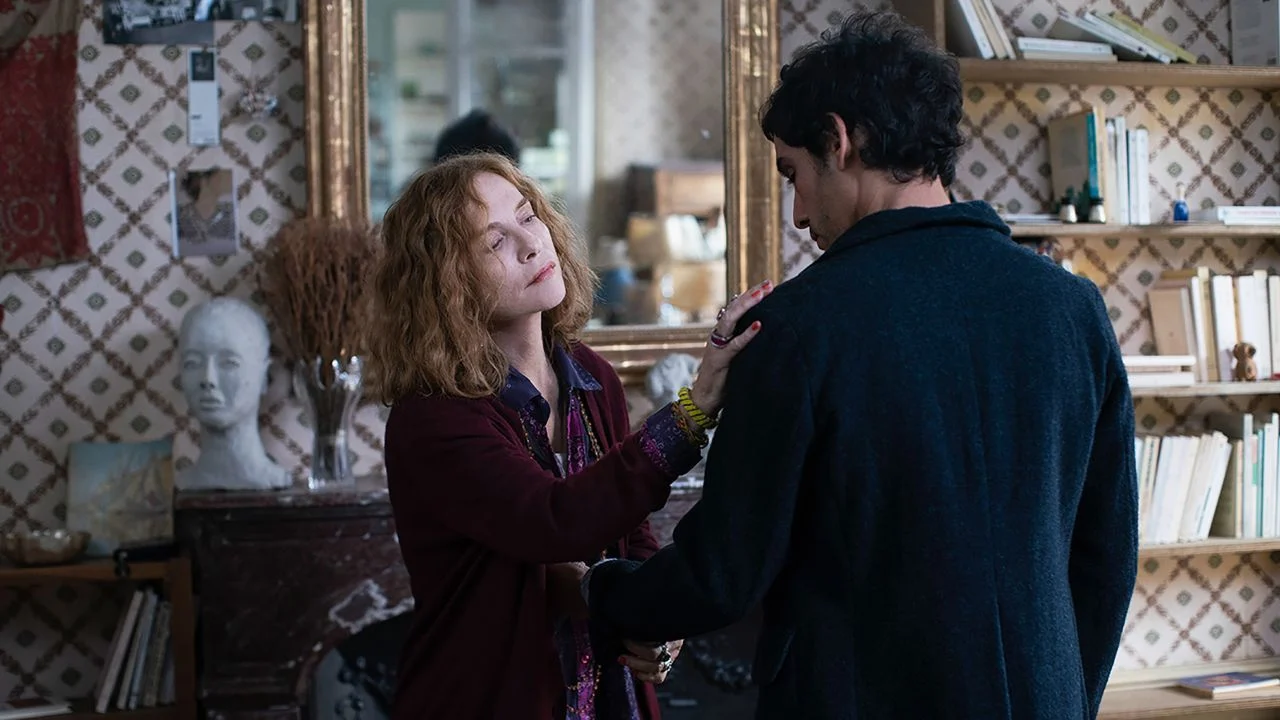
Writer Sylvie (Isabelle Huppert) takes homeless ex-convict Adam (Adam Bessa) under her wing.
While in Kieślowski a young orphan watches his much older neighbor in the house across the street, in Farhadi it is the writer Sylvie (Isabelle Huppert), who repeatedly uses a telescope to peer into the apartment opposite where she once grew up. Nita (Virginie Efira) now works there as a foley artist and sets music to nature documentaries with her colleague Theo (Pierre Niney) and her boss Nico (Vincent Cassel). Using the made-up name “Anna,” Sylvie makes Nita the protagonist of her new work and imagines a fatal love triangle with her two colleagues that takes place in the apartment across the street.
But the orphan also soon appears: Only recently released from prison, Adam (Adam Bessa) is homeless – until Sylvie’s niece (India Hair) hires him. He is supposed to support her aunt, who is slowly becoming forgetful, around the house, where the mice are already nesting under the sink. Sylvie is supposed to move out of the large apartment in just two weeks, so Adam is also supposed to help with the urgently needed clearing out. But the former petty criminal is soon not only captivated by Sylvie’s script, but also shares her fascination with the woman across the street. When he makes contact with Nita, he sets off a fatal chain of events…
Stories have very real consequences
The parallel stories that give the title are initially Sylvie’s life and the fictional goings-on in the apartment across the street. As a story-within-a-film, we see the drama that is unfolding in the author’s mind because Nita/Anna is married to her colleague but starts an affair with her boss. It takes a while until we leave this very uninspired preparatory work and fiction behind us, illustrated in desaturated colors and a fixed camera. Only when Adam not only speaks to Nita, but even gives her the half-finished manuscript to read, does “Parallel Tales” really get going.
This is where fiction and reality begin to influence each other – a motif that Farhadi takes up in many ways in the film itself. Nita’s profession as a noise maker was certainly not chosen by chance. It’s less about the sound design of “Parallel Tales” itself, but more about how the film makes us immediately aware that in the end everything is just fiction. For example, Nita and her team set several nature scenes to music. But the sounds of the animals, which the audience of the documentaries are presented as reality, are created using simple means in the small apartment. Even here, the supposed reality consists of fiction, which leads directly to how the imagined affairs in the draft of the novel contaminate real life.
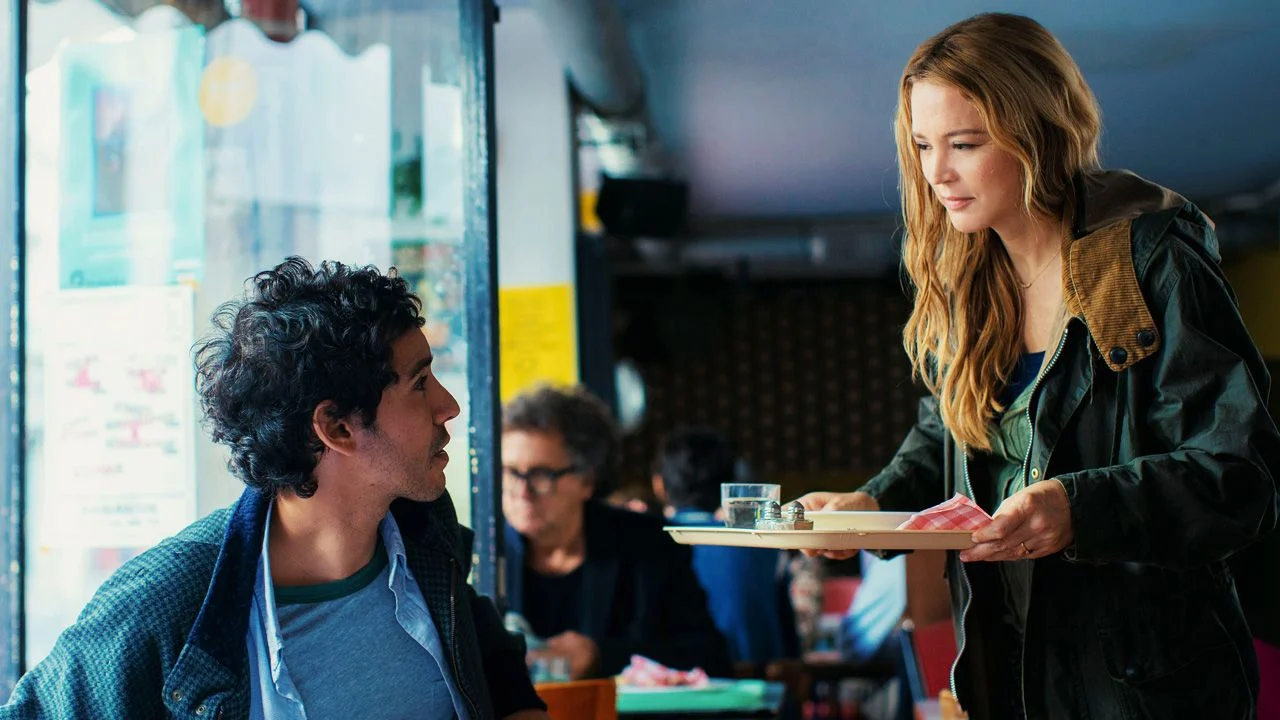
The meeting of Adam and Nita (Virginie Efira) sets the real plot in motion!
When Nita is suddenly confronted with the revelation that she was being watched the whole time, it’s not so much about the voyeuristic act. The question is much more interesting: What is it like when someone from the window opposite imagines a much more exciting life for you than the one you lead yourself? It’s a question that the men at her side will soon ask themselves. Why did someone get the impression when observing that there was a love constellation here that was different from reality? Are there perhaps signals here that are recognized with a neutral gaze but have always been overlooked? Farhadi skillfully tightens the tension screw without hitting the drum.
It’s little things that are kept quiet and misunderstandings that lead to jealousies and ultimately to assault. “Parallel Tales” never becomes a true thriller. Farhadi stages his scenes too soberly for that. Most of the moments that take place in the two apartments or nearby cafés and the subway are filmed calmly, but that doesn’t detract from the tension. Because Farhadi manages to involve his audience – who, like Sylvie, also observe the lives of these characters. You don’t remain neutral, you make your own judgment.
Even an immoral character is captivating
Of course, Adam, who poses as an author and forces his way into Nita’s life, repeatedly acts immorally. But at the same time you can understand this lonely young man from the street who finally believes he can see a way out of his life. Could he possibly make money by writing? But does he necessarily need Nita and the life Sylvie imagined as inspiration? But what is a first step as a writer worth if it is based on a lie and a script that he didn’t even write?
The strong second half makes “Parallel Tales” worth seeing – even though the great Isabelle Huppert (“Elle”) fades into the background for long stretches and only gets strong moments again in the successful finale. From the strong cast, in which Catherine Deneuve (“Belle de Jour – Beautiful of the Day”), another icon of French cinema, stops by for a brief guest appearance, one in particular stands out: Virginie Efira (“Benedetta”) impresses as a self-confident woman who is never pushed into a victim role by Farhadi, despite the all-round voyeuristic view of her character.
Conclusion: Despite the long running time and a somewhat ponderous beginning, Asghar Farhadi’s “Parallel Tales” impresses as a well-observed, complexly intricate and always exciting drama with a brilliant cast, from which Virginie Efira in particular (with a crazy scene in a small café) stands out.
We saw “Parallel Tales” at the Cannes Film Festival, where the film had its world premiere in official competition.