The title “Fatherland” seems particularly suitable for what-if scenarios. In his 1994 novel of the same name, filmed with Rutger Hauer, Robert Harris asks what a world would look like in 1964 if Nazi Germany had won the Second World War. The Polish director Pawel Pawlikowski, whose “Ida” was awarded the Oscar for the best foreign language film in 2015, makes things a little smaller in his seventh feature film: his “Fatherland” is “only” about the question of how Thomas Mann’s (Hanns Zischler) trip to Germany on the occasion of the awarding of two Goethe Prizes in 1949 would have turned out if his daughter Erika (Sandra Hülser), the She emigrated with him to the USA in 1933 and would not have steadfastly refused to ever set foot on German soil again in her life.
In any case, in the film, Erika accompanies her father first to Frankfurt am Main (Goethe’s birthplace), which is controlled by the Western powers, and then to Weimar, which is under Soviet rule (Goethe’s place of work and death). The German-German road trip is carried out surprisingly crisply in just 82 minutes by Pawlikowski and his co-author, the German director Henk Handloegten (“Babylon Berlin”). A few brief encounters with new officials and old acquaintances in the West, then the same thing again in the East, and suddenly “Fatherland” is over again. One would almost like to call the film “modest” in terms of its means, but the black and white photography by the two-time Oscar-nominated cameraman Lukasz Zal (“Cold War”) looks far too high-quality – and then even the smallest supporting roles are played by well-known stars.
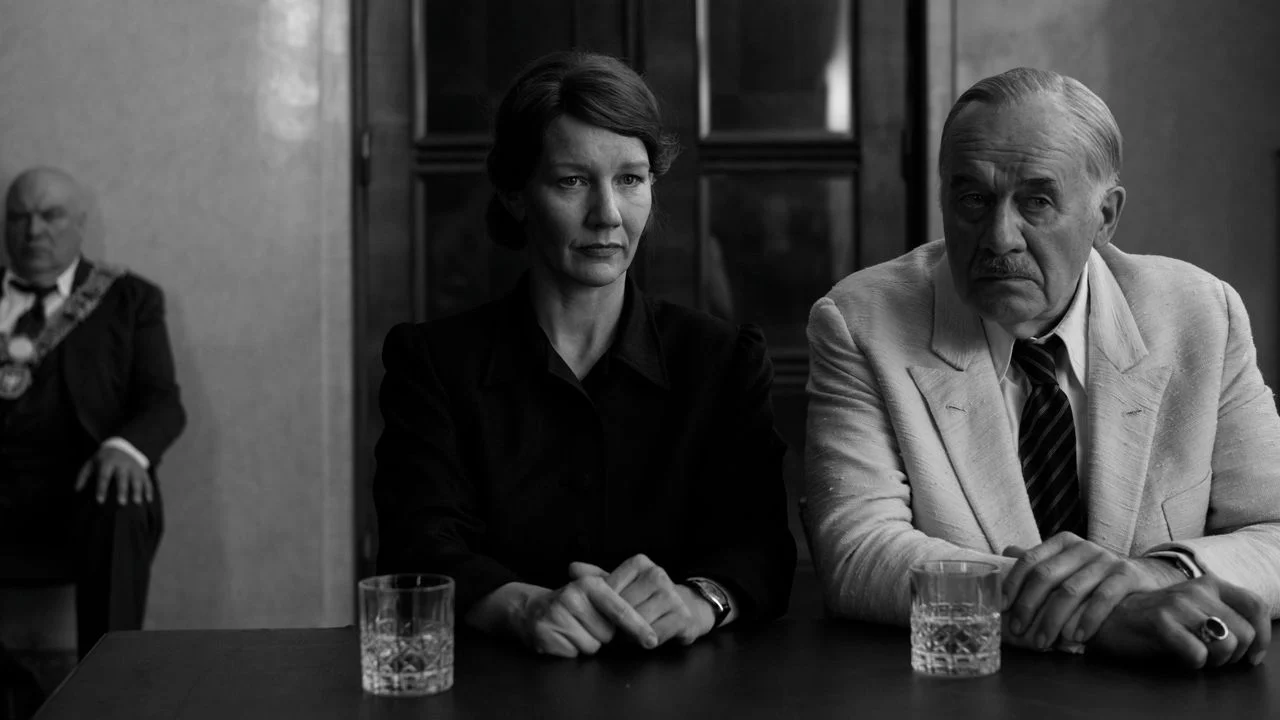
In reality, Thomas Mann (Hanns Zischler) returned to Germany with his wife. In the film he is accompanied by his daughter Erika (Sandra Hülser).
So Fritzi Haberlandt, a waitress in an East German canteen, just stops by briefly to say that the kitchen doesn’t open until 12 p.m. and until then the only thing available to drink is sea buckthorn juice. But the encounters with well-known personalities from the mayor of Frankfurt (Waldemar Kobus) to the first GDR culture minister Johannes R. Becher (Devid Striesow) are not much more detailed. Especially at the beginning of the reception after the award ceremony in Frankfurt, some of the dialogues feel as if the main aim was to fit in a particularly large number of Wikipedia snippets, both interesting and amusing, in as few lines as possible. Pawlikowski repeatedly allows himself and his audience cathartic outbursts: Thomas Mann dismisses Richard Wagner’s grandchildren Wieland (Enno Trebs) and Wolfgang (Theo Trebs) with a remark; Probably only a Nobel Prize winner for literature could insult something so beautiful and apt.
And while we’re on the subject of what-if scenarios: Where Quentin Tarantino had Brad Pitt open machine gun fire directly into Adolf Hitler’s face in “Inglourious Basterds”, the start of his alternative history trilogy, Erika Mann now at least gets the chance to give her ex-husband Gustaf Gründgens (Joachim Meyerhoff), the No. 1 Nazi actor, a hard slap in the face. A task that Sandra Hülser of course masters brilliantly. Since her 2023 Cannes double hit “Anatomy of a Case” and “The Zone Of Interest” she seems to be unstoppable; this year she has already won the Silver Bear at the Berlinale for “Rose” and landed a global megahit with “The Astronaut”. There is hardly anyone you would rather accompany on a trip through bombed-out Germany.
Tight and strict
But you shouldn’t draw the wrong conclusions from the short cathartic peaks. Anyone who knows Pawlikowski’s previous films knows that his work usually has something strict and often academic about it. “Fatherland” is probably his most entertaining film to date, but important topics are also discussed in such a short time: with his German-German double speech on Goethe’s 200th birthday, Thomas Mann ultimately explores nothing less than the question of whether there ever could be such a thing as a “good Germany” and can still exist now. Cameraman Zal captures this in stark black and white in strictly static 4:3 images, which seem even narrower than they already are because Pawlikowski places most of the action in the lower half of the screen.
In the upper half there is often an unusually large amount of space for walls or sky. But a real feeling of freedom only arises once, when Erika Mann walks alone through a park with Goethe statues in Weimar and the camera suddenly moves with her for the first time.
Conclusion: Alternative history version of Thomas Mann’s trip to Germany in 1949 captured in magnificent black and white images – given the many crisp encounters, the 82 minutes for a film by the otherwise academically strict Pawel Pawlikowski almost fly by, even if some of the dialogues sound like pointed Wikipedia summaries.
We saw “Fatherland” at the Cannes Film Festival, where the film had its world premiere in official competition.