
Mother Mary, played by Anne Hathaway – we don’t know her full real name – is a kind of pop hybrid: the otherworldly extravagance of her costumes and stage shows is reminiscent of Lady Gaga; she borrowed her imagery charged with religious symbolism and the will to self-transformation from Madonna. At the same time, her fragile physicality is reminiscent of FKA twigs – who not only appears in the film herself, but also wrote seven (mostly quite convincing) pop songs for the protagonist together with Jack Antonoff and Charli xcx. One of the main inspirations for director and screenwriter David Lowery was Taylor Swift’s tour for “Reputation”, certainly not entirely coincidentally an album that can be read as a recapture and reinterpretation of one’s own image.
It is precisely this field of tension between inside and outside, control and loss of control, as well as the perhaps never completely resolvable role as an individual and a changing projection surface that has made the pop star increasingly attractive as a cinema figure in recent years: films like “Vox Lux” or “Smile 2” deal (in very different ways), not least with the question of what it does to a person to be at the mercy of a public that knows the willingness for limitless admiration as well as perverse desire at failure. “Mother Mary” follows on from this, with Lowery refusing the expectations of a dazzling pop melodrama and only partially using the opportunity to tell Mary’s journey of pain as a horror film. That makes it interesting, but also frustrating at times.
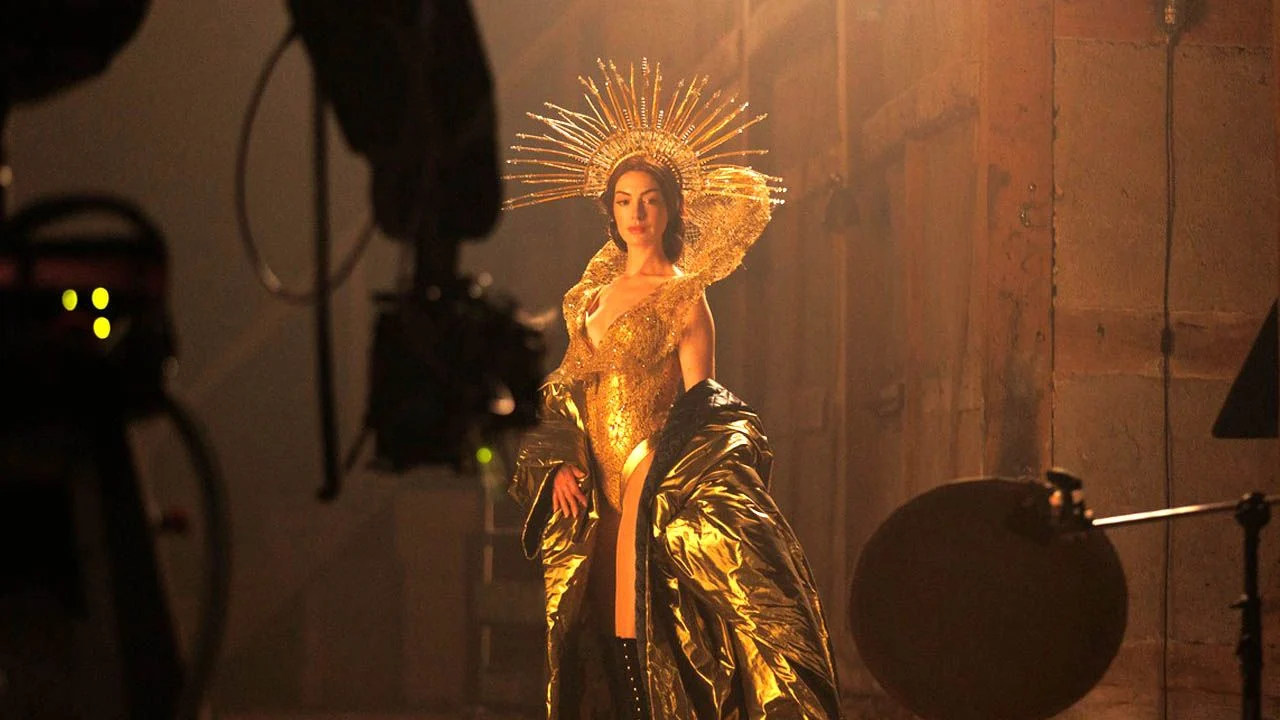
Saint symbols are the trademark of pop star Mother Mary (Anne Hathaway).
The beginning has something special: the camera pans up a never-ending piece of material, which only gradually reveals itself to be part of a sweeping dress until it reaches Mary’s face, which is surrounded by light reflections. She wears a nimbus-shaped headdress, the geometry of the stage and its neon-colored lighting create the shape of a cross – the symbolism is as clear as it is effective. To the relentless plucking of an electronic beat, a warning sign asks the audience to cover their ears (“This song is cursed”). The intro then explodes in a veritable cascade of cuts, at the end of which there is a sharp scream.
“Mother Mary” doesn’t remain as flashy as this statement opening. Lowery, who became known for the grief study “A Ghost Story” (2017), which is limited to a few square meters, has always felt more comfortable in small formats than in spectacle (this can be seen particularly well in big-budget outings such as the recent murky Disney live-action remake “Peter Pan & Wendy”). Even the stage performances shown in flashbacks, as glamorous and impressive as they are staged, have something cramped about them: in perspective, we are always very close to Mary, the audience is an anonymous sea of cones of light.
Chamber play instead of pop spectacle
“Mother Mary,” however, makes the frame much smaller: after the quasi-sacral pop overture, the film turns into a two-person chamber play. The voiceover that can be heard at the beginning of the film does not belong to Mary, but to a second character: designer Sam Anselm (Michaela Coel), Mary’s former creative partner. She was once responsible for the singer’s stage outfits and played a significant role in shaping her pop star persona – perhaps they were a couple, but the script leaves it at hints. About a decade ago there was a break between the two, and Sam makes it very clear who is responsible for this: “You are a carcinogen, a cancer,” she whispers darkly at Mary.
Nevertheless, Mary decided to seek contact with Sam shortly before her big comeback show and the release of her new single “Spooky Action” (a reference to Albert Einstein’s concept of “spooky action at a distance”). Some time ago she suffered an accident in public, which was interpreted by the media as a possible suicide attempt. In the middle of preparations for the upcoming arena performance, she escapes from the backstage area, gets on the plane and goes to Sam’s Gothic estate, which is located somewhere in rural England. She stands in front of her door with soaked hair and asks her former confidant for a dress. Only Sam is able to design a costume that is appropriate for the occasion and at the same time “feels like her”. Basically, it’s important to find the interface between people and fictional characters. What speaks for the film is that it does not pit the true and the artificial against each other, but rather thinks about how both can be woven into a unity.
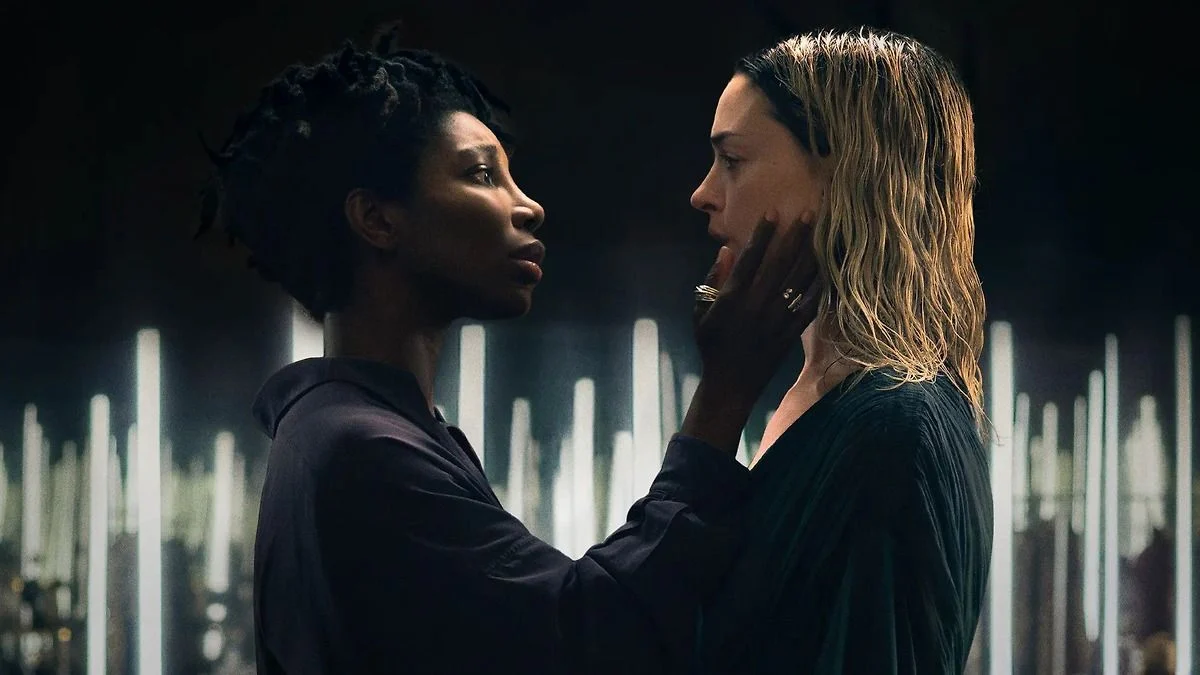
Mary meets fashion designer Sam (Michaela Coel) for the first time in a long time – their collaboration ended very badly ten years ago.
Sam accepts the assignment, even though she says she hasn’t heard a single note of Mary’s music in the past decade. She doesn’t want to know anything about her new single either, although Mary never tires of praising it as perhaps the best song of all time. In an old barn that has been converted into a studio, it is only primarily about suitable design ideas. Rather, Sam enjoys her newfound position of power, humiliates Mary and bombards her with accusations until the radiant pop icon finally disappears behind her tears. A highlight is a scene in which Mary is supposed to demonstrate her new choreography – without any musical accompaniment. In perhaps the most physically intense moment of her career, Hathaway descends into a silent expressive dance that is more reminiscent of an exorcism than a professionalized live routine – how fitting for a film in which demons have to be exorcised not only figuratively, but later also quite literally.
Both actresses carry this one-sided, largely verbal duel with their very opposite but equally expressive acting. But it’s only partly captivating. Lowery’s dialogues are mannered, artificial, theatrical – but above all mostly far too vague for what they are supposed to shoulder: getting to the bottom of a broken relationship and at the same time negotiating all sorts of fundamental things about fame, identity, authorship and the necessity of pop and idols in general. As attractive as the clash between Hathaway’s crumbling diva performance and Coel’s sardonic coolness may be at first, they cannot maintain interest throughout.
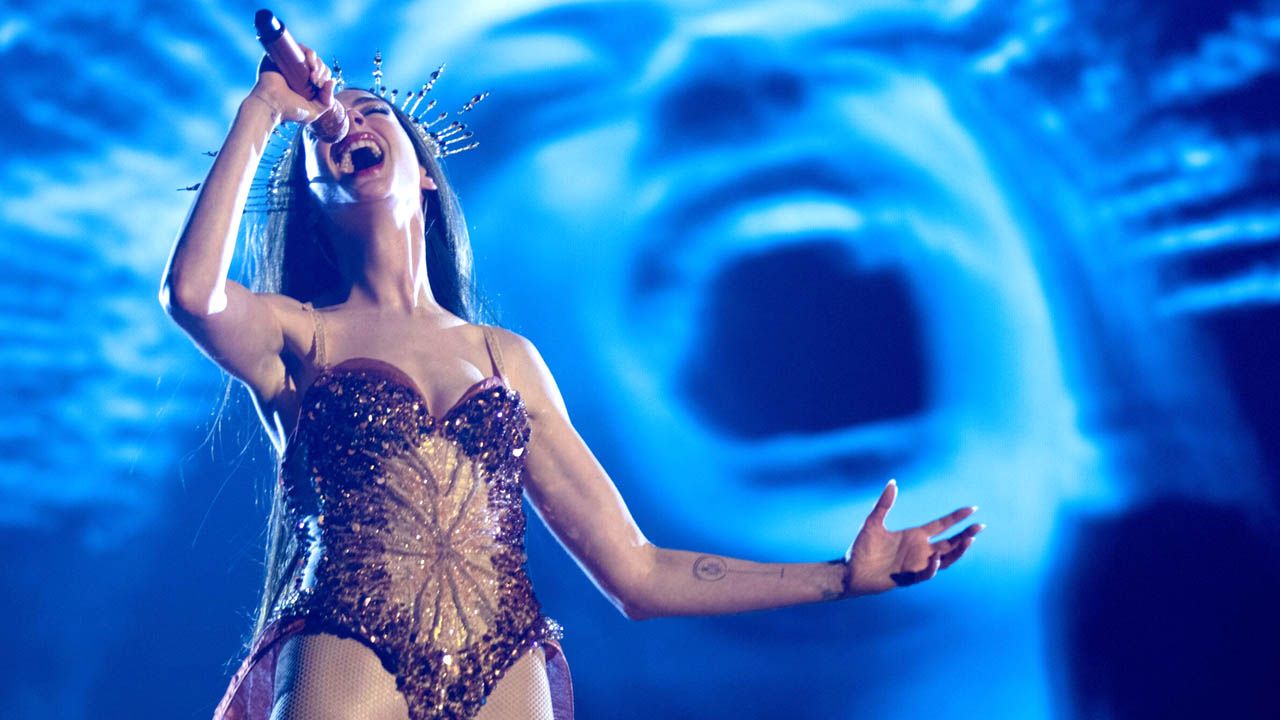
The concert scenes are the greatest viewing value of “Mother Mary.”
Formally, “Mother Mary” is also a mixed affair: On the one hand, Lowery cleverly stages the minimalist setting in the CinemaScope widescreen format as a second stage. He also demonstrates real showman qualities when he repeatedly cleverly breaks up and expands the cinematic space. But the harder it is to want to continue following the diffuse stream of words, the more tiring the low-contrast digital images of the same unadorned interior, darkened beyond recognition, become. Fortunately, “Mother Mary” returns to the stadium regularly: the concert sequences, implemented with visible effort and cutting back and forth between monochrome aesthetic smoothness and grainy video recordings, form the film’s central viewing value.
Around the middle, Lowery lets the scenario clearly tip into the genre-like. A séance board plays a role, there is a quite impressive body horror moment, and a ghost floats around in the picture as a somewhat heavy-handed metaphor. This is where the film finally threatens to slip away: what was previously cryptic turns into the overly obvious. However, you don’t want to be really angry with this unsatisfying, fraying, silly and overly serious film – after all, there is no other like it in the history of cinema. And when the symbolic act of resurrection is performed at the end, “Mother Mary” actually approaches a key idea previously formulated by Sam: pop as “sacred transformation of feelings.”
Conclusion: Reflexive pop extravagance, chamber play-like psychodrama, metaphysical horror: director and screenwriter David Lowery wants significantly more than he can deliver in the end – and gets lost between vagueness and over-clarity. Nevertheless, “Mother Mary” is not only frustrating, but also delightfully stubborn.