
It’s rare that I’m happy when a film is shown to the press in advance in the German dub. In the case of the bestseller film adaptation “Glennkill – A Sheep Thriller”, however, there were two good reasons to look forward to the screening date: Anke Engelke and Bastian Pastewka. The two have been a guarantee for a good mood in doubles since “The Week Show” – and have proven several times that they have wonderful chemistry together. Why shouldn’t this dynamic also be felt behind the microphone?
In fact, the two of them are also a highlight as the voices of the animated detective sheep and make a decisive contribution to making the world of “Glennkill – A Sheep Crime” feel pleasantly familiar. You immediately fall in love with the unusual wool investigators – even if the actual solution to the crime is very predictable. What is much more surprising is that a film about detective herd animals can score points with a surprisingly political note.
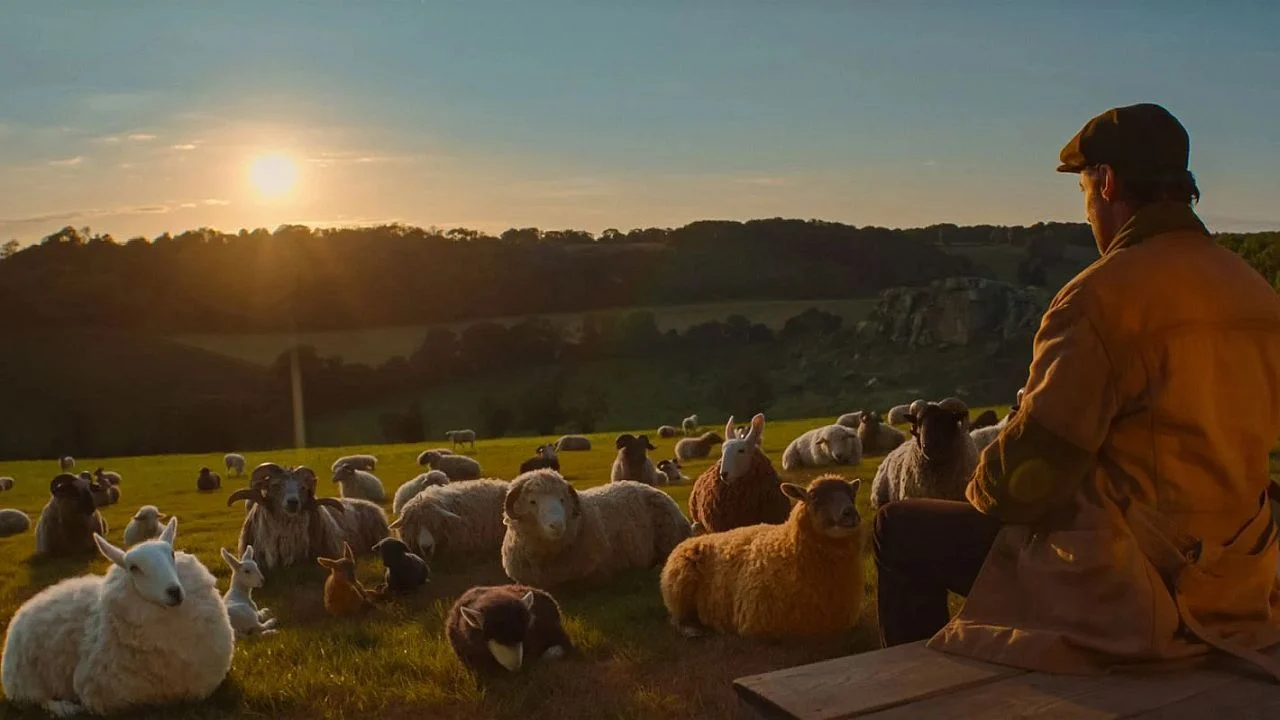
Every evening, shepherd George reads a crime story to his sheep.
The shepherd George Hardy (Hugh Jackman) is a passionate crime enthusiast. He likes to spend his time reading exciting murder stories to his sheep. He has no idea that the animals not only understand him, but also eagerly discuss the perpetrators, motives and clues after reading lessons. But the idyllic life is suddenly over when George is discovered dead in the pasture one day. The sheep soon have to realize that their beloved shepherd has been treacherously murdered. Since the local police officer Tim Derry (Nicholas Braun) has not yet been able to solve any serious crimes, the herd decides to take action themselves.
Under the leadership of the clever Lily (voice in the original: Julia Louis-Dreyfus / German version: Anke Engelke), the sheep begin the investigation. The wool detective is supported by the stubborn loner ram Sebastian (Bryan Cranston / Douglas Welbat) and the cozy Mopple (Chris O’Dowd / Bastian Pastewka), who is the only sheep who cannot forget unpleasant memories on command. Together they gradually uncover the truth.
No detailed implementation of the template
“Glennkill: A Sheep Crime” is not a detailed adaptation of Leonie Swann’s successful novel, which became a bestseller after its publication in 2005. There are not only serious changes to the content, but also smaller adjustments that are more of a cosmetic nature. So the black ram Othello has now been given a much less innocuous name, Sebastian, and the main character Lily was also named Miss Maple in the original – of course a clear reference to the brilliant senior investigator who was created by the legendary crime writer Agatha Christie.
The biggest difference, however, is the case itself, because the mystery surrounding the shepherd’s murder has been significantly defused and simplified. Instead of dark topics like depression or suicide, there is now a family-friendly criminal case that involves simple motives and a whole lot of gravel. This invites you to puzzle along, but viewers who are familiar with the genre should quickly figure out the solution.
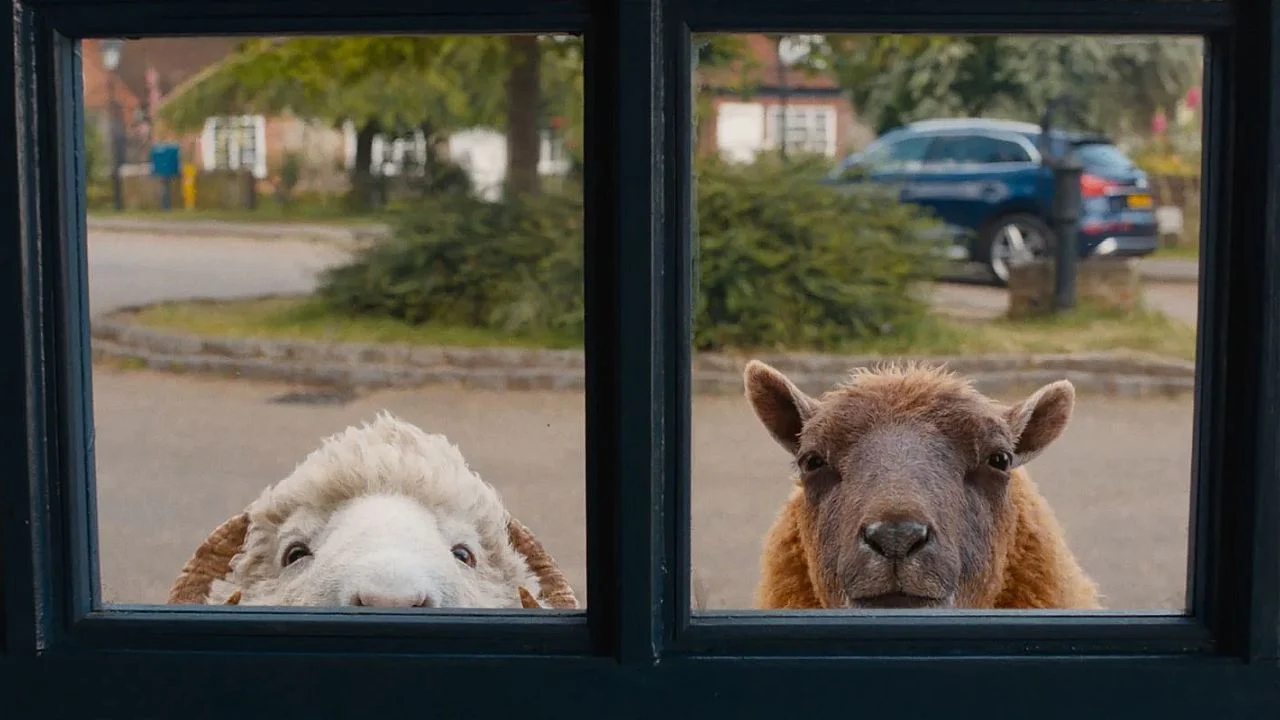
Lily and Mopple have to find the murderer together.
Despite all the changes, one thing has remained the same: the charm of the template. Who needs tricky brain teasers like “Wake Up Dead Man: A Knives Out Mystery” when you can have woolly investigators? And it’s just a lot of fun to rediscover the human world from the perspective of four-legged sleuths. In its best moments, the colorful hustle and bustle is reminiscent of the “Shaun the Sheep” series from Aardman Studios – even if it never quite comes close to the loving madness of the anarchic stop-motion claymation fun. There are always philosophical interludes that are particularly likely to appeal to older audiences. For example, when the ignorant four-legged friends openly and naively discuss the meaning and purpose of the church and God, it opens up a fresh perspective on internalized cultural rites and norms.
Unfortunately, “Glennkill – A Sheep Crime” misses the chance to really bring Irish village life to life. While cult films like “Long Live Ned Devine!” If you just make a living by dragging gnarly guys in front of the camera and capturing the special atmosphere of the Irish countryside, the town of Denbrook always feels like a backdrop devoid of real life. Many of the town’s residents seem far too modern and hip for such a sleepy town – and you won’t find the rough charm of dim pubs and real country uniques with weathered faces.

Nicholas Braun is a real scene stealer as police officer Tim.
Of course, “Glennkill – A Sheep Crime” can still score points with a few likeable characters. In particular, the hopelessly overwhelmed village policeman Tim Derry (Nicholas Braun) turns out to be a real scene-stealer. During his investigative work, he repeatedly meets individual members of the sheep herd – because they sometimes try to put him on the right track very directly or to teach him the basics of investigative work. It is completely understandable that the law enforcement officer eventually develops a downright paranoia about the clever animals – after all, they always seem to be one step ahead of him.
Nevertheless, in the fun goings-on, there are always moments that really touch the heart. Because even the sheep are not free from mistakes. In particular, the story of the outcast “winter lamb,” who is discriminated against and excluded by the other members of the flock because of his birth during the cold months, is heartwarming and provides some of the film’s most emotional moments.
A film against forgetting
In addition, “Glennkill – A Sheep Crime” also cleverly positions itself as a reminder against forgetting. The sheep can consciously erase traumatic events and unpleasant memories at the push of a button – something the herd makes plenty of use of. And so the four-legged friends not only ignore all the unpleasant elements of reality, but also consciously distort their own world view. Lily has to discover over the course of the film what value negative memories can have – and what helpful conclusions can be drawn from them.
Of course, this insight is not only important on a personal level, but also contains a political note. Especially in such chaotic times, in which fascism is spreading again and democratic orders are being threatened, it is incredibly important to remember the mistakes of the past. Who would have expected such nuances in an otherwise lively crime film about investigating sheep?
Conclusion: “Glennkill – A Sheep Crime” is a heartwarming whodunnit adventure for the whole family. Even if the actual case cannot compete with comparable genre representatives, it is an entertaining pleasure to watch the fluffy four-legged friends doing their investigative work. It is a pleasant surprise that there is also room for a political note in this humorous detective story, which is also loosely and organically integrated into the story.