
In the first five minutes of “Good Boy,” we watch 19-year-old Tommy (Anson Boon) getting drunk, doing coke, popping pills, puking on the sidewalk, literally pissing on people, cheating on his girlfriend in public, slapping his face, and beating up passers-by. There’s nothing you want more than for this evil and ruthless Count Koks to get a good beating. Lo and behold – Tommy is knocked out by a stranger and wakes up in a basement with an iron dog leash around his neck.
At the same time, Chris (Stephen Graham) is looking for a maid for his secluded property where he lives with his wife Kathryn (Andrea Riseborough) and son Jonathan (Kit Rakusen). Rina (Monika Frajczyk) is supposed to keep the apathetic wife and son company twice a week, do the dishes and spruce up the run-down property. On the other hand, she is supposed to studiously ignore Tommy chained in the basement, including a non-disclosure agreement.
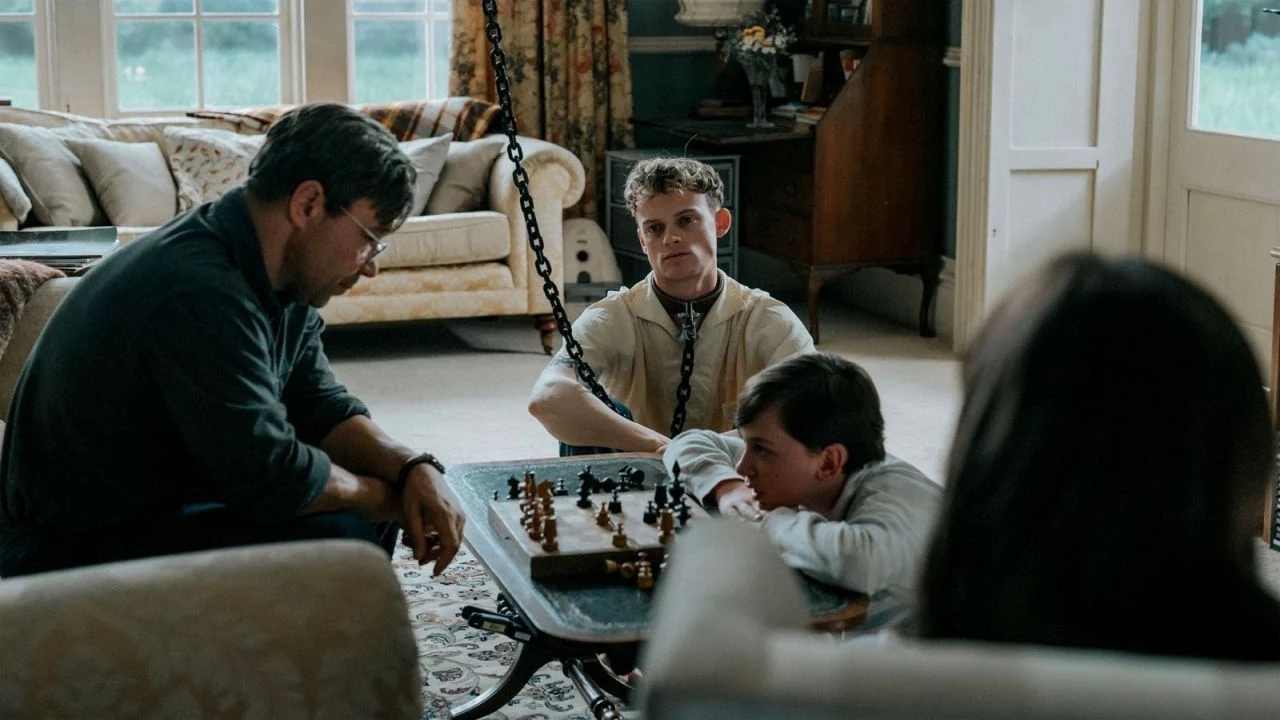
Tommy (Anson Boon) is literally put on a chain by his new “family”.
From now on, Tommy eke out his existence in the basement of the house, has to adhere to strict rules and is punished immediately if he violates them. If, on the other hand, he behaves like the eponymous “good boy”, relief and goodies await, such as TV evenings with popcorn during which Ken Loach’s social drama classic “Kes” is shown. However, what Chris and Kathryn plan to do with Tommy remains a secret, as does Rina’s role in this game.
Polish director Jan Komasa (“The Change”) first became known to a wider audience in 2019 when the sensitive religious drama “Corpus Christi” premiered in Venice and was subsequently nominated for an Oscar for Best Foreign Language Film. The fact that his new film is initially making the rounds at established genre festivals may seem surprising at first glance. Even the original English title “The Good Boy” had to be changed to “Heel” to avoid confusion with the ghost dog horror of the same name.
Completely different from “Saw” & Co.
What actually brings the film closer to horror and thriller is of course the initial situation, which has already been explored in this or similar way in numerous genre representatives. Whether “Saw”, “Martyrs” or “Panic Room” – there is certainly no shortage of films in which innocent victims are at the mercy of their violent perpetrators and derive a fair amount of tension from this. “Good Boy”, however, takes a different approach and is not quite as brutal, which also fits Komasa’s style better.
On the one hand, Tommy’s character is initially so unsympathetic that viewers may even perceive his situation as a just punishment. On the other hand, the family presented as adversaries is very special and quirky, but also has some gaps in the characters and the plot that don’t bode well. Nevertheless, the members always show themselves to be unusually helpful and almost kind.
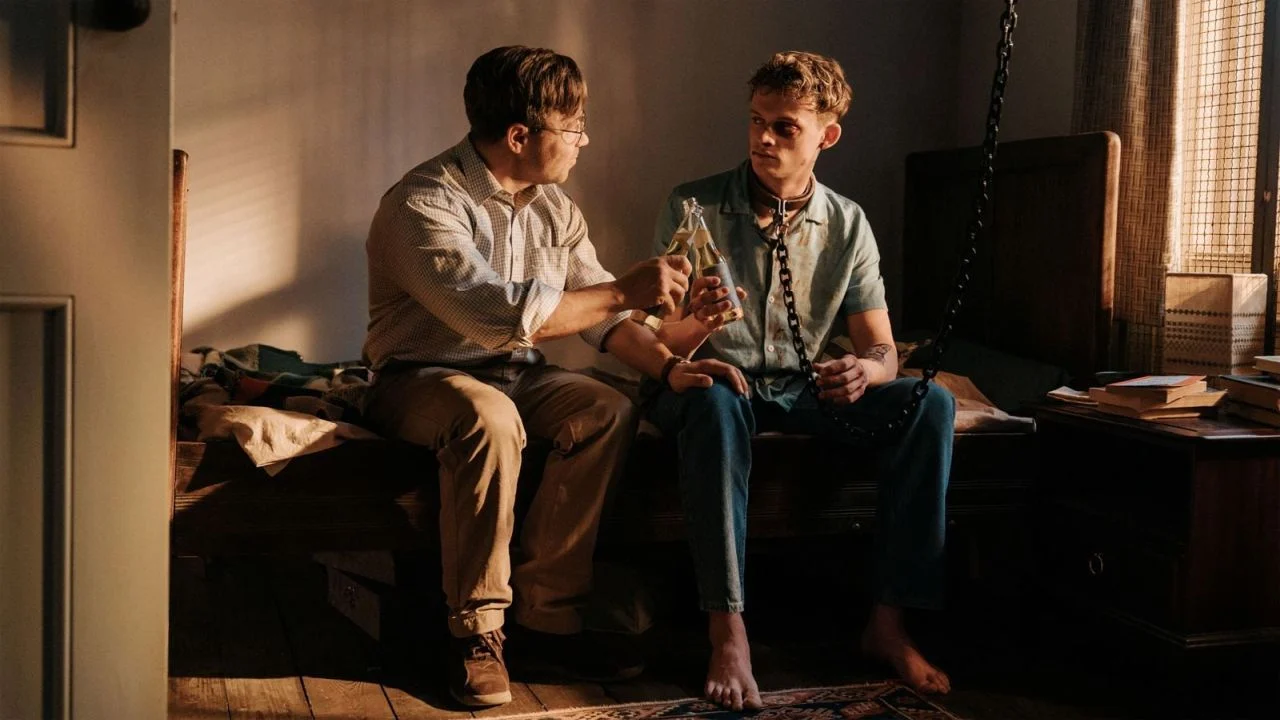
Does Chris (Stephen Graham) really only want the best for Tommy? Or does he actually have completely different plans?
The film derives its real appeal from the back and forth of positions and contradictory feelings that the individual characters evoke, because you can never be quite sure which side you should be on and who exactly you should root for. The film maintains this ambivalence unbroken until the end. Komasa can rely on a top-class cast. At the forefront are Stephen Graham, known from the Netflix hit “Adolescence,” as a vulnerable pater familias with emotional depths, and Andrea Riseborough (“Mandy”) as a wonderfully otherworldly mixture of dreamy fairy and careworn witch. Anson Boon as the chosen victim is convincing as a hedonistic teenager who continually gains new facets as the plot progresses.
Komasa has the technical reins firmly and confidently in hand throughout the entire running time, cleverly keeping the audience entertained, placing less emphasis on superficial tension and instead focusing on the psychological test of strength. Formally, he holds back from gimmicks; the technical means are used entirely to serve the story. In terms of content, he shows courage to leave gaps; not every question and every mystery is finally clarified. Only the plot about the housekeeper Rina seems a bit unmotivated and fizzles out more or less ineffectively towards the end.
Pleasantly ambivalent
The film’s great strength is its ambiguity and ambivalence, which Komasa is willing to endure. This means that when the final image has flickered across the screen, the film can also be read as a reactionary fantasy of redemption. Or as a daringly humanistic, fatalistic romantic reflection on excessive demands in the multisensory contemporary reality. Komasa does not take a clear position here and gives his audience a choice.
Conclusion: With “Good Boy” Jan Komasa presents a slightly different kidnapping thriller that cleverly balances the perpetrator and victim perspectives and breathes new life into the familiar initial situation through psychological subtlety and moral complexity. A well-rounded cast and an ambiguous script serve him well.