
The basic idea is brilliant: the doorbell rings. The art teacher Hanne (Dagmar Manzel, “Schtonk”) opens the door. Kurt (Harald Krassnitzer, “Tatort”) is standing outside and explains that he has forgotten his keys. After he scurries past her, Hanne stops in her tracks and looks as if she had just seen a ghost. The two were actually married once, but that was decades ago. Hanne now lives with the retired pastor Bernd (August Zirner, “A Whole Life”). Kurt, on the other hand, suffers from Alzheimer’s, which is why he can no longer remember the divorce and firmly believes that the marriage will continue.
But just because the premise of Welf Reinhart’s directorial debut is so curious straight away, that doesn’t mean that in the end it won’t end up with the same old consternation. But puff cake! Fortunately, “The Lost Man” is not off-the-shelf arthouse kitsch, but rather thrills with an unexpected ménage-à-trois (even if it never goes to extremes). In this happy shared utopia, you really want things to turn out well for everyone, even if everyone secretly knows that things can hardly continue like this in the long term with such a treacherous dementia.
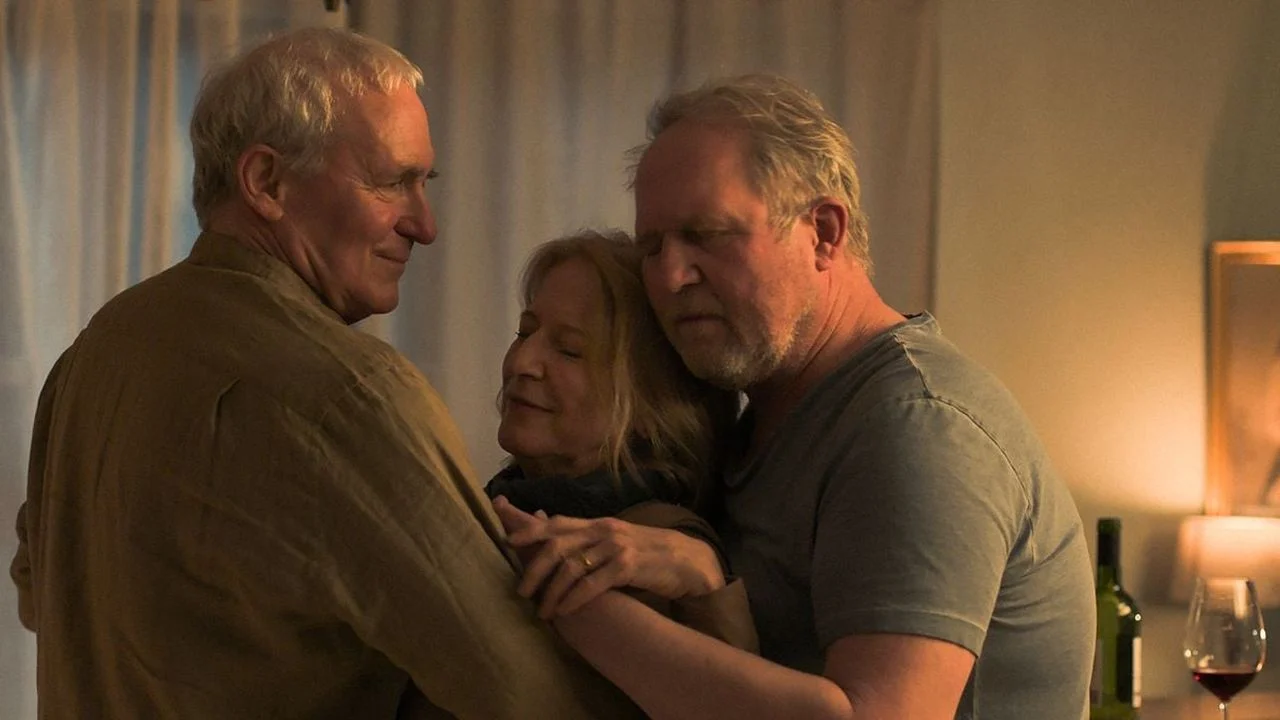
We keep our fingers crossed for this trio: Dagmar Manzel as Hanne, Harald Krassnitzer as Kurt and August Zirner as Bernd.
In any case, Hanne won’t be able to get rid of the surprise guest so easily. His adult daughter Samira (Lene Dax) is currently abroad and is completely overwhelmed anyway. The day clinic from which Kurt escaped (again) doesn’t want to take him back either; An alternative home doesn’t open until the next day – and then suddenly there’s no space left. So Kurt is staying for now – and especially because of Bernd’s selfless efforts: You want a priest like that! He even agrees to a more permanent shared apartment, as long as he retains the right to veto it if it no longer works. After all, things don’t go smoothly when Kurt sneaks into bed at night and cuddles up to “his” wife.
I had already read a user review in advance in which the trio from “The Lost Man” was compared with the love triangle from Luca Guadagnino’s “Challengers – Rivals”. That’s obviously a tongue-in-cheek exaggeration – because of course things aren’t as orgiastic as those between Zendaya, Mike Faist and Josh O’Connor on the tennis court in the spontaneous senior shared apartment. But even if in “The Lost Man” there is never more than cuddling, there is still a grain of truth in the unexpected comparison: We see early on that things are obviously not going well for the clerical Bernd in bed – and with Kurt someone comes into the house who lends a hand, goes into nature, does things with his hands. One is a piano player, the other a piano maker – and Hanne actually thinks they’re both pretty good.
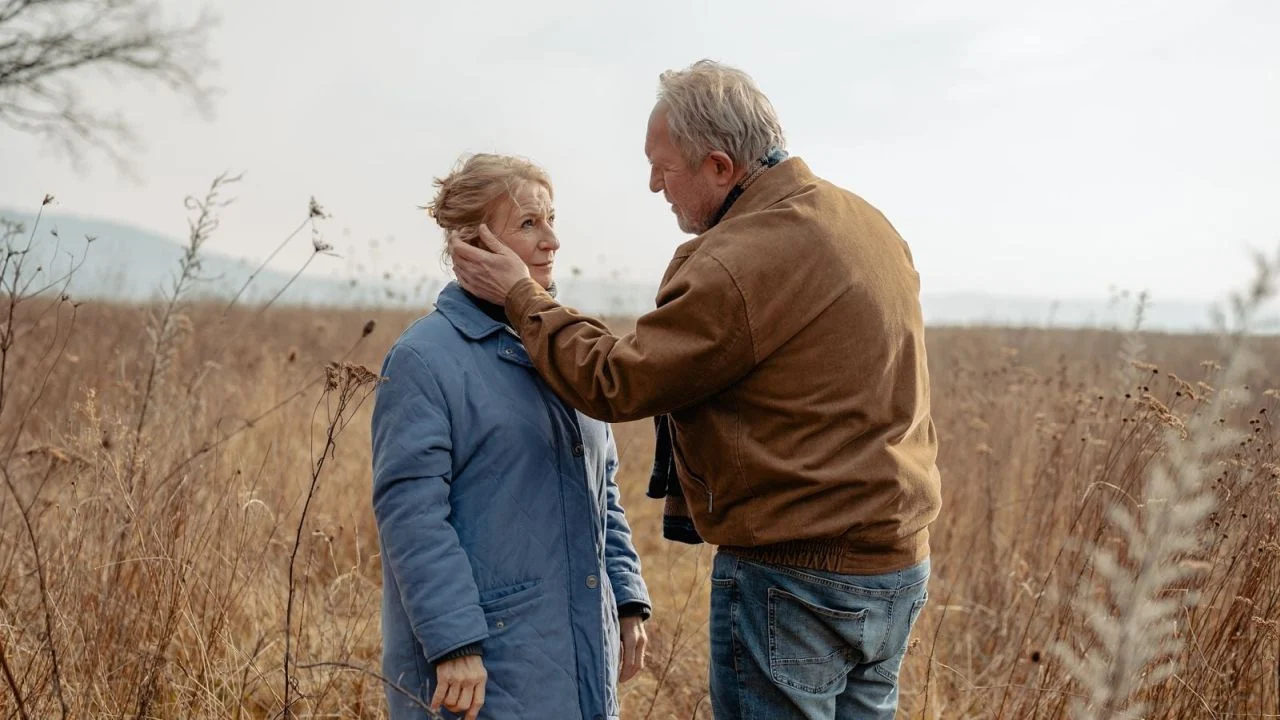
Kurt lets himself be shown where he is still allowed to touch Hanne (and where he is not).
On the bus, Hanne sits on Bernd’s lap and holds Kurt’s hand. There is at least a touch of utopia in the air! You almost want to shout at the screen: “Then finally smooch!” But “The Lost Man” also celebrates rebelling on a small scale: Right at the beginning, Hanne is taken out of class by a colleague – in German film, this is actually a surefire sign that something terrible must have happened. But here the colleagues just hide in the workroom to smoke – and there is also a stupid saying from the not stupid students after they return.
In any case, “The Lost Man” scores with a wonderfully light, pleasantly dry humor – especially given the “heavy” subject matter: When Hanne talks about Alzheimer’s disease, the misunderstanding Kurt naturally expresses his pity for his rival Bernd. And when things do get serious, that works too: in what is probably the film’s most powerful moment, Hanne pushes her abusive ex away until he – also increasingly frustrated and desperate – finally offers her his hand: “Where can I touch you? Show me!” Such moments in “The Lost Man” are played as magnificently as they are written.
Conclusion: A dementia film very far away from the usual kitsch of concern. Instead of the usual Alzheimer’s stuff, there is subtle humor, a lot of empathy and even an astonishing level of humor Horniness. You keep your fingers crossed – even if you have long suspected that this utopia, characterized by a deep sense of humanity, can hardly last.