
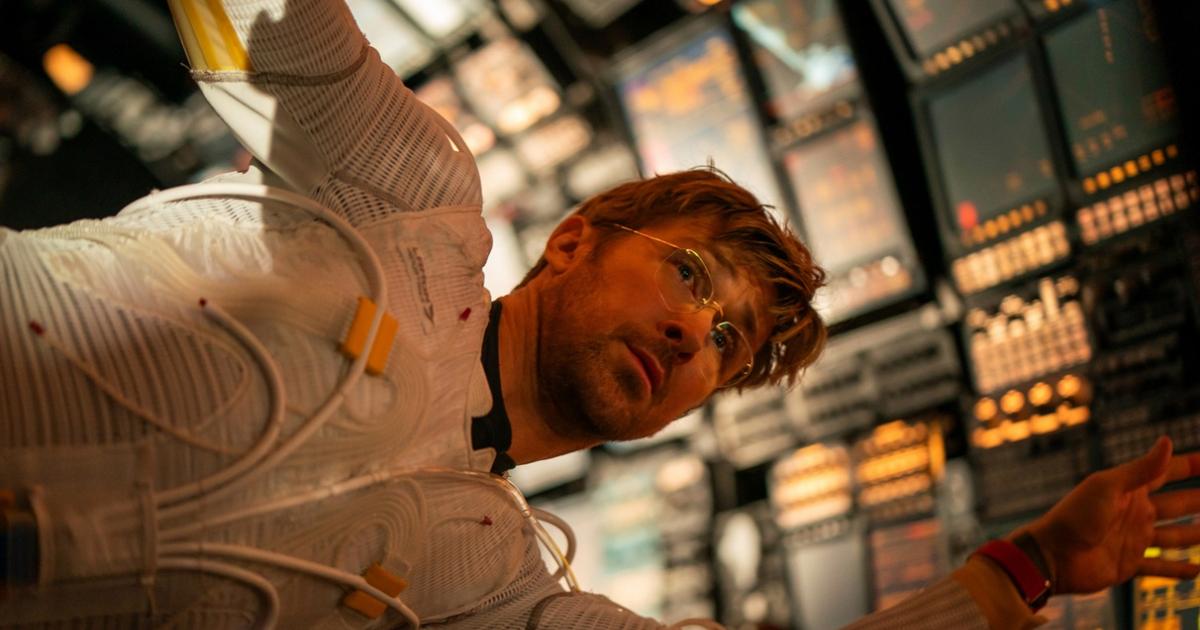
He already provided the template for “The Martian”. Now another novel by Andy Weir has made it to the cinema.
Within a short time, US author Andy Weir (53) has earned a reputation as an expert on space robinsonades. In the film adaptation of his debut novel “The Martian” it was Matt Damon (55) who increased the population of the red planet from 0 to 1. In “The Astronaut” it is now Ryan Gosling (45) who is stranded alone in space – or not? The parallels between the two works and thus their respective adaptations seem overwhelming at first glance. But there is a small, yet gigantic difference that provided an absolute magic moment in the book – but unfortunately it is already spoiled in the trailer for the film.
One-way ticket to space – that’s what it’s all about
Our sun is dying. Microscopically small, deep black organisms, called astrophages by scientists, rob the vital star of its energy. In the next 30 years, the experts calculate, the sun will have cooled radically and, as a result, the world population will have halved – and that is the best-case scenario. A short time later, all of humanity will be wiped out.
But she doesn’t want to completely accept her dark fate yet. Led by the stoic and competent Eva Stratt (Sandra Hülser, 47), an international team of experts puts together a space mission with extremely low chances of success. But little hope is better than no hope at all. Molecular biologist Ryland Grace (Gosling), who now works as a high school teacher, could tip the scales to save the entire universe thanks to his theories, which are ridiculed by colleagues.
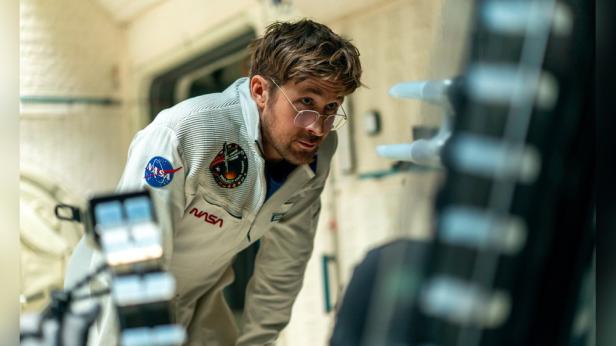
Scene from “The Astronaut – Project Hail Mary”
Faithfulness to the original: a blessing and a curse
There is definitely a reason why “The Astronaut” is originally called “Project Hail Mary”: the mission to save humanity is designed as a one-way street and is therefore symbolically and literally a suicide mission. This has extremely many facets and twists in the book. Weir loves to base his fiction on as many scientifically plausible foundations as possible.
The cinema adaptation tries to do some justice to this complex approach, which on the one hand cannot be praised enough – there are already plenty of generic science fiction films with an action twist. On the other hand, “The Astronaut” seems very rushed, especially in its exposition. Even the almost two and a half hour running time only manages to scratch the surface of the cleverly crafted premise of the original.
The anachronistic narrative style was also implemented faithfully and, in contrast, consistently successfully. At the beginning of the film, Gosling’s character wakes up from a year-long induced coma, much to his own surprise, on a spaceship in the middle of the infinity of space. How he got there, why all his crew members are dead and what the actual goal of the mission is… his memories only slowly return, which are then shown to the audience via flashbacks. Amnesia for the main character often feels like a cheap, cinematic sleight of hand. In this case, she fits very organically into the story and knows how to create a few twists.
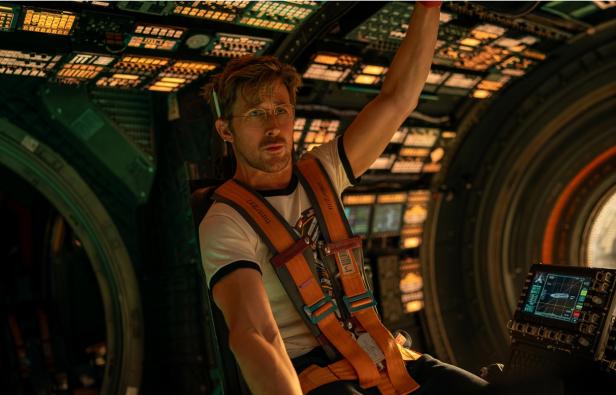
Scene from “The Astronaut – Project Hail Mary”
A magic moment in the trailer
Speaking of twist: The fact that trailers are now too long and reveal too much of the film can unfortunately be seen in its purest form with “The Astronaut”. If you want to look at it optimistically, it at least makes it easier to avoid spoilers in reviews like this one. Yes, as you can see in the preview clip, Ryland Grace has an incredibly touching encounter of the third kind in the course of his space adventure. As a reader, this completely pulled the ground from under your (perhaps weightless) feet. Up until this point, “The Astronaut” was, like “The Martian,” a rather down-to-earth sci-fi film.
Without revealing too much about the alien, which Ryland and the audience quickly grow fond of: those familiar with the original may have reacted with some concern to the announcement that “The Astronaut” would be made into a film. Would the screen adaptation even begin to adequately portray the two’s endearing and life-affirming intergalactic bromance?
Skeptics can be reassured on this and another point. The interaction between the two dissimilar main characters is also the highlight in the film. The overarching message that Weir was aiming for with “The Martian”, although not subtle but quite charming, also comes across. While all the nations on earth worked together to get Mark Watney alive from Mars, two completely different life forms in the universe are now pulling together to save it. Luckily, they have more than four arms at their disposal.
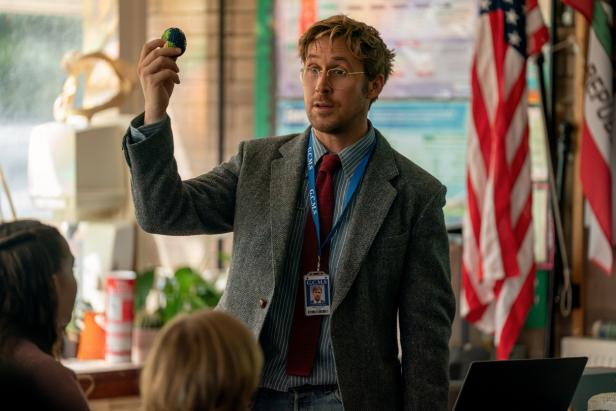
Scene from “The Astronaut – Project Hail Mary”
Show stealer Sandra, too much humor and too handsome Ryan?
In addition to the special effects department, the fact that this succeeds is of course primarily due to the main actor Ryan Gosling. Did book readers have the pretty boy in mind when they followed the heroic journey of the nerdy molecular biologist Ryland Grace? Certainly not. If anything, it’s Gosling’s basic star power that sometimes distracts from the actual action and takes away the immersion. A slightly less well-known, less present actor might have suited the material better. But Gosling doesn’t have to be vilified as being wrongly cast.
However, there is also perfect casting to marvel at: Sandra Hülser is able to steal almost every scene in which she appears. As Eva Stratt, she is wonderfully pragmatic, never unsympathetic and with subtle mischief in her approach to saving all life. By the way, she provides one of the most emotional moments in the film, in which, after “Toni Erdmann”, she can once again prove how expressively she can sing. Allegedly, Gosling personally advocated for Hülser to grab the karaoke microphone in one of the flashbacks and, in a mix of melancholy and optimism, Harry Styles’ (32) “Sign of the Times” sings. If that’s really true, then: Thanks, Ryan!
What initially caused discomfort when looking at the director’s chair turns out to be true. Weir doesn’t skimp on humor in his book either, but he generally uses it as an outlet for his main characters to deal with hopeless situations. The directing duo Phil Lord and Chris Miller (“21 Jump Street”, “The Lego Movie”) overdo it too much with the slapstick controls. Too often, deeply emotional scenes are opened up unnecessarily in the main plot as well as in the flashbacks. Since the Marvel strips and new “Star Wars” films, this seems to have become a real reflex of the dream factory, which will hopefully soon be a thing of the cinema past.
Conclusion:
Is the thumb pointing up or down on “The Astronaut”? Like its two dissimilar main protagonists, some viewers will probably disagree about this. The plan to implement it true to the original is actually exemplary, but the film sometimes seems very rushed due to the abundance of events in the book.
Nevertheless, the adaptation by the directing duo Phil Lord and Chris Miller, which is sometimes too humorous, manages to convey to the cinema audience the simple and hopeful message of the original, which is unfortunately so difficult to translate into reality: If we manage to look beyond our own horizons and differences and pull together, we can save the world – no, worlds. If even a human meatbag and a rocky alien can do it, why can’t we do it among ourselves?
4 out of 5 weightless karaoke mics