
“The Day He Arrives” is the title of a 2011 film directed by South Korean filmmaker Hong Sang-Soo. As is often the case, this one tells the story of a film director. Albeit from someone who no longer makes films. In three variations on the same evening, he instead does what men do in Hong's films: sit in restaurants and bars, talk about love, life and art, drink a lot of alcohol and approach women – usually in vain, see: “drink a lot of alcohol”.
The title of Hong's latest film – in fact the twenty-third that the prolific filmmaker has completed in the decade and a half since – now feels like a variation on his earlier masterpiece, as melancholic as it is funny and elegant. That it is in “The Day She Returns” is about a return and not an arrival, a shift is more of a cosmetic nature – because basically almost all the protagonists in Hong's films are returnees. Often failures, whose once promising or dream-dance career only tries to maintain a miserable appearance in the soy-pregnant grand speech. Artist-actors who return to their old home because no one there has yet noticed that their intellectual glamor has long since congealed into a pose is.
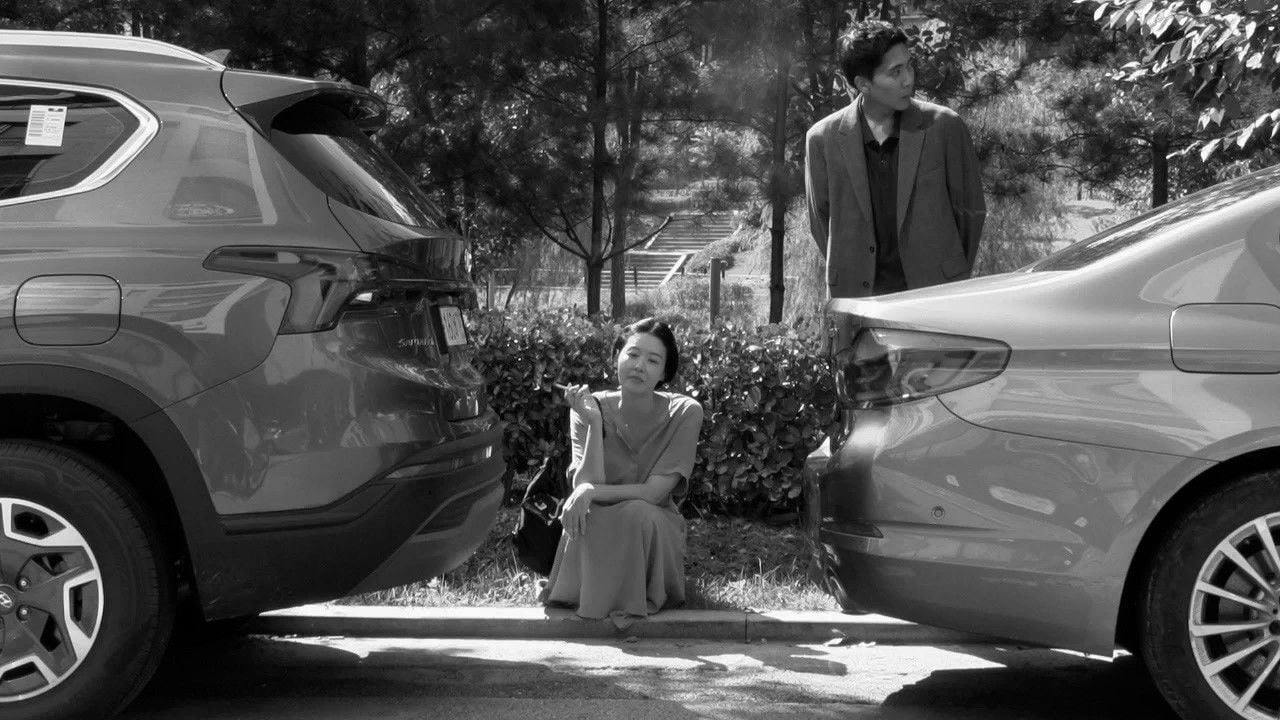
After completing each interview, the nameless protagonist (Song Seon-mi) treats herself to a drag of her (e-)cigarette.
In “The Day She Returns,” however, we are dealing with a protagonist – an actress (played by Hong regular Song Seon-mi) who has taken on a role again for the first time after a twelve-year career break and a divorce from her daughter’s father. In an independent film. Why not? We meet this nameless actress at a press event in a German restaurant. Here she is interviewed by three younger female journalists in three consecutive, numbered episodes.
Hong once again uses the stylistic device of repetition and variation that is omnipresent in his work. Running gags arise when the overly stereotypical final question is answered with the same platitude in every interview. And yet, every conversation develops its own dynamic, which allows the protagonist to reliably fall outside the framework set by the formal situation in her own individual way. She actually already knew after the first interview: Maybe I said too much.
The drinks become softer, the topics become heavier
After all, the first journalist has just rejected the offer – which has also become a running joke – that we could drink a beer together in a very informal way. Much to the displeasure of her interlocutor, even if, as always with Hong, she tries not to let anything show, with not entirely perfect politeness. She keeps commenting that the German beer that is available on tap on site is excellent, and the second and third reporters are happy to be convinced.
Alcohol has always played a prominent role in Hong's cinema, as a tongue loosener that causes every carefully maintained facade to collapse when he is completely intoxicated. For decades and several films, it was the Korean spirit soju that all of Hong's protagonists consumed in considerable quantities. Since a few films, however, they have become significantly more diverse in their drinking behavior – and also softer: from hard stuff to beer or the beer-like rice drink Makgeolli. In “The Day She Returns” it’s the good old Munich Hofbräu beer, but the protagonist also has to hold back – because of the good figure she needs for a comeback. But health reasons also play a role, as Hong often approaches the difficult topics of illness, death and the inexorable loss of vision in his recent films.
Actually, the talkative protagonist would like to continue drinking every day, just like she used to, as she reveals to one of her interviewers. If she didn't have her daughter, she would probably be an alcoholic, and she would often prefer to sit in a corner, drink quietly to herself all evening and not talk to anyone.
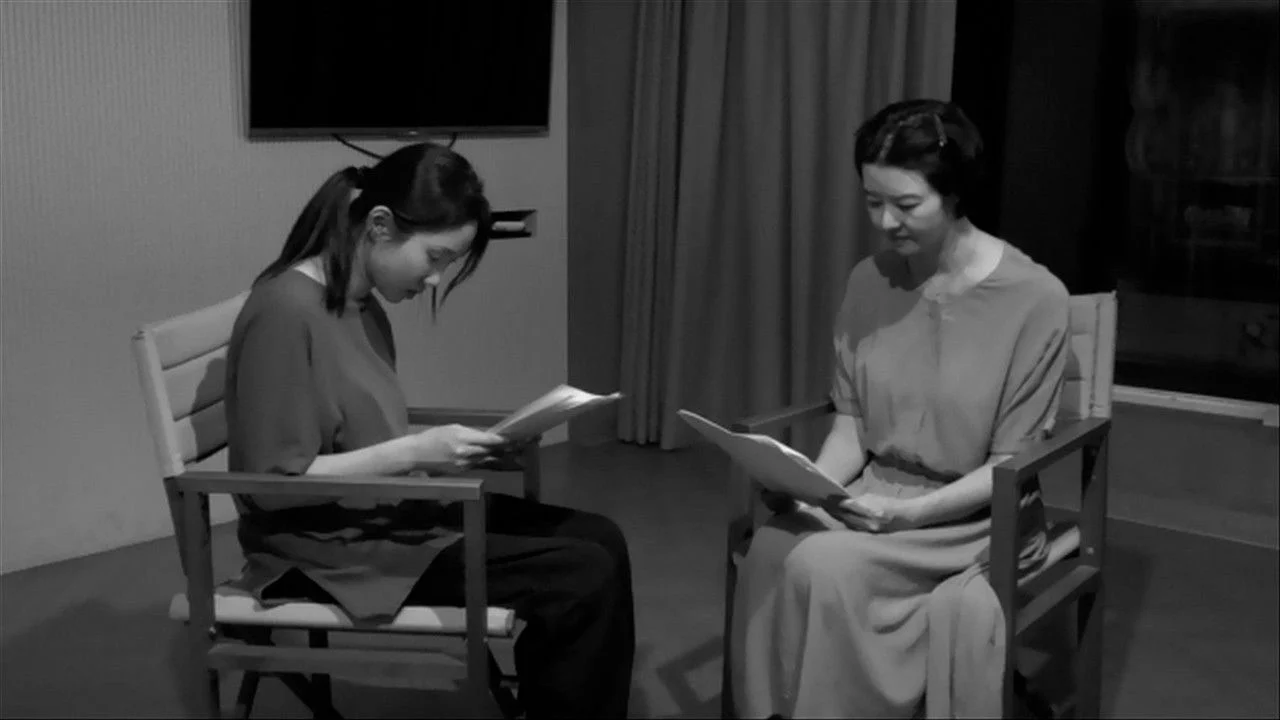
At the end, the actress in the center should repeat the various interview situations again as an exercise.
In each of the three conversations there are moments where something breaks out of the protagonist that she would actually rather not tell. About her divorce, about the alcohol, about the fact that she basically can't stand most people. She withdraws the latter; after all, what are authorized interviews for? And at the end, Hong gives the whole experimental arrangement of appearance and reality, variation and repetition an extra twist when he sends his protagonist to drama school, where he has her write down what she just experienced – or the version that she remembers of it – in a script for a small play scene and have him act it out with another student.
The result is again: repetition and variation, sometimes remembered, sometimes embellished, sometimes completely recreated, and the scene that Hong constructs from this is sometimes deeply sad and all the while screamingly funny. Our memory is the script that we constantly write about ourselves, and what doesn't fit into our self-image, we simply rewrite. And really pompous nonsense only ever comes out of it when we try to wring meaning or even poetry out of all the nonsense. Because then we get stuck and get confused in the script of our own lives.
Conclusion: With “The Day She Returns” the South Korean master director Hong Sang-soo delivers another of his big, small films, both sad and melancholic and screamingly funny. Then a Hofbräu beer. On tap.
We saw “The Day She Returns” at the Berlinale 2026, where it celebrated its world premiere in the Panorama section.