
Henri-Georges Clouzot's 1953 masterpiece “Wages of Fear” proved how exciting it can be to follow a group that has to transport cargo from A to B. This motif has been taken up again and again in the cinema since then – not just in William Friedkin's remake “Breathless with Fear”. It also forms the core of films as diverse as George Miller's action highlight “Mad Max: Fury Road” or the Liam Neeson B-movie “The Ice Road”.
The experienced editor Padraic McKinley also uses this scenario in his feature film directorial debut – and does so in an impressive way. “The Weight,” which was filmed in Bavaria, combines Western and survival drama in a thoroughly captivating way. Its great highlight is an outstanding Ethan Hawke (“Training Day”), who goes from a loving father to a fighter who knows no pain, as well as a score that drives the action at the right moments.
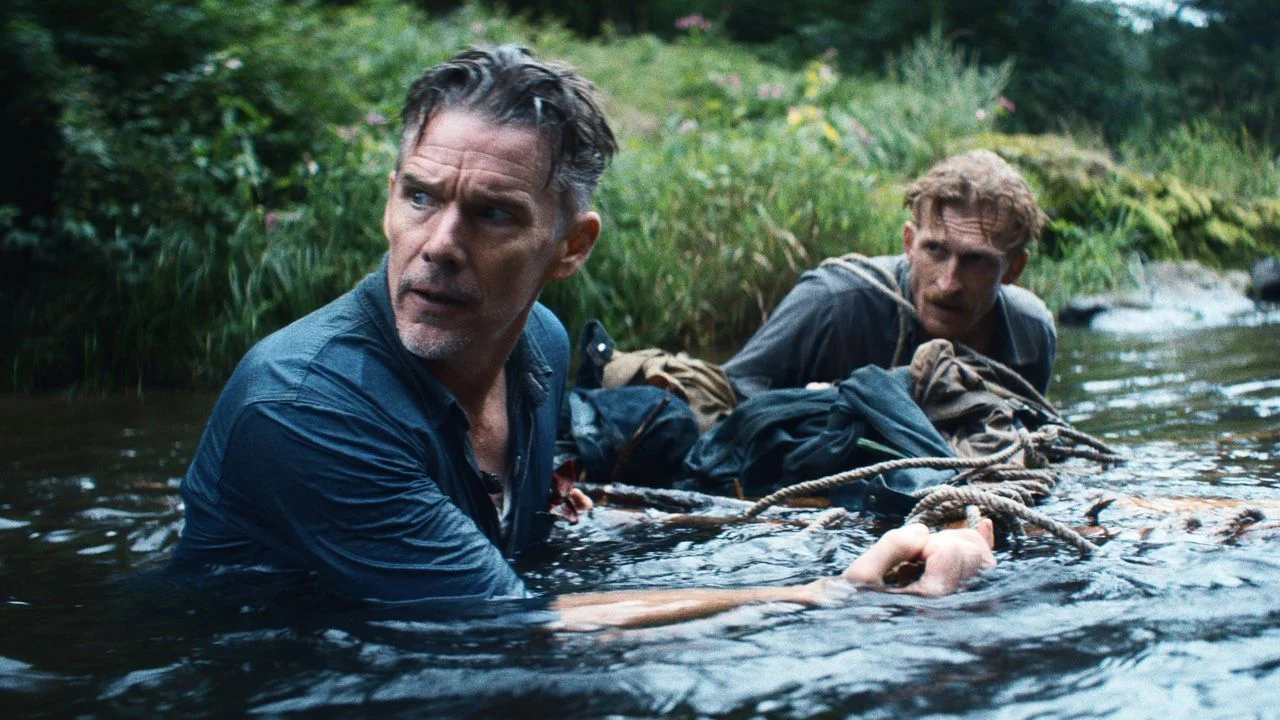
Samuel and his valuable cargo: He can't lose an ounce if he wants to see his daughter again.
In 1933, the severe economic crisis had been raging for four years. The single mechanic Samuel (Ethan Hawke) still only plays the outlaw when he races across the fields in his car. This way he can take his daughter Penny's (Avy Berry) worries away, at least for a little while. But when the two lose their apartment a short time later and are picked up by the police for a flimsy reason, Samuel is really labeled a criminal. He soon ends up in the labor camp of the strict overseer Clancy (Russell Crowe). He not only recognizes his prisoner's cleverness and many talents, but also his desperate situation. At the end of the month, Penny will be given up for adoption and Samuel will lose her forever.
So Clancy suggests a deal: Because President Roosevelt wants to confiscate all gold reserves for the state treasury in a few days, mine operator Taggert (Alec Newman) wants to quickly smuggle out a fortune. Together with three other prisoners, the arrogant chatterbox Rankin (Austin Amelio), the Indian socialist Singh (Avi Nash) and the naive farmer Olson (Lucas Lynggaard Tønnesen), Samuel is supposed to transport four backpacks full of gold through the Oregon wilderness. They are guarded by the heavily armed Yanks (Sam Hazeldine) and Letender (George Burgess). The indigenous Anna (Julia Jones), who fled the mining camp, also forces herself on them as a companion. Samuel is determined to deliver every gram of precious metal to its destination in exchange for the immediate and complete remission of his sentence. But is this the case for everyone in the group?
A bit of a long start, but worth it!
“The Weight” takes a little while until the real highlight – the exciting trip through the wilderness – begins. And even if the first third could use minor cuts, the preparation is worth it. The warm relationship between father and daughter provides both a contrast and the necessary foundation for Samuel's later transformation. When he goes beyond all limits to reach his goal, you understand why he is taking on this suffering. The scenes in the prison camp ensure that Rankin, Singh and Olson also become flesh-and-blood characters whose fate we don't care about. Above all, of course, they give the once again great “Gladiator” legend Russell Crowe the opportunity to show in just a few scenes that he enriches every film with his presence.
When the gold transport begins, “The Weight” reveals its full quality. The secret departure from the mine at night is already an exciting sequence, followed by numerous others. First of all, Matthew Booi and Shelby Gaines' effective script places expected obstacles in the way. A dilapidated suspension bridge has to be crossed just like a raging river. However, both scenarios are given a twist that sets them apart from comparable scenes. Of course, the Oregon wilderness, which is excellently surrounded by the Bavarian Forest, is not the only danger; you also encounter shady characters who could keep an eye on the valuable cargo. The fact that Samuel and Co. are not allowed to lose a single gold bar on their risky hike in order to get their sentences remitted provides additional intensity.
Paranoia in the tour group
Of course, it becomes obvious early on that the real danger is the group itself. Does Anna secretly collect poisonous plants? Did Rankin actually try to drown Samuel during a rescue mission? Is Singh, who preaches a fairer distribution of wealth, really willing to make rich racists even richer? Even if a few good and bad roles are clearly assigned, expectations are repeatedly undermined here. This ensures that the film, which is very straightforward in a positive sense, remains highly exciting with several strongly staged, short action sequences and that the second half in particular is almost always nerve-wracking.
The fact that you can rarely take a breather here is due not least to the score by the brothers Latham and Shelby Gaines. Ethan Hawke brought the artists, known for their sound sculptures made from a wide variety of materials, on board an off-Broadway theater production in 2010 because they always bring the unexpected out of sounds. They also contribute exactly this quality to “The Weight”. Instead of a classic orchestral score, they often only let individual instruments, for example an echoing electric guitar, break the silence. Each of these precise moments immediately triggers unrest and additional tension – also because sometimes it doesn't sound like music at all, but more like noise.
Conclusion: “The Weight” is a gripping survival drama and a highly exciting thriller in which well-known genre motifs are enhanced by a physically noticeable production, a brilliant Ethan Hawke and an unconventional score.
We saw “The Weight” at the Berlinale 2026, where it celebrated its European premiere in the Berlinale Special Gala series.