
She is said to have tortured and cruelly killed between three dozen and several hundred women – the reported numbers vary considerably. She then bathed in its blood, which she said had a rejuvenating effect. This is what you need to know about Erzsébet Báthory, known as “The Blood Countess,” before you watch Ulrike Ottinger's film of the same name – because the director doesn't give the audience much context for her first non-documentary film in 36 years. So it's not a text panel listing key historical data that introduces us to the protagonist, well, yes, played by Isabelle Huppert, but rather an image.
In the first shot of the film, a small boat drifts silently through an underground body of water. Erzsébet Báthory sits enthroned at the bow like a figurehead – a mythical presence. Her pompous dress, the coffin that partially encloses her, the watercraft itself – everything blends seamlessly into one another in the same blood red, so that it is difficult to discern any dividing lines between Huppert's body and the material surrounding her. It is a reversal of the journey into the realm of the dead: the Hungarian noblewoman who died in 1614 returns – as she does every 25 years – to the present as a vampire.
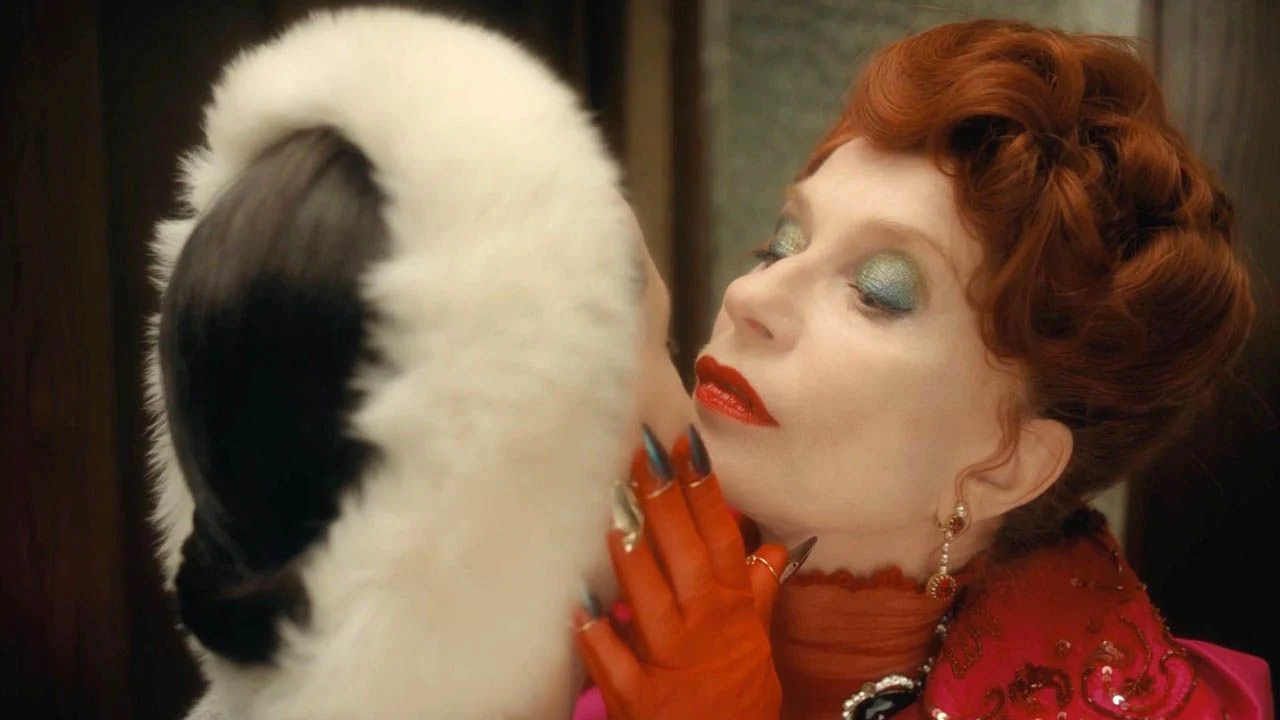
Countess Erzsébet Báthory (Isabelle Huppert) has returned from the realm of the dead – and is hungry for blood!
Together with her maid Hermine (Birgit Minichmayr), Erzsébet Báthory (Isabelle Huppert) searches Vienna for a mysterious book that has the power to erase all evil from the earth – and thus destroy the vampire kingdom once and for all. But Báthory's nephew, Baron Rudi Bubi von Strudl zur Buchtelau (Thomas Schubert), is also after the artifact – albeit for completely opposite reasons: He is a vegetarian and for this reason strictly rejects all vampiric activities. Meanwhile, in the wake of the sudden increase in bloody murders, Inspector Unbelief (Karl Markovics) and his assistant are hot on their heels, while the vampirologists Theobastus Bombastus (André Jung) and Nepomuk Nachbiss (Marco Lorenzini) as “masters of the uncertain sciences” primarily pursue theoretical interests.
Completely free cinema
The opening described at the beginning is programmatic for the film: another boat soon appears behind the boat. It is an excursion boat with a group of motley tourists who, as part of a guided tour, learn that they are in the Seegrotte Hinterbrühl, the largest underground lake in Europe. Just as Ottinger's version (or rather: fantasy) of Báthory combines several centuries, the past and present coexist quite naturally in the film – often in a single image.
As a place where history can be seen and experienced almost everywhere, Vienna is the real hub of this “scavenger hunt in three-quarter time” (as the additional title says). However, the film does not present the city as an open-air museum, but rather as a playful space of possibilities and a baroque chamber of curiosities. While Ulrike Ottinger's previous feature films often felt more like academic exercises (“Portrait of a Drinker”) or filmed performance theater (“Freak Orlando”), “The Blood Countess”, whose script she wrote together with Nobel Prize winner for Literature Elfriede Jelinek (“The Piano Player”), comes out with something completely different: completely free cinema, exuberant in terms of content and form, but above all almost entirely ridiculously funny.
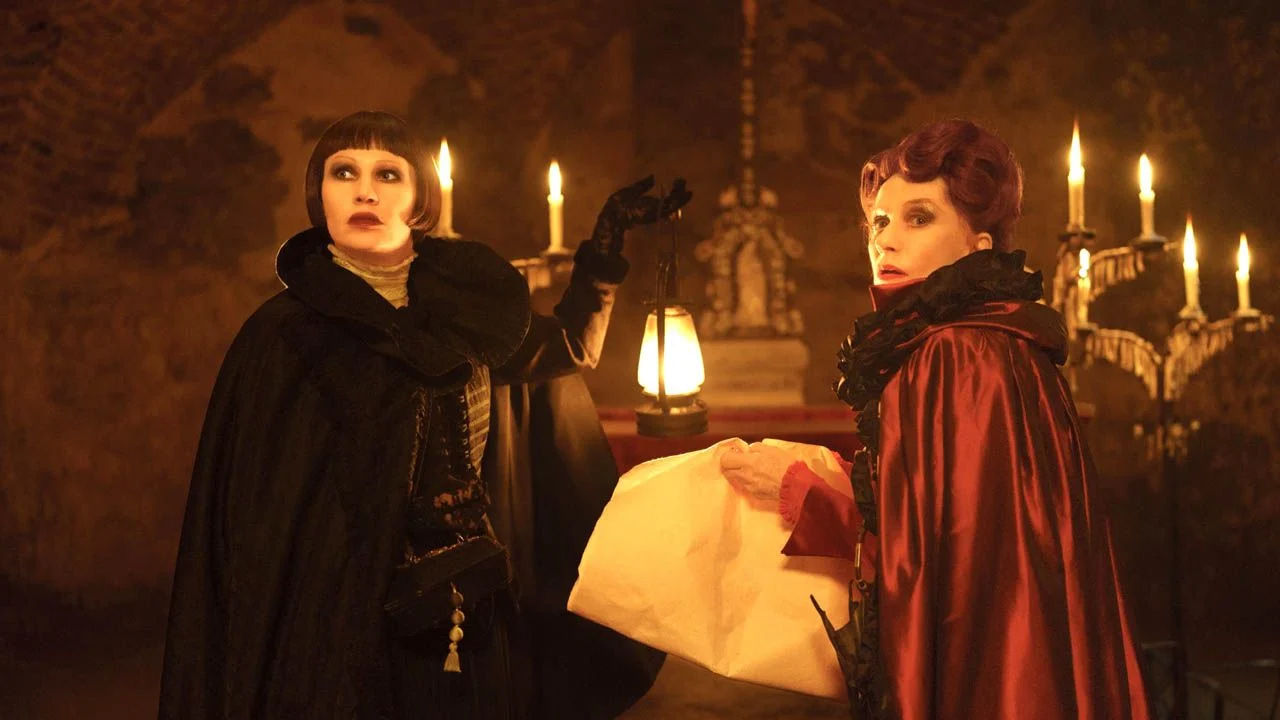
Erzsébet Báthory and her maid Hermine (Birgit Minichmayr) are desperately looking for a powerful book.
“The Blood Countess” is chock-full of references to cultural and intellectual history – for example to the Swiss doctor and alchemist Paracelsus (whose real name was Theophrastus Bombastus Von Hohenheim) or the philosopher Walter Benjamin (the vampirologists are working on an essay called “Vampires and their identity in the age of virtual reproducibility”). At the same time, however, the film is characterized by a great love of silliness: the humor is based on specifically Viennese idioms, but it doesn't shy away from jokes – and most of the members of the ensemble practice amusing acting, analogous to their role names, which are pronounced with visible enjoyment. Significantly, it is Lars Eidinger, who normally doesn't shy away from the opportunity to play the center stage as a transgressive star, who gives the film a touch of down-to-earthness as therapist Theobald Tandem.
The French film legend Huppert plays along with the joke, endowing Erzsébet Báthory with her own enigmatic aura, while at the same time smugly ironizing her iconic status (and that of her character). Ottinger doesn't say that there are significant doubts about the violent myth surrounding the “Blood Countess” – but who would really trust this miraculous revenant, who lets a CGI bat named Pipi (short for Pipistrello) carry out errands and fly it into the camera several times, as if we were in Dario Argento's “Dracula 3D”, with such a level of bestiality?
Conchita Wurst is also there
The film was shot almost exclusively at original locations in Vienna – including the Narrenturm, the Strudlhofstiege, the National Library, the Café Havelka (where the best Buchteln is served – “a real comforter”) and numerous catacombs and crypts. In this way, a cinematic cartography of the Austrian capital is created, which appears as an enchanted, morbid threshold place where anything can happen at any time – ESC winner Conchita Wurst also stops by several times to lead the way through a clandestine vampire ball as master of ceremonies and to make a furious surprise appearance in the presence of, among others, Field Marshal Radetzky.
“The Blood Countess” finds its very own form in the intermediate area of wild camp, decidedly funny genre pastiche, intellectual play, alternative city archive and urban exploration. And when at the end all the threads come together on the Prater and a midnight dinner takes place in a gondola on the Ferris wheel, Ottinger even takes her cinema back to its roots as a fairground attraction and illusion machine.
Conclusion: After being in development for almost 30 years, “The Blood Countess” is now possibly director Ulrike Ottinger’s best feature film – and definitely the funniest.
We saw “The Blood Countess” at the Berlinale 2026, where it celebrated its world premiere in the Berlinale Special Gala series.