
The fact that Anthony Chen ends his drama “We Are All Strangers” with, of all things, Yusuf Islam’s classic “Father And Son” may seem a little cheesy at first, but it is nonetheless a beautifully fitting conclusion. At the same time, the generational dialogue sung by the folk rocker in two voices is somewhat contradictory to what has just been seen. Because where the son in the song wants to go his own way, in the finale of the “Growing Up” trilogy, which was created by chance, the offspring has made themselves comfortable with their caring father. “Just Relax, Take It Easy” is not the parental advice here, but rather the junior’s attitude to life. Only circumstances force the son in the film to go his own way and grow up.
Today “Father And Son” is known as an intimate ballad, but the song was actually written for a gigantic musical project. “We Are All Strangers” will also be remembered primarily as an intimate story about four fates that form a family of convenience. At the same time, the film also takes on epic dimensions; more than 100 actors appear in the credits, there are at least 50 different locations – and the twist-filled story spans years. Along the way, Chen also talks about the changes in his home country of Singapore and the associated social upheavals. But he never loses sight of his main characters. He accompanies them with a lot of heart and, despite some blows of fate, maintains a constant optimism, which he symbolizes right at the beginning with a smiley next to the film title.
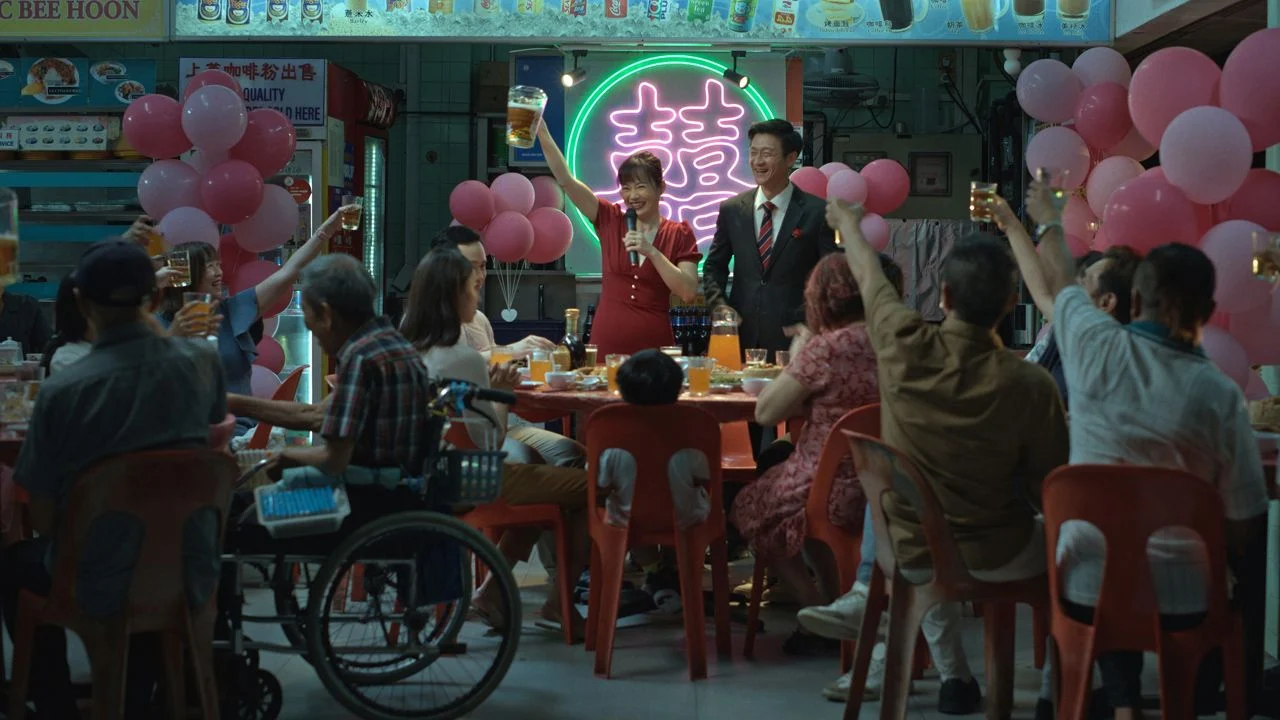
A moment of happiness: The wedding is celebrated in style with the regular guests in the snack bar.
School dropout Junyang (Koh Jia Ler) lives his day carefree. He can always rely on his father, Boon Kiat (Andi Lim), to watch his back and, if necessary, pay the cell phone bill or the traffic ticket. The father barely makes ends meet as the operator of a snack restaurant, but has been reluctant to raise prices for his remaining regular customers for years. Instead, he sometimes gives out a meal for free. Perhaps the upcoming military service will help the junior grow up. But there is another piece of news that shakes Junyang's carefree life. His girlfriend Lydia (Regene Lim), who is about to graduate from high school and receive a possible music scholarship, is pregnant.
Her strict Catholic mother insists on an immediate wedding. As befits the situation, it's in a 5-star hotel with at least 20 tables, which Boon Kiat can't actually afford. Especially since he himself has just proposed to the also penniless beer seller Bee Hwa (Yeo Yann Yann). So you suddenly live as a quartet and finally even as a quintet in the apartment that is far too small, which always offers an unobstructed view of the skyline of a metropolis in which new high-rise buildings full of luxury apartments are constantly being built…
A young man and a 50-year-old state grow up together
When Anthony Chen was looking for an eleven-year-old boy for his 2013 Cannes-winning debut “Ilo Ilo,” he looked through thousands of children before he finally came across Koh Jia Ler. When he needed a 16-year-old protagonist for his second feature film “Wet Season” around six years later, he said he despaired in the casting process – until he saw a picture of his former discovery while scrolling through Instagram and simply cast him again. In the third joint project, Koh Jia Ler was involved from the beginning. When he told his director that he had dropped out of school, Chen quickly incorporated his own worries about his protégé's decision into the script for “We Are All Strangers”.
Even if the films have no contextual connection, the director himself considers them a trilogy. The works, in which Malaysian-born Yann Yann Yeo (“Havoc”) plays another leading role, document not only the growing up of Koh Jia Ler, but also the coming of age of the island metropolis of Singapore. In “We Are All Strangers” we learn again and again how difficult it is for everyone to find affordable housing. At the same time, luxury accommodation is being sold as a third or fourth home to very rich foreigners for absurd prices – preferably in cash. The local population is left behind – or they have to act with grandstanding and fake Rolexes as if they themselves were part of this new turbo-capitalist society.

Your own apartment may be small and sparse, but the view is wonderful.
Real locations with their real sounds and the people who are sometimes actually there form the background for “We Are All Strangers”. Not only does this ensure that Chen's works can be looked back on again and again in the future if you want to know what Singapore was like at a certain time. The associated authenticity also affects the actual drama. Here too, the filmmaker is primarily an observer and companion. Of course, he specifically uses the pregnancy, an illness or money problems to give the plot a new direction. But this never feels like another forced script twist, but always like a natural development and challenge.
The focus is not on being excited about whether even better times lie ahead for this unusual family, which is only gradually growing together. Rather, what you are particularly happy about is how they approach their lives with optimism. The best moment of the film is Boon Kiat and Bee Hwa's first date. They had agreed to meet at a stop, but when she wanted to know where they were going on the bus, there was no destination. Boon Kiat can't afford more than the fare anyway and at least the bus is air-conditioned. And in fact there is no need for more for this deeply romantic moment (later wonderfully mirrored) in which we simply observe, without many words, how the two of them come together – literally in the end.
Conclusion: Like the “Father And Son” used as the end credits song, “We Are All Strangers” is a little cheesy, but at the same time so beautiful that you can't get many passages out of your head. A quiet but powerful portrait of a not entirely voluntary family thrown together against the backdrop of ever-increasing social inequality in Singapore.
We saw “We Are All Strangers” at the Berlinale 2026, where it celebrated its world premiere in the official competition.