
What has to happen before someone spits on their own reflection? Geert, one of the two main characters of “Dust”, punishes himself with this gesture. Although one cannot really say whether the spitting is actually done out of self-hatred, or whether this scene is simply a test of the world's growing hatred towards one's own lying image. Meanwhile, his young chauffeur and lover splashes around naked in the pool of Geert's dreary designer house. Shortly afterwards, a bag full of shredder scraps ends up in the water, mountains of paper. This puts the entire catastrophe into one striking picture.
But always in order!
“Dust”, the new film by Anke Blondé, begins – of course – with dancing dust. In the dark, a projector shines into the camera. In front of it, the smallest pieces of fluff and particles shimmer in the light of a presentation of big dreams and promises. Blondé, who previously directed the miniseries “Juliet,” among other things, looks back to the time before the turn of the millennium in this business thriller. What is now technically commonplace and taken for granted is experiencing its first boom here in its infancy and experiments.
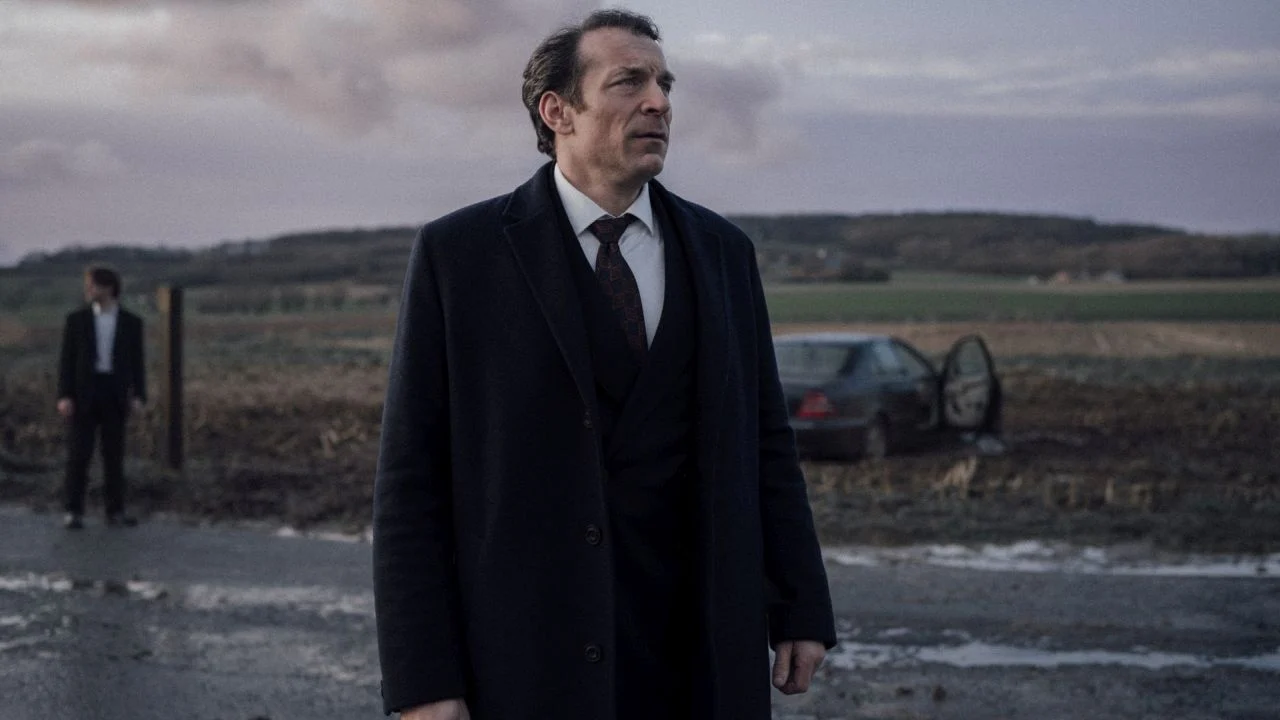
Geert (Arieh Worthalter) only has a few hours left before he will probably have to spend many years behind bars.
Geert (Arieh Worthalter) and Luc (Jan Hammenecker) do the big business of converting speech into text and vice versa. For example, you sell the dream of one day being able to simply ask your own cell phone about the weather. In Flanders, the region is to be enriched with a large research and business location with thousands of jobs. At least that was the original plan. Now, in 1999, Geert and Luc are facing ruin.
In a toilet, the entrepreneurs meet a journalist (Anthony Welsh), who has discovered their crooked dealings, including the invention of all sorts of fake companies. His disclosure report has already been completed and is scheduled to reach Wall Street a day later. So Geert and Luc have little time left to clean up the traces and prepare for the downfall of their lucrative empire…
Dreams and fears before the turn of the millennium
“Dust” is inspired by the story of the Belgian company Lernout & Hauspie. In 2001 the company went bankrupt after the two founders were arrested. The fictional film apparently sees itself as a contemporary document that captures the shadows already cast by the dawning millennium with all its hopes, failing dreams, fears for the future and dubious deals. Once Geert meets his sister, who works in a bakery. She proudly points out the new machines and the new oven. Soon, she believes, bread will be sold around the clock. At this point, the harsh economic reality is still hidden by naive hopes. Great disillusionment is already brewing in the background.
In general, Anke Blondé's production quickly makes the decay and failure noticeable. “Dust” is an atmospherically dense, initially very absorbing film, whose wavering musical background suggests a permanent threat. The images are sparse, grayish or at most submerged in sepia tones. The large shredders rattle repeatedly on the soundtrack. Mountains of files and documents are to be destroyed in order to hide their own past.
Exciting paranoia cinema
In addition, the film does a good job of making the nervousness, anxiety and hopelessness of his troubled existence become palpable at the center. The cameraman Frank van den Eeden often uses shaky, very close shots that allow little overview and perspective of the world. A ball that suddenly hits a window in a swimming pool is a shocking moment. The slightest noise is enough to make you jump in this constant state of alarm.
Final encounters with loved ones are undertaken. A few bundles of money are buried in the horse stable or passed on to relatives so that they can at least profit from the last remnants of the collapsing business model. This works as a paranoia cinema for about an hour. Unfortunately, “Dust” continues for almost an hour afterwards and this is where the whole film falls apart in such a sobering way. He then treads on the spot so much that you wonder more and more with every minute why he remains so cautious and vague in his dealings with his characters.
Superficial snapshot
It's debatable whether “Dust” is trying to arouse pity for its shady main characters. In this sense, the film can certainly be understood as a provocation. He dares to consistently confront his audience with the emotional world of fraudsters without there being any too strong contrasts in perspective. People like to get involved in this game, even if filmmakers with such questionable narrative perspectives quickly find themselves on thin discursive ice today. It would only be welcome if this would also trigger a deeper process of reflection and negotiation. In “Dust” this is largely absent on a narrative level.
“Dust” is neither particularly enlightening on the business nor the private level. The family constellations and affairs remain in the spotlight. How exactly the economic machinations are rigged scratches the surface and is basically limited to the little information provided in the exposition. The entanglements that emerge at fancy receptions, for example, the illusions that have to be created, the maintenance of the entire machinery; All of this would be very exciting material to give this film more substance. But Blondé's direction and Angelo Tijssens' script prefer to exhaust themselves in the same tortured and sad looks and scenes of despair.
“Dust” ends where things get interesting
The time of decline here is also a time of waiting and moving around. Every now and then Luc has to throw up again and again. The body can hardly cope with the guilt and failure. But why doesn't the film manage to take a closer look at the whole structure that it's supposed to be about? Why is he so satisfied in this character snapshot that is at some point very tough?
The fact that “Dust” at some point resorts to the hackneyed metaphor of the stuck car and that it ends at the very point of confrontation where the characters are just beginning to speak, think and point out things is just the height of disappointment. Two men have to live with the consequences of their actions and are still trying to straighten out the last remnants of their legacy. But the film has less and less plausible answers as to why we should endure this for so long.
Conclusion: “Dust” shows the crisis of two entrepreneurs as a doomsday scenario on the threshold of the 2000s and the emerging digital age. At first it was exciting, but it completely missed out on a closer look at its own themes. As a description of the condition, the actually highly explosive material is soberingly thin and flattened.
We saw “Dust” at the Berlinale 2026, where it celebrated its world premiere in the official competition.