
The Heysel disaster on May 29, 1985 on the sidelines of the European Cup final between Liverpool FC and Juventus Turin is considered one of the darkest moments in football history. Shortly before kick-off, there was a mass panic following riots in which 39 people died and hundreds were injured, some seriously. The responsibility was quickly placed solely on the fans. English football clubs were even banned from all international competitions for years. Only further investigation revealed that the question of guilt was significantly more complex. Violent and heavily drunk hooligans encountered a dilapidated stadium that was completely unsuitable for this game and was also overcrowded. In addition, there was a complete failure of the local authorities before and during the events themselves.
Director Teodora Ana Mihai (“Waiting For August”), who comes from the documentary genre, does not recreate the terrible events in the stands in her feature film drama “Heysel 85”. Instead, she integrates original archive footage between the fictionalized scenes, which largely take place in the stadium catacombs. From two different individual perspectives, in which a professional and a personal agenda collide, she attempts to convey the emotional impact of the tragedy. It's an interesting idea, but it fails across the board – and not just because Mihai's approach is incredibly flat and with a wooden hammer. She also does herself a huge disservice with the fictionalized, grotesquely exaggerated figure of the Brussels mayor.
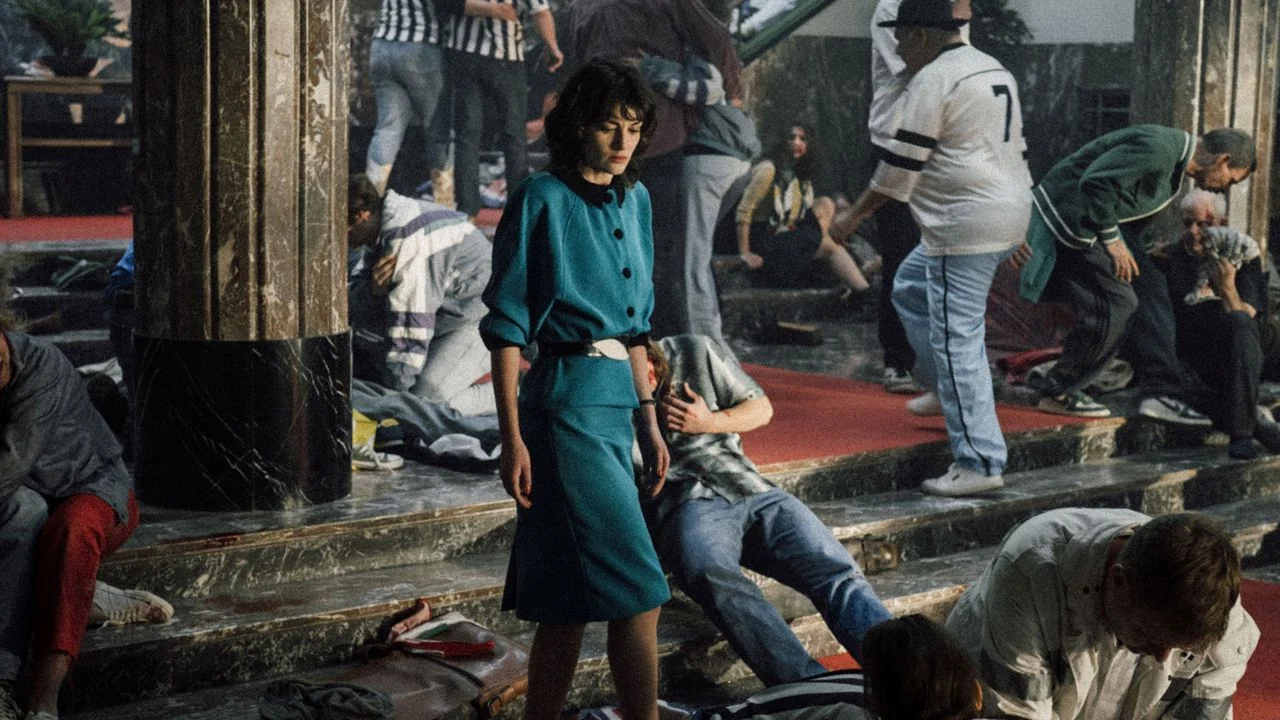
Powerless, the mayor's daughter Marie (Violet Braeckman) walks through the many seriously injured people!
In “Heysel 85” we follow the terrible events primarily through the eyes of Marie Dumont (Violet Braeckman). She is the daughter and press spokesperson of the mayor of Brussels, Marc Dumont (Josse De Pauw). She watches with excitement as her alcoholic father acts as the great host of the most important football game of the year. Later she is just as close when, after a panic, more and more seriously injured Italian fans are brought into the stadium and people even die in front of her eyes. She is also right in the middle of the most important decisions in the role of translator between the men, who are powerful but have long since become hopelessly overwhelmed and who continue to escalate the catastrophe.
Like Marie, it dawns on the Belgian-Italian journalist Luca Rossi (Matteo Simoni) early on that this football evening will not be a peaceful celebration. When the catastrophe begins, he can provide Italian radio with first-hand impressions of the dramatic events, but also pass on the survivors' messages to their families at home. At the same time he is extremely worried. His little brother, his father and his uncle were also in Block Z, which was stormed by hooligans – and there is still no trace of them…
Lots of explanation to start with
In the first 15 minutes, Teodora Ana Mihai dutifully ticks off all sorts of factors that led to the catastrophe. At the press conference, a reporter is amused by the outdated stadium. Another addresses the ignored warnings about English hooligans. The next one asks about the uncontrolled black market in counterfeit tickets. Short scenes with the police inform us that there are not enough staff and that the radio batteries are empty. In addition, Block Z is suddenly full of Italian fans, even though the area directly next to the Liverpool supporters was actually intended for a neutral audience.
You can hardly rattle off such preparatory facts in a more uninspired and trite way than “Heysel 85” does here. Instead of weaving information organically into the plot, Mihai and her co-authors Lode Desmet and Isabelle Darras repeatedly misuse the characters as mere explanatory tools for the audience. Otherwise, the main thing is apparently to lay it on as thickly as possible – as if the actual tragedy and the failure behind it weren't already terrible enough to justify a filmic treatment.
A cheap caricature bears responsibility
In the second half we follow endless circular discussions by the actual decision-makers about what to do now. Should the football game take place despite the ever-increasing number of deaths in order to calm the fans and prevent even more fatal riots? However, “Heysel 85” puts even more focus than on this moral dilemma on the fact that all the old men are once again talking over Marie when she wants to say something. She is only here to translate and not for her opinion. And in the end, her father's figure overshadows everything that happens.
At the beginning, the mayor is portrayed as a big Zampano who doesn't let anyone else speak at the press conference. He is the host of this game, he is in command. He then sends his daughter across the stadium to get the liquor cabinet key from the caretaker (from his cubby full of pictures of naked pin-ups). Really no cliché should be left out. And while people are dying miserably outside, he sits drunk in the corner with his favorite whiskey and pushes all responsibility away. The police and the football association are responsible; he has nothing to do with any of this.
At least the Germans are on the right side
With her drama, which unfolded almost in real time, Mihai was obviously not interested in processing the events. She doesn't want to get to the bottom of the question of why the real mayor Hervé Brouhon survived the drama relatively unscathed and, unlike two police chiefs and the general secretary of the Belgian Football Association, did not have to face court afterwards. She doesn't want to argue that it was less the black market than a corrupt UEFA official who brought the Italian fans into Block Z. By placing so much focus on an incompetent and drunken official, she instead distributes responsibility to a fictionalized caricature. This is a betrayal of the dead.
The actual strengths don't help much anymore. Old TV recordings and private videos are effectively integrated. The film's events are visually staged in such a way that the images could have come from the 1980s. There are always effective moments – for example when the Italian radio presenter no longer reports anything, but only recites the barely legible notes from survivors to their families back home. At the same time, it is not only the character of the mayor who has already been criticized that borders on a parody. If ZDF is the only European broadcaster to decide not to broadcast the football game that is actually still taking place, this will not be left as a statement. Instead, it is garnished with a (meant to be funny???) saying that as a German you are finally on the right side.
Conclusion: A cinematic derailment. Despite the effective use of archive footage, “Heysel 85” fails due to its grotesque exaggeration and a script that does not process the historical tragedy but instead exploits it with a mallet for maximum effect.
We saw “Heysel 85” at the Berlinale 2026, where it celebrated its world premiere in the Berlinale Special section.