
In Chinese philosophy, the term “Dao” describes the path that every person takes throughout their existence on earth. And it is of course no coincidence that the French-born director Alain Gomis (“Félicité”), whose parents came from West Africa, chose this term as the title for his new film. He deliberately uses the associated image of a circular movement without beginning or end as a starting point for a three-hour meditation on the relationship between those who emigrated to France and those who remained in their African homeland.
It's also about generational and gender relations, the traces and wounds of colonialism and certainly a whole lot more. “Dao” may be a fictional film, but Gomis also plays with documentary meta-approaches in an unusual way. So the meandering film develops into a cinematic experiment that is sometimes overwhelmingly exuberant, but nonetheless always exciting.
What it's (superficially) about
The “plot” plays only a minor role in “Dao”: Two years after her father’s death, Gloria (Katy Correa), who was born in France, travels to the West African country of Guinea-Bissau to take part in a traditional ceremony in honor of the deceased together with numerous relatives in her father’s home village. She is accompanied by her daughter Nour (D'Johé Kouadio), who travels to Africa for the first time and follows in the footsteps of her ancestors.
Some time later (but edited parallel to the scenes in Africa) Nour gets married. It is the occasion for an exuberant celebration that takes place on a luxurious farm outside of Paris. Both events bring relatives and friends together, people drink and dance, argue and settle, and life takes its course…
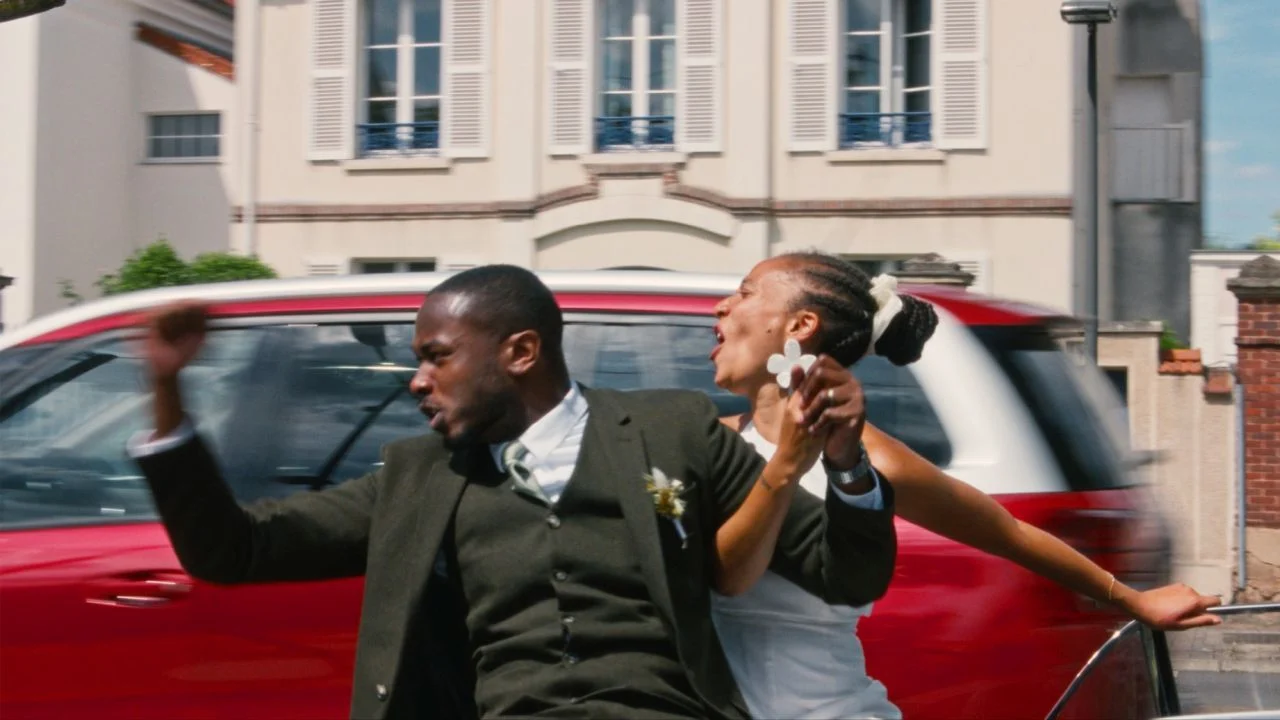
Nour (D'Johé Kouadio) is an overjoyed bride.
However, the second (meta) level is much more important: the first scenes of “Dao” take place, in a way, before the start of the actual film. These are casting moments in which the actors who will later be cast speak directly into the camera. They talk about themselves, their roots and their wishes and hopes for the film project. Two women slowly come to the fore. At some point they no longer seem to speak as themselves, but have slipped into their roles. Alain Gomis will return to the casting room a few times, where black or Arab people will talk about their experiences with everyday racism or their relationship with their parents.
After this unusual beginning, it is clear that what follows is a feature film, but it draws much more directly from reality than is the case with most fictional material anyway. Even though Gomis had a loose script construct in mind, which, among other things, was based on the death of his own father, the film was primarily made in rehearsals and during filming. Actors included their own experiences as second or third generation Black French people. In this way, “Dao” becomes a documentary-like portrait of two worlds that have more to do with each other than even many of those involved initially want to admit.
The tension between fiction and documentation
The loose plot repeatedly jumps back and forth between the two celebrations – and thus between Africa and Europe, between a traditional village and the sophisticated court with the celebrating community in luxury brand outfits. At first, Gomis seems to be concerned with the differences between those who stayed in Africa and those who made it to France. However, it gradually becomes apparent that the discrepancies may not be as big as they initially seemed. At some point, here and there, the young men clash, while in the end it is the woman's role to take care of the household and children. And here as there, it is the rituals that bring the community together and hold it together, especially in the extensive dance and celebration scenes.
Only in a few moments does Gomis abandon his documentary approach and stage conventional-seeming dialogue scenes, which then seem a bit stiff. Gomis has set out to do a bit much in his sixth film and tries to touch on slavery and colonialism in short, but nevertheless carefully inserted passages. In its best moments, however, “Dao” manages to tell the story of the relationship between Europe and Africa in a powerful way – and to indicate how much the traces of life in the old homeland also determine life in the new one.
Conclusion: In a playful and complex way, Alain Gomis combines a documentary approach with fictional scenes in which second and third generation French emigrants from Africa are confronted with the legacy of their ancestors. A sometimes exuberant film, but full of ideas and rousing scenes of partying and dancing, which conjures up a feeling of community that even seems to reach across the ocean between the old and new home.
We saw “Dao” at the Berlinale 2026, where it celebrated its world premiere in the official competition.