
For more than a decade, Dara Van Dusen had the idea of making a film of Stewart O'Nan's novel “A Prayer For The Dying”, published in 1999. The Corona crisis may have played a part in the director finally being able to realize the western drama set in 1870. After all, we have all experienced firsthand how a pandemic can shake and test a society. O'Nan also used a real crisis as a template for his novel: In the 1990s, a diphtheria epidemic led to the collapse of social order in the small town of Black River Falls – including several murders.
Both the novel and the film adaptation are less interested in this disintegration of a community than in the guilt-ridden main character, who struggles more and more with his faith in God in the face of constant blows of fate. The original novel is written in the rare first-person form. Readers are addressed directly and thus become part of the protagonist's decisions: “You did this,” it says when he has to make a difficult decision. However, Dara Van Dusen does not manage to find a cinematic equivalent for these stylistic devices. So for a long time – also because of the lack of an interesting opponent – we remain impassive observers of a boring inner struggle. Only at the end does that change…
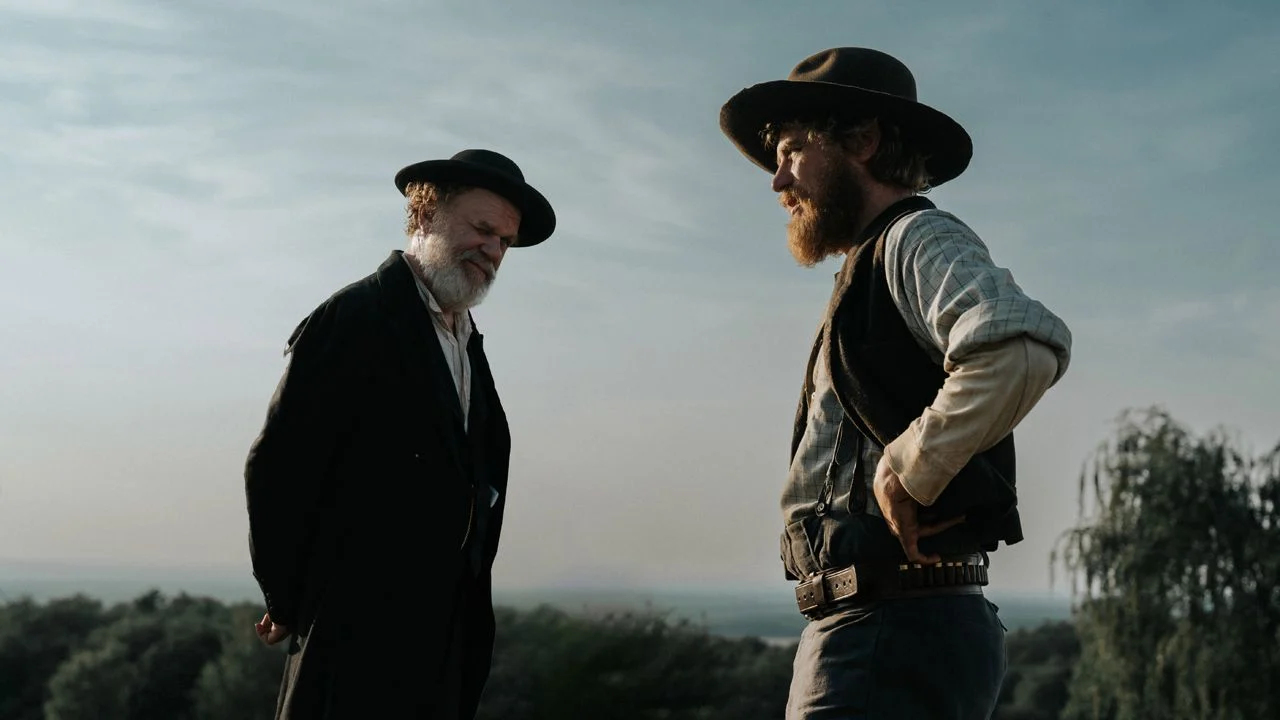
Jacob (Johnny Flynn) and the Doc (John C. Reilly) are faced with an almost impossible task.
Wisconsin in 1870: Jacob (Johnny Flynn) tries to forget his past as a Civil War soldier by serving the small town of Friendship instead. As sheriff, priest and, if necessary, undertaker all in one, he has built a new life for himself with his wife Marta (Kristine Kujath Thorp) and a small baby. He feels responsible for the place and all of its residents – even for a suspiciously viewed cult community that lives in the forest. Jacob is determined to always do the right thing for everyone. But it's not that easy when the body of a man unknown in the city is found.
After the examination, the local doctor (John C. Reilly) is convinced that something worse is on the way. In addition to a drought that has been plaguing the area for some time, there is a threat of a diphtheria epidemic. Isolation is necessary in order not to infect the neighboring communities – but an official quarantine could lead to a panicked escape and thus achieve exactly the opposite. So how do you act? With the next catastrophe looming on the horizon with a massive forest fire, Jacob must realize that every decision he makes is just a choice between two evils…
A film of many ideas
The director Dara Van Dusen, who was born in New York, trained at film school in Poland, but has lived and worked in Norway for many years, was only able to realize her feature film debut after a long struggle. This was possible thanks to the support of numerous production companies and film funding funds from half of Europe – including a shoot in Slovakia, which is a cost-effective counterpart to the American West. We don't know who among the numerous donors actually wanted to have an active say in the end, but for a long time “A Prayer Of The Dying” feels as if one or two ideas were dutifully included here and there.
Sometimes scenes are randomly lined up that have no real connection to each other. What happens in the mini-town, which is probably only illustrated with a handful of houses for budgetary reasons, is incredibly brittle. The conflicts have been going on for a long time. Despite being cast with John C. Reilly as the character, the doctor, who never achieves the necessary balance for Jacob and rather remains completely insignificant, doesn't want to impose a quarantine – then that's just how it is. The other residents seem to just plod along through their existence anyway. “A Prayer For The Dying” is incredibly slow at times because so much is actually happening, but everything is staged in such a distant, dry manner, as if it were nobody's business.
An elephant in the Wild West
The big drama is currently taking place in Jacob's house. Yet Van Dusen barely lets us feel the conflict of a man who harms his own family because he believes he is doing the right thing for the larger community. It always continues with a quick step and a new scenario.
In a bizarre scene, a circus even stops by. Like Jacob's visions, which were inserted somewhat randomly at the beginning and which refer to a war deed by the ex-soldier – which, in contrast to the original, is unresolved – this is at least one of the more interesting breaks that lightens up the otherwise rather dry work. The camera suddenly pans wildly through the traveling crowd, including an artificial elephant – and even briefly evokes associations with a horror film.
At least the (cheap) apocalypse is exciting!
The director really goes all out – apart from a few blatantly violent moments when staging the progression of diphtheria, especially with Jacob's daughter – but only at the end. We have long since understood that, despite his biblical name, Jacob is not the one protected by God, but rather a revenant of Job – this was unnecessarily spelled out in one of the many flat dialogues. Van Dusen stages the final realization of the protagonist, who is plagued with suffering after suffering, as a wild, apocalyptic fever dream that completely unhinges the previous image design.
It doesn't hurt that in the run-up to this finale, people go up in rather cheap-looking CGI flames and a huge locomotive that looks a bit like a papier-mâché construct plays a central role. The artificiality, which is certainly due to the low budget, actually increases the fascination of a film that finally slides to an urgently needed surreal level. Instead of banal moral platitudes, what follows is an exciting examination of guilt and faith. But unfortunately “A Prayer For The Dying” is already over at that moment.
Conclusion: “A Prayer For The Dying” is an ambitious western drama whose power is largely hidden under a brittle, distant production. Only in the surreal, apocalyptic finale does director Dara Van Dusen find a gripping visual language – but unfortunately that comes too late.
We saw “A Prayer For The Dying” at the Berlinale 2026, where it celebrated its world premiere in the Perspectives series.