
On June 25, 1961, a piece of music history was written at the Village Vanguard jazz club in New York. The perfectly harmonizing Bill Evans Trio performed here in the afternoon and evening – and unleashed a downright hypnotic atmosphere with their intuitive, extremely smooth interplay. Between Bill Evans on the piano, Scott La Faro on the double bass and Paul Motian on the drums, who glided virtuosically over the keys, the musical chemistry was just right – something that can still be heard today. The gig resulted in two live recordings, “Sunday At The Village Vanguard” and “Waltz For Debby”, which are still among the best jazz albums ever. The legendary performance marks both the high point and the end of a jazz formation that understands itself musically blindly.
On July 7, 1961, Scott LaFaro died in a car accident – plunging the eccentric Bill Evans into a crisis. He disappeared from the scene for several months until rumors of his death finally started circulating. Through a photo by Lee Friedlander from 1962, the British documentary filmmaker Grant Gee (“Innocence Of Memories”) became aware of this interesting blank space in Evans' biography: in front of the two laughing members of his (new) band, he looked as distant and astonished as if he had just seen a ghost. This gave birth to the idea for the visual style of his feature film debut “Everybody Digs Bill Evans”, which was partly virtuously edited but somewhat unconfident, especially given the constant jumps in time.
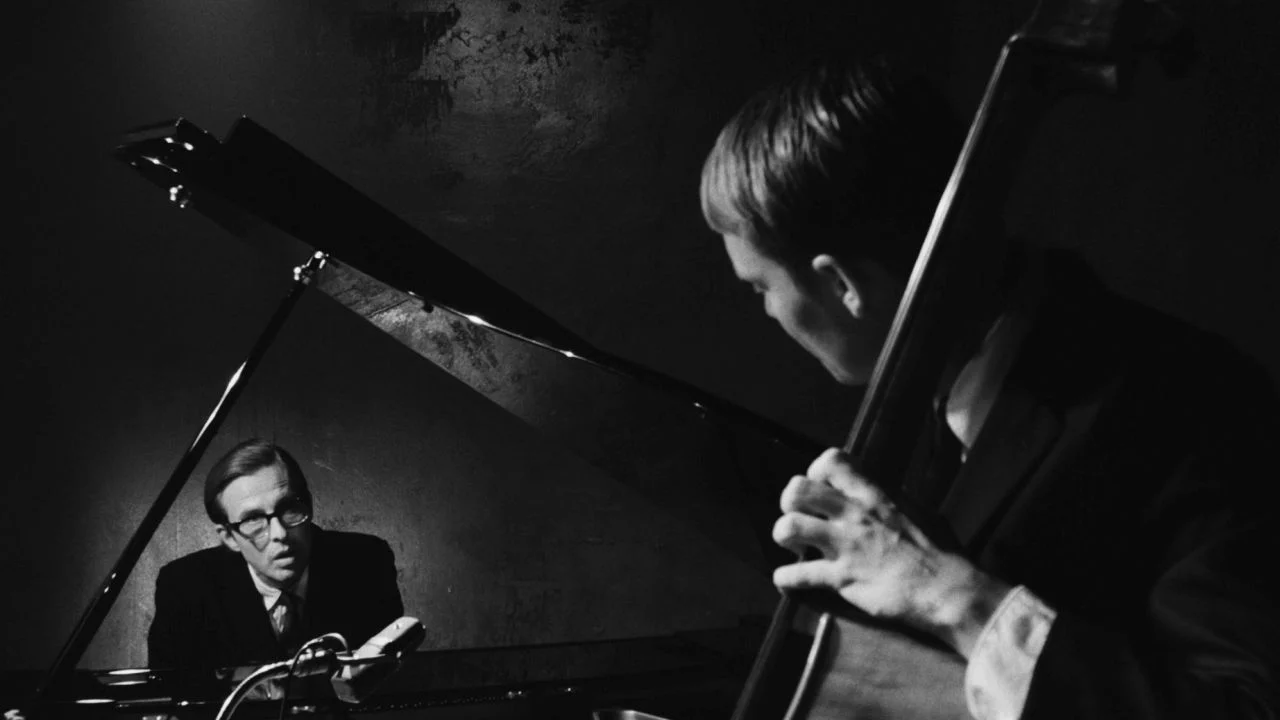
The engraved black and white of “Everybody Digs Bill Evans” will certainly delight more than just jazz super fans.
1961: After the death of his friend Scott La Faro, Bill Evans (great: Anders Danielsen Lie) vegetates lethargically in his small New York apartment. His worried brother Harry Jr. (Barry Ward) temporarily takes him into his family – but soon notices that Bill is numbing his pain with cocaine during his secret nightly trips into the city. For a change of scenery, he quickly puts Bill on a plane to Florida, where Bill stays with his parents Harry (Bill Pullman) and Mary (Laurie Metcalf) for a few months. After going cold turkey, Bill increasingly recovers – until at some point his on-off girlfriend Ellaine (Valene Kane) shows up at the door with a contract from the record company…
A great start
At the beginning of his directing career, Grant Gee directed several music videos for Blur, Radiohead and Nick Cave & The Bad Seeds, among others. Especially the first minutes of “Everybody Digs Bill Evans”, when the song “Jade Visions” is played on stage during the opening credits, can therefore be understood as a reminiscence of his own oeuvre: in flowing, virtuoso montages of carefully composed black and white images, the strings of the double bass transform into road markings or the recording magnetic heads of a tape recorder into rotating tires, until the time levels of the legendary Concert and the fatal car accident merge into an indissoluble unity (just like the Bill Evans Trio during their performances).
While the transitions by editor Adam Biskupski (“We Need To Talk About Kevin”) are incredibly smooth here, the time jumps into the future that are repeatedly interspersed with the crackling of a record player are all the more abrupt as a bumpy transition. Here, as if out of a chronicler's duty, the film jumps over a decade into the future and shows the deaths of Harry Jr., Ellaine and Robert Evans himself. However, the scenes seem like foreign bodies not only because of their intense colors and low-contrast retro look, but also dramaturgically.
Unnecessary jumps in time
These (morbid) insertions weren't actually needed in the focused psychological drama about grief, (unspoken) family conflicts and life goals. Anders Danielsen Lie (“The Worst Man in the World”) presents Bill Evans with a voice that is always somewhat hoarse and as gentle as it is introverted, giving insights into his inner life, especially through small gestures such as a tear when listening to the newly released live album. This is particularly true with his relationship with Scott La Faro: While they fit together well musically, problems in their relationship off stage shine through. Bill Pullman (“Independence Day”) as Harry Senior, who is visibly getting on in years, turns out to be unexpectedly complex: under the facade of a garish grump who, for example, complains about the quirks of other golfers and thus provides some lightening humor, there is a palpable rumbling.
Nevertheless, it takes a while for his secrets and lies to emerge in a musical father-son conversation. In fact, Grant Gee manages to get at least a little closer to his title character in scenes of tense calm and strongly contoured black and white shots. Just as the multi-perspective novel “Intermission” by the Welsh author Owen Martell, published in 2013, was able to do, which served as a template for “Everybody Digs Bill Evans”. Neither the book nor the film leans too far out of the window: fortunately, the exceptional musician is not completely disenchanted or even explained in the (largely) calmly and calmly told drama.
Conclusion: Precisely because the blank space of several months in the biography of the eponymous exceptional jazz pianist, which has never really been clarified to this day, is not filled in very concretely, the experienced music documentary filmmaker Grant Gee succeeds in making a feature film debut with a strong cast, which only overextends the arc unnecessarily when it jumps to the end of the lives of its protagonists.
We saw “Everybody Digs Bill Evans” at the Berlinale 2026, where it celebrated its world premiere in the official competition.