
For the first time, the Berlinale opened with an Afghan film. Or at least with a film by an Afghan filmmaker. Director Shahrbanoo Sadat has been living in exile in the West since the Taliban came to power again in 2021, which is why her tragicomedy “No Good Men” is a largely German production that, although set in Kabul, was actually largely shot in Hamburg.
The fact that you don't notice this in the story of a camerawoman who makes her way in the patriarchal Afghan society is one of the greatest qualities of the committed, sometimes somewhat naive film. “No Good Men” is loosely based on true events, the main actors play variations of themselves. Although they sometimes act a bit wooden, they are still authentic to a degree that one tends to overlook some of the film’s weaknesses.
The last days before the Taliban
Kabul, 2021. Naru (Shahrbanoo Sadat) works as a camerawoman for the local television station Kabul TV, previously on banal advice shows. As a woman, she has a difficult time in the patriarchal Afghan culture and her skills are not valued even when working in the male-dominated broadcaster. That only changes when she manages to collect quotes from women on the streets of the city who have always remained silent with their male colleagues – and who give the reports about life in the war-torn country a special authenticity.
Suddenly, the experienced TV reporter Qodrat (Anwar Hashimi) also becomes interested in Naru and supports her professionally, but also in her private life: Naru has been living separately from her husband for some time and is worried about custody of her five-year-old son. And hanging over everything is the impending withdrawal of American troops and with them the conquest of Kabul by the Taliban. Is Qodrat really the one good man to be found in Afghanistan?
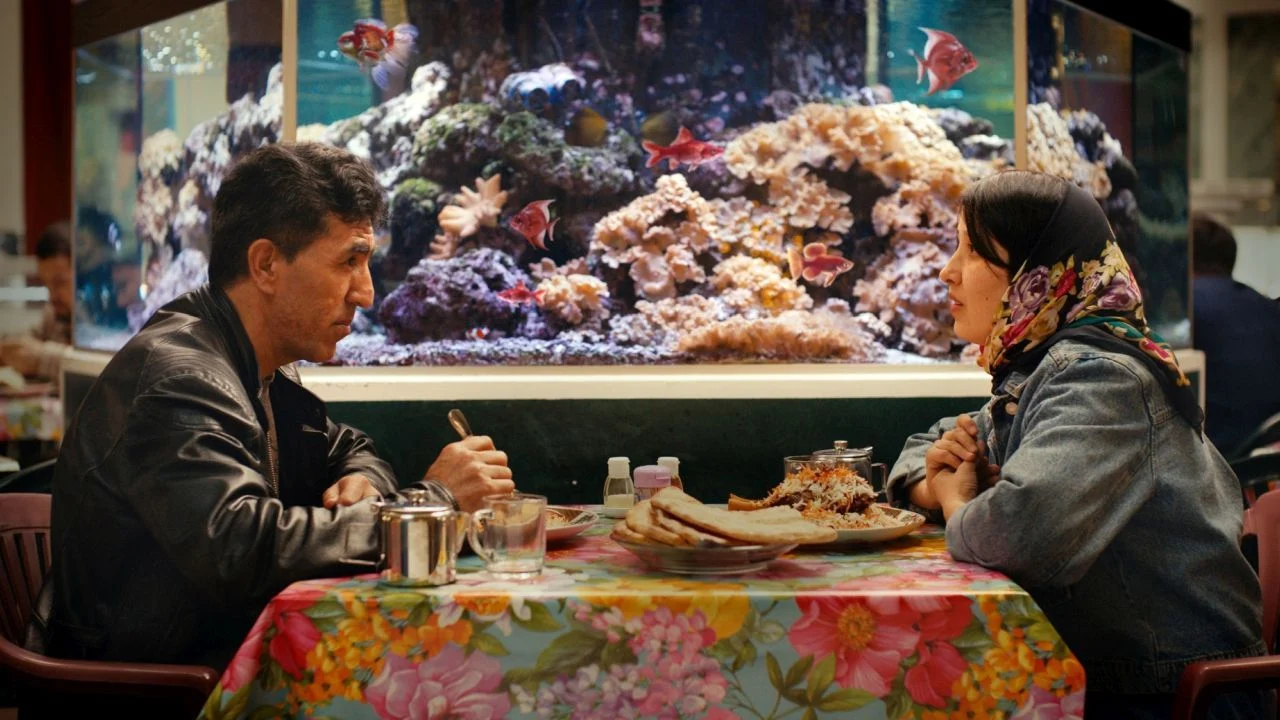
Naru (Shahrbanoo Sadat) is downright euphoric when a man, Qodrat (Anwar Hashimi), shows her real respect for the first time.
With the sentence “Our freedom is defended in the Hindu Kush,” the then German Defense Minister Peter Struck justified participation in the NATO operation in Afghanistan in 2002, which began as a result of the attacks on September 11, 2001 and ended miserably in the fall of 2021 with a desolately organized withdrawal. At that time, Afghans tried desperately to catch one of the last flights that would take them outside and thus to safety from the advancing Taliban. With these tragic images ends “No Good Men”, which previously tells an often surprisingly light-hearted story in which moments of hope for a better future collide with increasingly fragile reality.
Shahrbanoo Sadat, who herself had to flee her home for good in August 2021, acts as co-author, director and leading actress. She had previously achieved two festival successes with the films “Kabul Children's Home” and “Wolf And Sheep”, which were largely made with amateur actors and then premiered in Cannes. All of these films were based on scripts by Anwar Hashimi, who this time also plays the male lead – just like the director, who is not an experienced actor. You can tell that in the film, especially in more dramatic scenes the performances are only partially convincing.
A vibrator as a moment of liberation
It's completely different when Sadat presents himself in his interactions with other Afghan women, when relationships and intimacy are discussed and a friend who is currently visiting Kabul from the USA pleases the newly separated Sadat with a vibrator, as if you were on “Sex & The City”. It is moments like these that speak in a surprising, refreshing way about everyday life in a country that is usually only featured in the news when a bomb explodes or the Taliban advance.
Even though filming couldn't be done on location for obvious reasons, Sadat and her production designers remarkably manage to recreate life on the streets of the Central Asian state in Germany – complete with lots of dust, crumbling Western cars and a lively market. Everyday life that was able to re-emerge for a short time before chaos and the totalitarian Taliban moved in again due to the withdrawal of Western troops. If you're wondering why Germany should take in Afghan refugees, “No Good Men” might provide part of the answer.
Conclusion: In her semi-autobiographical film “No Good Men”, the Afghan director Shahrbanoo Sadat tells of life in Kabul shortly before the Taliban took power again. In terms of acting and dramaturgy, it seems a bit bumpy at times, but it is convincing with an often light tone that seems authentic and provides a refreshingly different view of Afghanistan than one is used to in the German news.
We saw “No Good Men” at the Berlinale 2026, where it celebrated its world premiere as the opening film.