
Nicolas Cage in a Bible epic? Why not? After far too many years in the B-movie hell enforced by tax debts, where he had to accept almost every role offered for financial reasons, the Oscar winner (for “Leaving Las Vegas”) can now shoot whatever he wants again. The vast majority of his fans should be grateful for his newfound courage in his choice of roles – after all, it has produced such outstanding films as “Mandy”, “Pig” and “Dream Scenario”. In addition, “The Carpenter's Son” is neither a tired new edition of classic monumental works like “The Ten Commandments” nor one of those lame uplifting dramas that the Christian US studios are currently producing in series again.
But what is “The Carpenter’s Son” then? Is it a father-son psychological thriller, an eccentric coming-of-age drama, a wild historical fantasy or a dark supernatural horror? That's almost as difficult to answer as making a judgment as to whether the whole thing was a success or was over-ambitiously botched by director and screenwriter Lotfy Nathan (“Harka”). The film definitely has plenty of weaknesses, but it is also pleasantly idiosyncratic. Let's put it this way: If you liked Martin Scorsese's not-so-easy-to-digest “The Last Temptation of Christ” and enjoyed the more violent sequences in Mel Gibson's “The Passion of the Christ,” you should probably give “The Carpenter's Son” a chance.
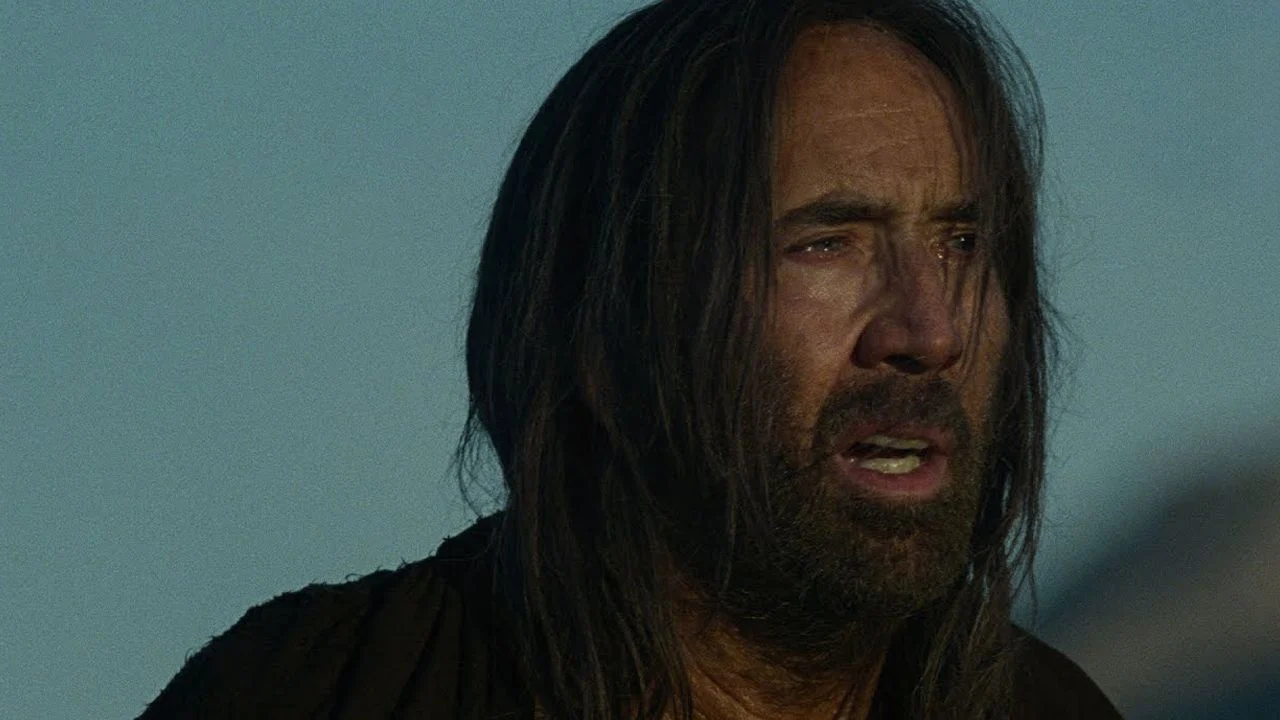
In “The Capenter's Son” Nicolas Cage holds back surprisingly for a long time – until the raging madness breaks out of him again.
When the soldiers of King Herod, appointed by Rome, kill all male children in the region on his orders, a carpenter (Nicolas Cage) and his wife (FKA Twigs) flee Bethlehem with their newborn son. Thanks to a trick and a bit of luck, the family is actually able to escape the slaughter and reach the desert unharmed with their donkey. 15 years later, the three are traveling in Egypt – still trying to remain undetected. Because their supplies have been used up and their financial resources are limited, they move into a modest hut in a village.
The father, obsessed with his family's safety, quickly finds work and also tries to explain to his son (Noah Jupe) the dangers of the world around him. The pubescent teenager is already busy enough with his desire for the neighbor girl Lilith (Souheila Yacoub). Yet he begins to become as aware of the malevolent spiritual forces around him as he is of his own extraordinary abilities…
Alternative Gospel
At the beginning we described “The Carpenter's Son” as a possible biblical epic. But of course that is not entirely correct. Because even if the family trio, which remains nameless, can easily be identified as Joseph, Mary and Jesus, the specific story of “The Carpenter's Son” will certainly not be found in Holy Scripture. The script is instead inspired by the so-called “Gospel of St. Thomas” – a collection of quotations and short dialogues attributed to Jesus Christ. It is one of the Apocrypha, a series of religious writings from the early days of the religious movement that, for various reasons, were not included in the biblical canon.
First we see Herod's soldiers brutally and nonchalantly murdering small children. After the atmospheric and intensely staged opening scenes surrounding the birth and first days of the future savior, there is a stark jump in time. This is prepared by a cryptic voiceover from Nicolas Cage. What exactly that means initially remains just as mysterious as a character who appears again and again in the episode. Depending on which eyes we see it from, this is portrayed by two different actresses: one by the young Brit Isla Johnston (“The Queen's Gambit”), the other by the Greek professional dancer Elena Topalidou, who is 30 years older than her.
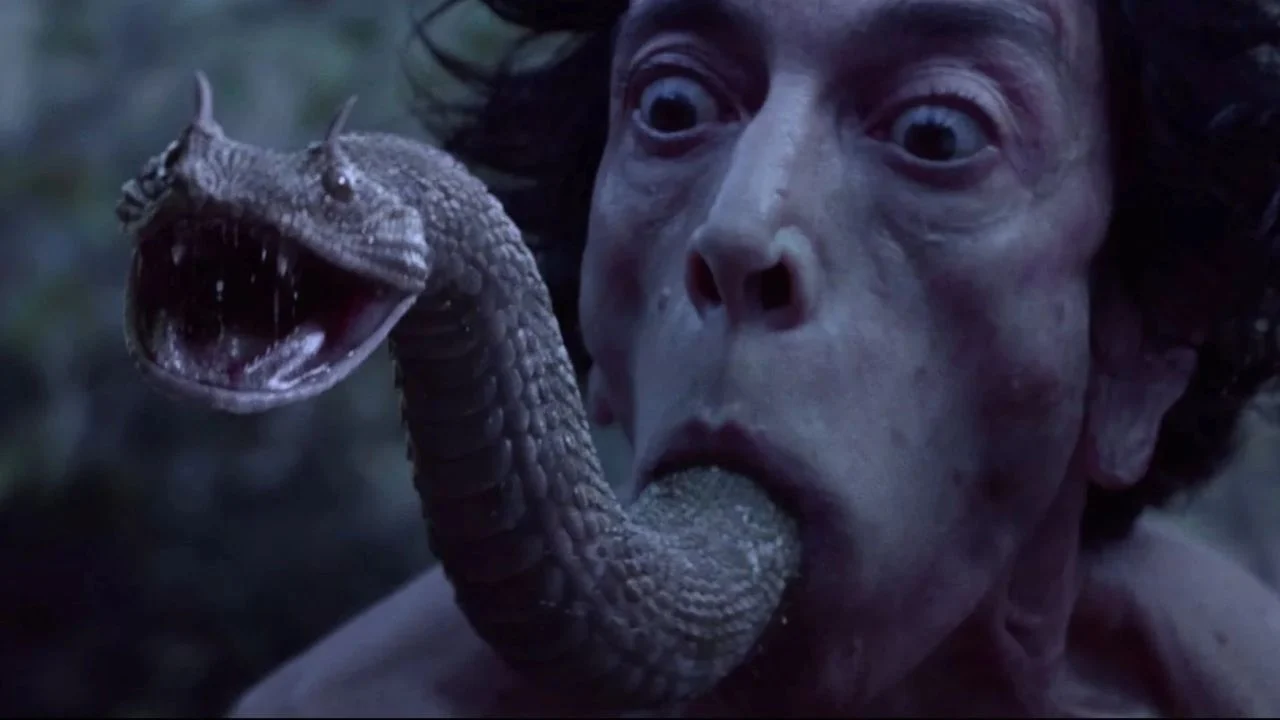
“The Capenter's Son” always surprises with weirder ideas.
After the time jump, however, the film meanders for quite a long time. While we watch the family carrying out trivial activities, at first glance not much is really happening. One or two film fans are likely to lose patience with Lotfy Nathan and his work here. At least some of it pays off to stick with it. Because some of the later, much more crazy events only become understandable through these scenes. In addition, the tensions within the family are built up slowly and believably. Nicolas Cage and Noah Jupe (“A Quiet Place”) do a good job – and the pop singer FKA Twigs, who won a Grammy in early 2026, can also be quite convincing here, in contrast to her previous appearances in “Honey Boy” and “The Crow”.
The performances adapt to the production, which is concerned with authenticity even in moments with supernatural occurrences. Although Cage's facial expressions are as intense as usual, he otherwise remains surprisingly reserved for long stretches – until, of course, he is allowed to have one of his typical outbursts. The performance of Johnston and especially Topalidou, on the other hand, is almost entirely expressive. The character is referred to as “The Stranger” in the credits, but it quickly becomes clear who he is actually supposed to embody. She will become the ultimate bad influence on the future Messiah. The teenager's rebellion fueled by these encounters and the acceptance of his difference by the man who always suspected that he was not really his father lead the story to its inevitably dark and yet somehow reconciliatory end.
Rather slow towards the finale
This finale itself may be predictable in some ways, but the path leading up to it is peppered with a few surprises. Unfortunately, the director doesn't manage to present a homogeneous story flow; instead, a lot of it seems very episodic. For example, the boy's visit to a Roman prison camp, where the girl he was just pining after is being tortured, like a foreign body that was perhaps even inserted later. That's a shame, because the scene, which is reminiscent of Dante Alighieri's descriptions of limbo, is definitely worth seeing visually and atmospherically. Other horror passages are not always coherently integrated either. In addition, although they are cruel and bloody, they are not carried out with such consistency that “The Carpenter's Son” should at least really delight genre freaks.
Presenting the teenage years of Jesus, which are left out of the Bible, in the form of a film that is often quite crass but never clumsy or even blasphemous is an attractive idea on paper. The experiment, because that's what the whole thing feels like at times, doesn't fully work out – primarily because of pacing problems and stumbling blocks in the plot. Nevertheless, fans of the stars involved can at least get involved.
Conclusion: Nicolas Cage as Joseph of Nazareth is an inspired casting decision. It's not the Oscar winner's fault that the often experimental film only works in parts. It is courageous and provocative and attractively implemented despite the apparently not exactly opulent budget.