
Cambodian documentary and very occasional feature film director Rithy Panh has become best known in international film festival circles as the essential chronicler of the atrocities his country endured under the Khmer Rouge. In harrowing, sometimes more, sometimes less experimental documentary experiments such as “S 21, the Death Machine of the Khmer Rouge” or “The Missing Picture,” Panh drew a ruthless assessment of the communist reign of terror under the dictator Pol Pot, who ruled in the second half of the 1970s.
With his new documentary “We Are The Fruits Of The Forest”, Panh is now turning to a new topic. The Bunong indigenous population in eastern Cambodia traditionally lives in and with nature and the forests – a way of life that is becoming increasingly impossible in the modern world. The film's narrator, Bunong Pa Kreb, tells us that the laws of the market are not understood there. Sometimes you should grow this, sometimes that: cassava, coffee, rice, rubber trees. And when everything was ready to be harvested, the prices had long since plummeted again. He grows what he is told, says Kreb, and yet he cannot pay off his debts to the bank.
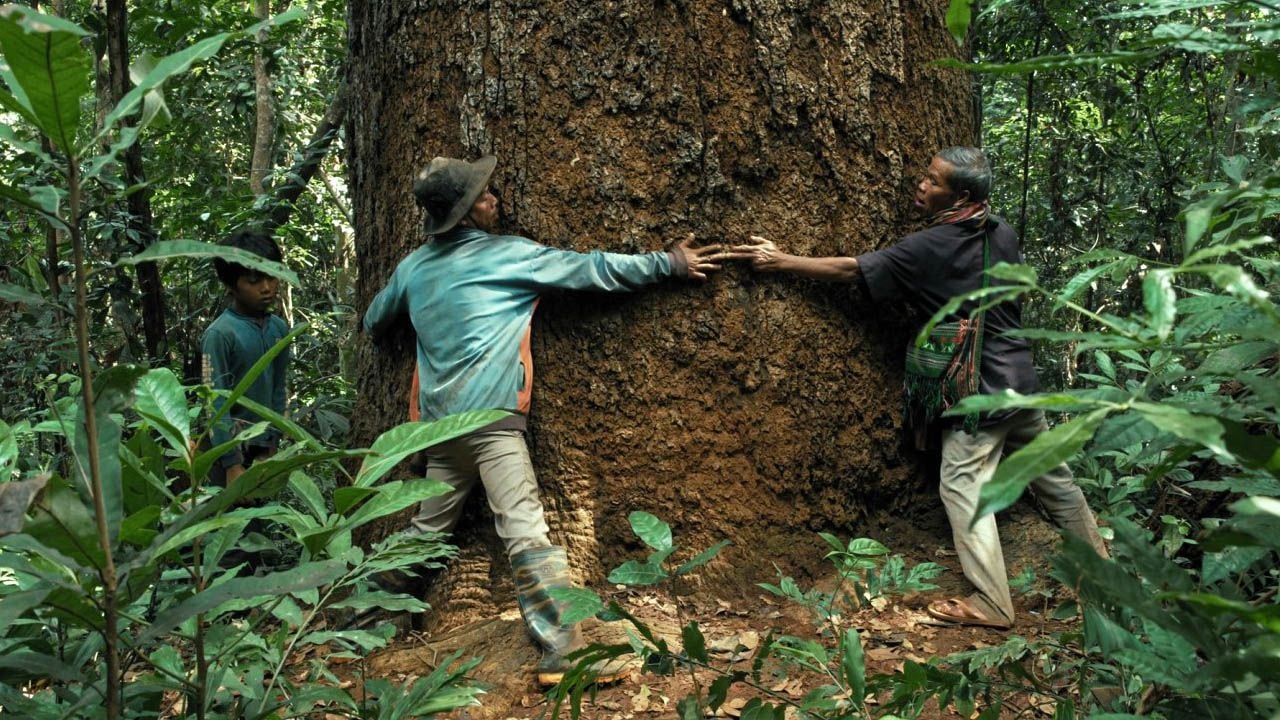
The Bunong are one with the natural world around them – but in the modern world they are forced to participate in the destruction of their own habitat.
Rithy Panh accompanies his narrator and his people through their existence for a while, somewhere between ancient customs and modernized ways of working. This includes, for example, the felling of huge trees in the rainforest, which no longer have to be felled by the Bunong men after days of hard work, but are brought down with a chainsaw within minutes and processed into boards and planks directly on site. They are aware that the forest, which is sacred to them and which once marked their habitat as well as the realm of their mythology, continues to shrink and die – they have no alternative to this work of destruction.
“We Are The Fruits Of The Forest” is a pessimistic film. Pa Kreb appears to be an outspoken critic of any modernization, and the gradual disappearance of the Bunong's cultural traditions hurts him deeply. The rituals and working methods of his ancestors are disappearing, as are their spiritual ideas – more and more Bunong are even converting to Christianity and putting up crosses. That's the worst thing of all – at festivals the sound now comes from the boombox instead of the traditional gong instruments, and every pre-modern superstition is appropriately mourned for the loss of its effectiveness.
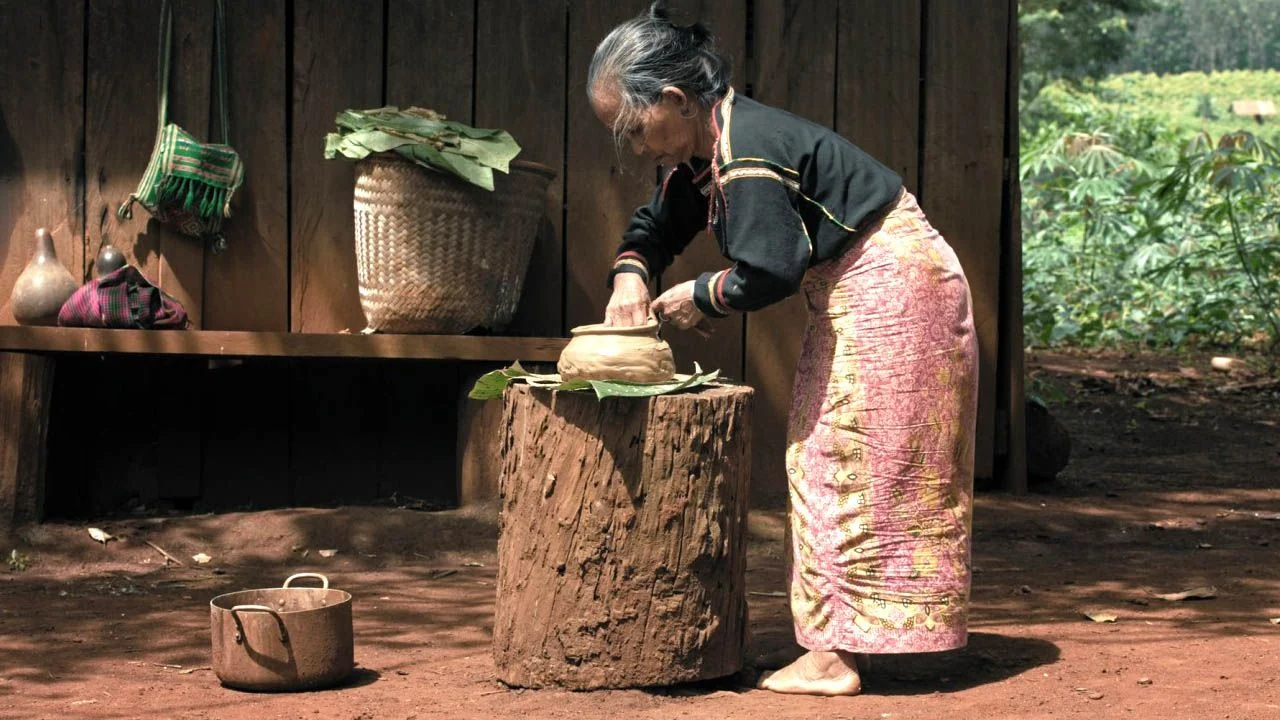
Documentary filmmaker Rithy Panh often does nothing in “We Are The Fruits Of The Forest” other than watching his protagonists do their work.
At its core, however, the story that Rithy Panh tells here is primarily an economic one. Once, as Pa Kreb tells it in the voiceover, the forest was everywhere and belonged to no one. The Bunong could plant their fields wherever they wanted, and different forests were dedicated to different purposes. Today everyone owns land as private property, fences are everywhere, and the Bunong are forced to over-cultivate and thus exhaust the little land that is available to them for cultivation. Even the forest of the dead is full and he will no longer be able to be buried there.
Now, these are not entirely new topics, and the decline of traditional ways of life has often been mourned in international (documentary) cinema. “We Are The Fruits Of The Forest” remains captivating for long stretches, probably precisely because its staging remains largely classic. Watching the Bunong at work, or what remains of their customs and rituals, offers a window into a world that is disappearing. Rithy Panh certainly plays with stylistic devices that are already familiar from the more experimental of his earlier works. However, the split screens with which he integrates archive footage of the historical Bunong, filmed by, among others, the French ethnologist Claude Lévi-Strauss, into the film can safely be classified as decorative and do not contribute anything significant to what is depicted.
A picture that poses a mystery
But then there is this one image that keeps flashing like a spotlight and cutting up what is shown. A young woman looks into the camera, her gaze unreadable. What does it express – sadness, anger, fighting spirit? And what exactly lies in this look that captivates Rithy Panh so much that he chooses this image, which remains enigmatic until the end, as the structural element of his film? How can we grasp this almost Barthesian punctum that apparently gripped and carried the filmmaker away? We will have to live with this question, because Panh himself does not resolve it and in the end leaves us alone with this one enigmatic, insistent image.
Conclusion: For his new film, the Cambodian documentary director Rithy Panh leaves the horrors of the Khmer Rouge, of which he has become the most important chronicler over many films, to rest and turns to the indigenous Bunong ethnic group, who live in the Cambodian mountains between tradition and modernity. In “We Are The Fruits Of The Forest” he doesn't tell a new or never-before-formulated conflict, but he does offer compelling insights into a disappearing culture.
We saw “We Are The Fruits Of The Forest” at the Berlinale 2026, where it will be shown in the Forum section.