
I'm 42 years old, but that doesn't help me now, quite the opposite. The romantic hero of “An Almost Perfect Proposal” is a former engineer who, despite being retired, begins to study art history in order to win the heart of his childhood sweetheart Alice, who is now a professor. As a “Very Best Ager”, which is the original title of the film, I might find this incredibly charming. At the age of Walter's fellow first-year students, however, even the conclusion “total cringe” would seem to be an understatement. Of course, I'm reducing both generations to the usual clichés – but don't worry, Marc Rothemund (director) and Richard Kropf (script) don't do it any differently.
The real problem is that, after their joint film hit “Wochenendrebellen” (4 stars from FILMSTARTS), the duo is acting pretty lazy in places this time – and, in contrast to their protagonist, doesn't show the slightest desire to really understand the young generation. The result is a film for best agers by best agers – with young people how they obviously imagine best agers to be. This is sometimes downright annoying. The comedy-proven stars Heiner Lauterbach (“Grandchildren for Advanced Players”) and Iris Berben (“The Nickname”) have to use all their charm to still interest us in their autumn romantic escapades.
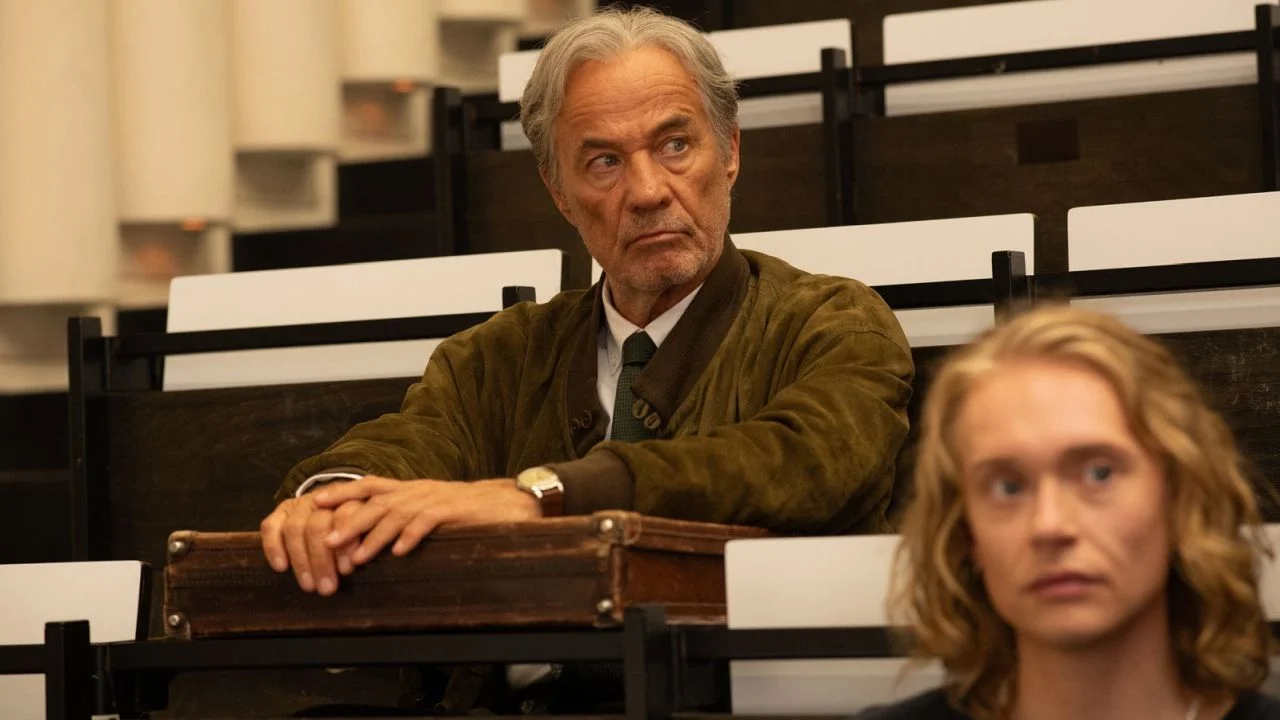
In order to win back the love of his youth, Walter (Heiner Lauterbach) returns to his studies even in retirement age.
“An almost perfect proposal” is quite a euphemism. After all, “an absolutely catastrophic proposal” would be a much more appropriate description of how the pedantic bourgeois Walter (Heiner Lauterbach) tried to convince his girlfriend Alice (Iris Berben) to marry him more than 40 years ago. Instead of a honeymoon, the marriage proposal ended with all sorts of painful bumps for HER – and with a harsh rejection for HIM. But now the two meet again by chance in a sushi restaurant in Regensburg's old town: HE is happy, while SHE is more panicked about possibly having a stalker on her cheek.
And in fact: Walter can't be shaken off even with clear “nos” – and instead even enrolls as a visiting student in art history so that he can take part in Alice's lectures. At the same time, he remains a thoroughly middle-class ex-engineer who can name the dimensions of the pictures, but fails miserably at the task of describing what looking at a painting triggers in him. Maybe his much younger fellow students could help him broaden his perspective on the really important things in life – and in return he could give them a little old age wisdom?
Not everything used to be better
Of course, the initial stalker concerns in the film are just a gag. But honestly: If HE settles in at HER workplace after several clear rejections so that SHE can no longer easily ignore HIM, then Walter has definitely disqualified himself as a romantic hero for the majority of the audience under 45. And in fact: Heiner Lauterbach and Iris Berben have to work incredibly hard later on to get us on their side instead of just trying to tell Alice to please get away as quickly as possible.
However, the script hardly does the two stars any favors: instead of providing a comprehensible explanation for Walter's development, it has to suffice that after watching Édouard Manet's “Olympia” he is suddenly a completely new person. But because this is not enough of a romantic gesture, a situation is created in an awkward manner (and implausible for those familiar with the academic world) in which the protagonist can prove himself to be a career savior for Alice, who obviously has both feet firmly planted in life.
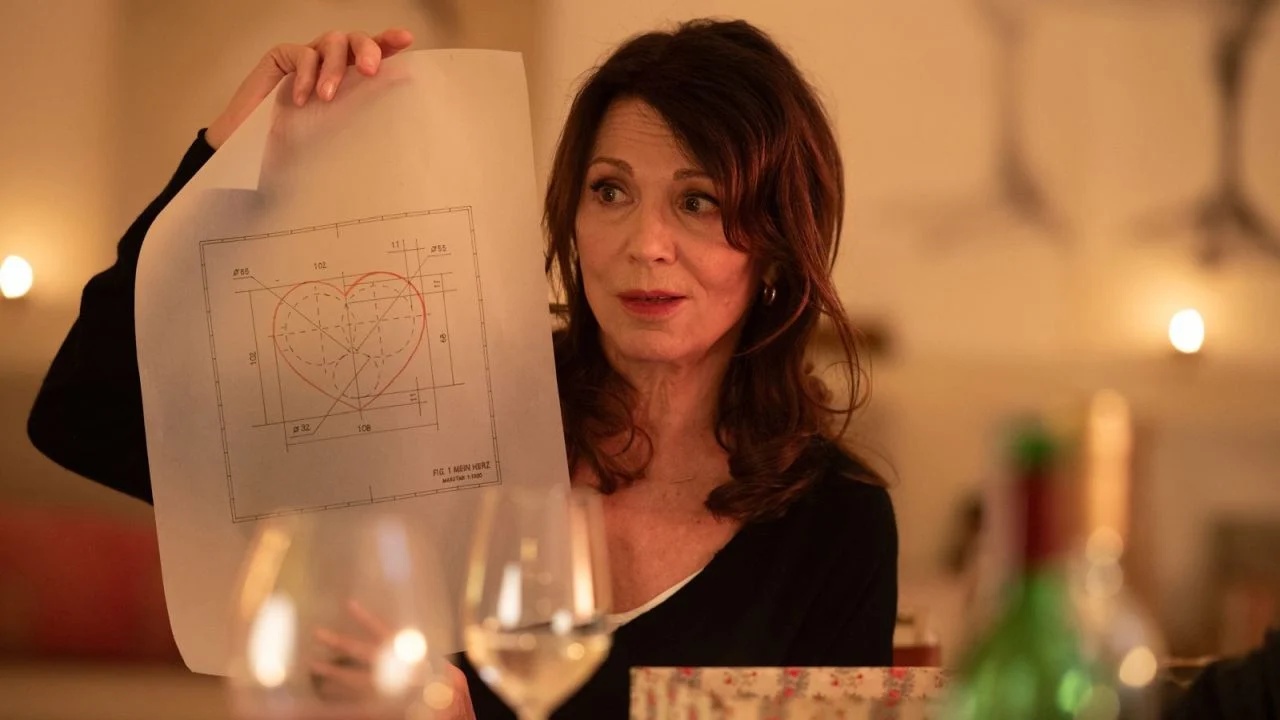
Alice (Iris Berben) is initially not very enthusiastic about her admirer's architectural declarations of love.
At least on paper, “An Almost Perfect Proposal” is one of those films in the tradition of “Dead Poets Society” where generations learn from each other. But as soon as he enters the university for the first time, Walter is immediately reprimanded by a young woman because he dared to hold the door open for her – and even after that, the university scenes are one long bullshit bingo, with terms like “people of color”, “fatshaming” or “non-binary” being thrown around almost every second. Of course, the topic is particularly popular in German comedy cinema. But even if one may argue about how revealing “Old White Man” really is, Simon Verhoeven has at least tried to translate the already largely exhausted debates into punch lines.
“An almost perfect proposal,” on the other hand, is in most cases content with simply saying these buzzwords. You have to think for yourself why this is funny. But there is one positive exception, which at least everyone who has experienced the iconic grumbling firsthand will be happy about: On the study trip at the end of the semester, Walter asks himself whether one should adapt to the famous bad mood of the Viennese – or whether that might not be cultural appropriation.
Conclusion: Unfortunately, you first have to dig through a thick layer of cringe in order to get through to the charm that is undoubtedly there.