
To this day, Stefan Zweig is one of the most widely read Austrian authors. The upper-class and well-traveled cosmopolitan with Jewish roots wrote his name in literary history in the first decades of the 20th century with a realistic narrative style and psychologically complex characters. The “Chess Novella” written at the beginning of the 1940s, in which the atrocities of the Gestapo are discussed during a duel on the game board, is still considered his best-known work today. But even though he published a lot, Zweig was only able to complete one novel in his writing life: “Impatience of the Heart,” which is about the (self-)perceived but never “real” feelings of a lieutenant towards a paralyzed entrepreneur's daughter.
For Lauro Cress, this is a timeless topic; after all, we are increasingly encountering a lack of authenticity, and not just on social media. This is also why the Munich filmmaker chose a modern and quite free interpretation of the material published in 1939 for his first feature film, making Edith's actually small part much larger than in the literary original. The result is a certainly not flawless, but atmospheric and intense relationship drama, which won the award for Best Feature Film at the Max Ophüls Prize film festival.
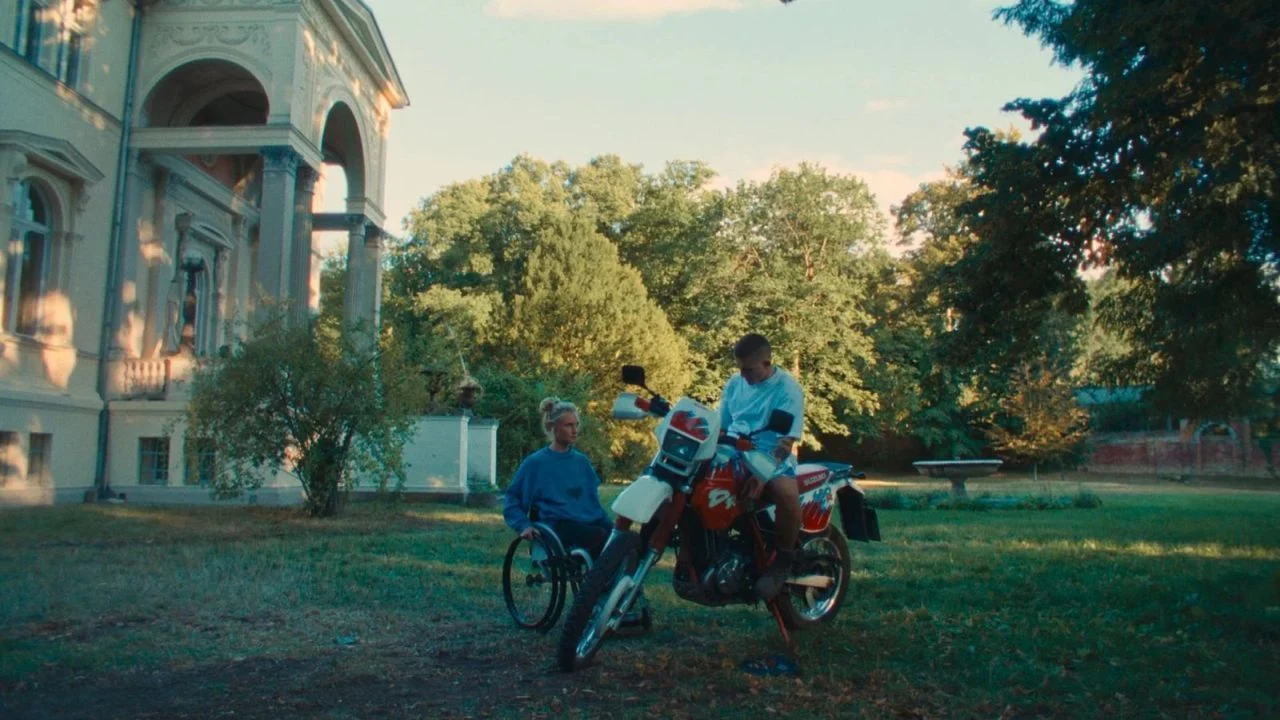
Isaac Nasic (Giulio Brizzi) feels responsible for Edith (Ladina von Frisching). But does he love her too?
The migrant's son Isaac Nasic (Giulio Brizzi) works in the guard battalion in the Bundeswehr. When he spends an evening at the bowling center with his comrades, he meets the tough Ilona (Livia Matthes) and her sister Edith (Ladina von Frisching). Due to a misunderstanding, he realizes too late that the daughter from a wealthy family has been paralyzed from the waist down since a motorcycle accident and uses a wheelchair – which leads to an embarrassing scandal.
As compensation and probably also out of pity, Isaac then takes care of Edith, with whom he shares a passion for motocross. Without any real romantic feelings, he soon begins a relationship with her, although he keeps it a secret from the outside world. When Edith sees a risky and expensive stem cell treatment as a chance to be able to walk again, the situation comes to a head…
A real discovery in the lead role
In addition to four short films, Lauro Cress has also made music videos and advertising films, especially for various car brands. For his feature film debut, however, in addition to the Fraktur font for the title, he avoided any overly conspicuous stylizations and optical gimmicks. However, he attaches even greater importance to a realistic setting and genuine characters. Above all, the casting of Giulio Brizzi (previously seen in the Italian Netflix series “Adoration”), who credibly embodies the troubled inner life of his character, torn by feelings of duty and belonging and striving for recognition, proves to be a real stroke of luck. Its range extends from sensitive care when wearing something to go swimming in the lake, to tender romance during the first kiss, to spurred ambition when it comes to medication and possible therapy.
He becomes openly aggressive when he punches his comrade Holzer (Jan Fassbender) in the nose at his birthday party for making a stupid comment about “the nurse”. Ladina von Frisching also delivers a strong performance in which she impressively embodies both the self-confident and adventurous as well as the extremely fragile side of her character, who is increasingly in poor health and at times impenetrable. On the other hand, the brittle acting Livia Matthes (“60 Minutes”) doesn't really get beyond the walking cliché of the ice-cold, calculating career woman who moves from one call to the next and occasionally sneaks in some spontaneous sex in the shed, even due to a lack of screen time.

You keep your fingers crossed for the two of them, even if you have long felt that the relationship was doomed from the start.
In a bed scene between Isaac and Edith that fails due to sensitivities, physical limitations and lack of desire, the technical deficiencies of this narrowly budgeted debut work are revealed alongside Cress' impressive sense of sensitive staging of even difficult situations. As with other sparsely lit interior scenes, the red-drenched scenery lacks contrasts and contours; the sound technology causes dialogues that are already quiet and not very accentuated to be drowned in the humming background noise. In view of the coherent dramaturgy in the script by Lauro Cress and Florian Plumeyer (“Until the End of the Night”), which uncompromisingly and painfully dissects how Isaac, after initial carelessness, increasingly fails in his fight for love and recognition, there would have been (even) more in this little pearl of young German film talent.
Conclusion: Two complex characters and an intense relationship drama that lacks fine-tuning visually and acoustically. “Impatience of the Heart” is a successful update of Stefan Zweig's masterful (and only) novel – and a promising debut work.