
After its premiere at Hamburg's Ohnsorg Theater in October 2019, the stage comedy “Extrawurst” enjoyed a meteoric rise: in the 2021/22 season it even became the most performed play in Germany! However, this unprecedented success does not come as a complete surprise: Not only do the authors Dietmar Jacobs and Moritz Netenjakob – like the French theater super hit “The First Name” before them – create a constantly escalating spiral of arguments with a premise that sounds absurd at first. They also set their piece in a tennis club – and a more explosive place for social debates can hardly be imagined (apart from perhaps an allotment garden club).
So it's no wonder that “Extrawurst” has now been made into a film – and director Marcus H. Rosenmüller (“Whoever dies earlier is dead longer”) has even brought together an absolute all-star cast for it. What particularly stands out, of course, is Hape Kerkeling's comeback to the cinema, who – if you leave aside his mini-appearance in “The boy needs some fresh air” – can be seen on the big screen again for the first time in 16 (!) years (“Horst Schlämmer – I'm running!”). So it all sounds like an absolutely safe bet – and perhaps that's where the problem lies: In the six years since the play's premiere, there have been a number of films that have followed a very similar line – most recently, for example, “Old White Man”. That's why some gags could have used a sharper update. The opportunities that the cinema offers compared to the stage are also rarely used.
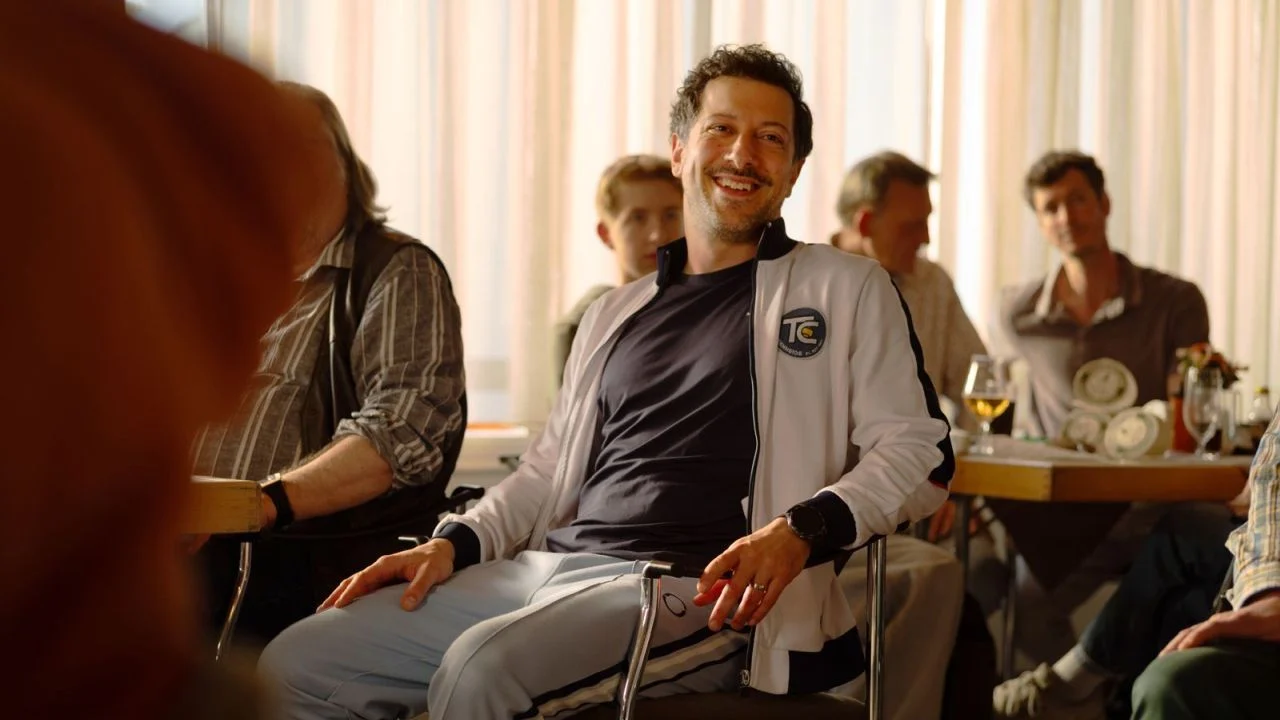
A “simple” discussion about a new grill for Erol (Fahri Jardim) gets completely out of hand in “Extrawurst”!
Club meeting at the Langenheide Tennis Club: As expected, the re-election of President Heribert Bräsemann (Hape Kerkeling), who has been in office for 25 years, is unanimous. The new building of the clubhouse was also quickly waved through, although the awarding of the contract to the president's brother-in-law certainly had a twist. But then comes point 7: “Other”. Normally there is never anything, but this time the club's deputy president Matthias Scholz (Friedrich Mücke) suggests purchasing a new gas grill model XQ3010 – with four separate heating surfaces that allow up to 50 sausages to be emitted (instead of the previous 20).
This point also seems to go through without any problems at first. But then Melanie (Anja Knauer), who moved from Berlin with her husband Torsten (Christoph Maria Herbst), suggests buying a second grill for her doubles partner Erol (Fahri Yardim). After all, as a Muslim, he is not allowed to eat meat that has been grilled with pork sausages. Erol waves it off straight away and says that you don't have to go to such trouble just for him. But by then the discussion had already developed a dynamic that was no longer even accompanied by the presidential favorite saying: “Period. Out. Put some grit on it!” is to be stopped…
Chekhov's tennis racket
The literary principle of “Chekhov’s Gun” is that if a pistol appears casually in the first act, then it must also be fired in the third act. The same applies, of course, to an oversized tennis racket that is set up as a sculpture in the entrance to TC Langenheide eV. Apart from that, only Milan Peschel (“The Nanny”), as the janitor struggling with a broken ball machine, lightens up the ongoing discussion with brief sprinklings of physical slapstick. The dispute moves from the club restaurant to the tennis hall and the workshop to the driveway – but the production doesn't exactly offer much variety.
Instead, it is up to the actors and the debate dialogues to drive the escalation spiral forward. Of course, it's never really about the grill in the first place – but instead about all the previously hidden animosities, prejudices, jealousies and resentments that are now all breaking through to the surface at once. Luckily, “Extrawurst” doesn’t make it so easy to simply zero in on the most obvious scapegoat – namely the right-leaning, authoritarian grill identity keeper Matthias. Instead, over the course of almost 100 minutes, everyone gets rid of their fat, while the coalitions regroup on every topic that is raised (greetings from Jean-Paul Sartre and his piece “Closed Society”).
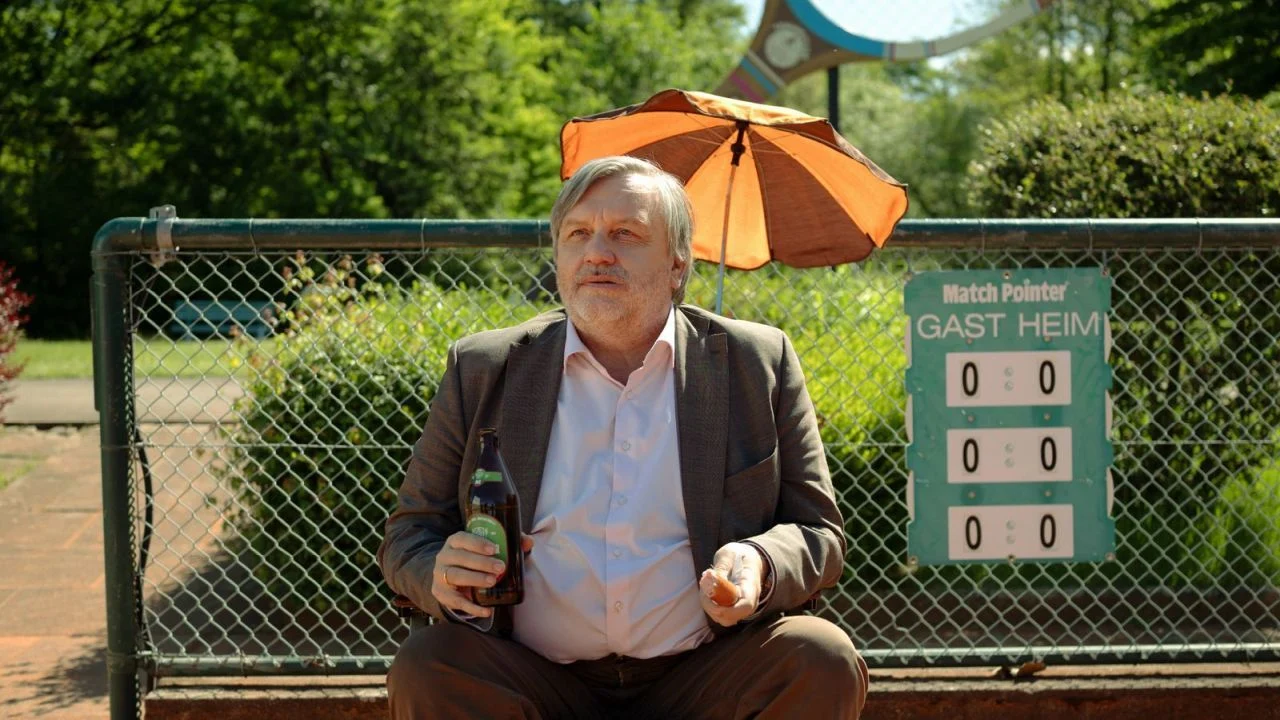
You can think what you want about “extra sausage”. But it's definitely a great joy to finally see Hape Kerkeling in the cinema again after all this time!
“Even” Erol shouts out quasi-AfD slogans at some point – and at the same time exposes the prejudices of his club mates, who didn’t believe he could do that “as an immigrant” or “as a Turk” (even though he’s lived in Germany as a German since he was born). So the comedy walks a fine line, because it's not that easy to feel sympathy for the characters at any point – with the exception of the president, who Hape Kerkeling embodies with a disarming melancholy and an obviously longing love for his club, despite his shirtless approach.
Thanks to its roots as a tabloid piece, “Extrawurst” naturally leaves its audience with a reconciliatory feeling from the cinema. But if you look more closely, the satirical comedy contains a very similar view of society as in the Italian “The Perfect Secret” original (which the German remake unfortunately didn't dare to approach with its modified ending): After the everyone-lay-their-cell-phone-open-on-the-table test of courage destroyed everything, the film simply jumps back to the beginning of the evening at the end. The game is never played, everyone is happy, but the audience knows that these friendships only work because everyone keeps secrets from each other. And it is also clear after “Extrawurst”: Clubs or societies can probably only exist if we don’t know everything about the worldviews of our fellow human beings. Pretty painful, but good if you can still laugh about it.
Conclusion: If you want to know what makes Germany really tick, you should take part in a club meeting – or alternatively watch “Extrawurst”! However, director Marcus H. Rosenmüller doesn't even try to add a great “cinematic” dimension to his screen adaptation of the stage mega-hit. Instead, he relies entirely on the material and the stars – and even if neither of these let him down, there would certainly have been more if he had had more courage to go to the cinema.