
The actress Brigitte Bardot, who recently died at the age of 91, was considered a style icon at the end of the 1950s. Her look, which was simultaneously sensual, comfortable and confident, included flat shoes, then called “cendrillons” and now commonly known as ballerinas, off-the-shoulder tops, flowing skirts and of course the typical capri pants. Through her films, the Bardot look became known worldwide and copied by many young women – a new fashion direction was created.
The year is 1958: France is waging war against the independence movement in Algeria, Charles de Gaulle has just become prime minister, Brigitte Bardot is being insulted as a communist, and checkered Capri pants are seen as a sign of absolute depravity – at least in middle-class circles who are only too happy to show off their newly acquired, saturated wealth.
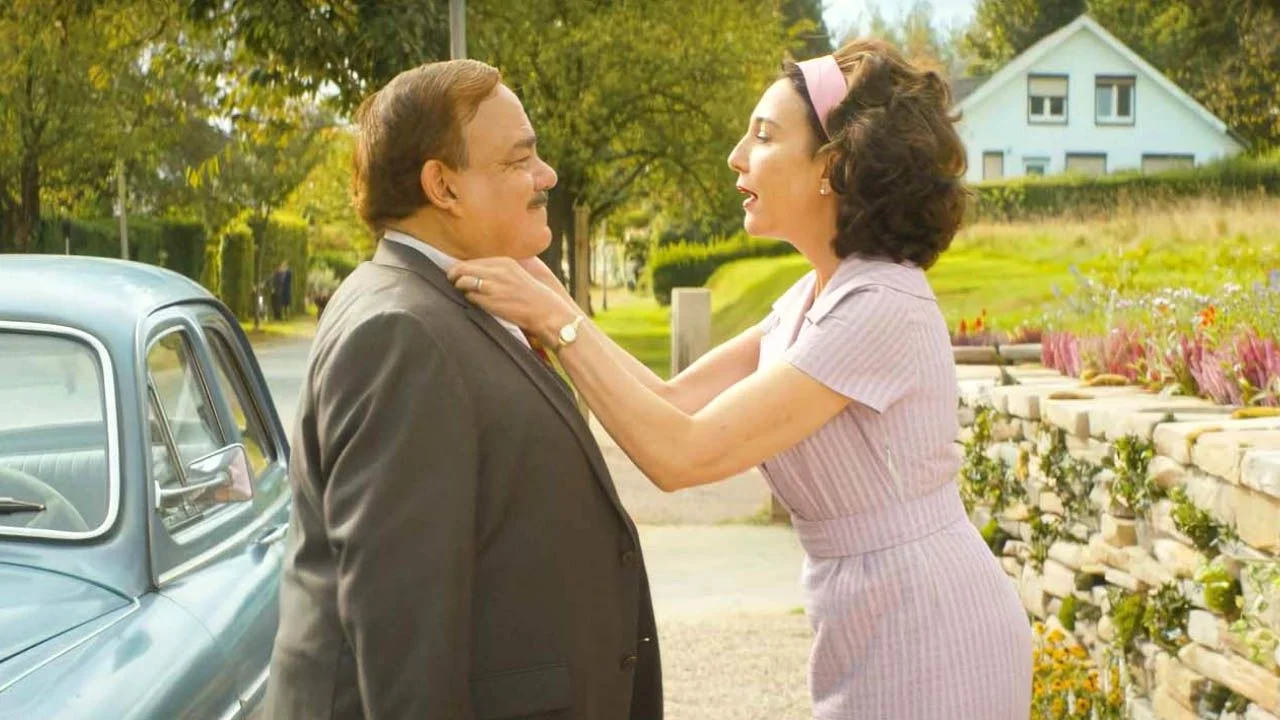
In 1958, housewife Hélène (Elsa Zylberstein) doesn't even think about questioning her oh-so-idyllic picture-book life.
The perfect housewife Hélène (Elsa Zylberstein) lives in a sunny picture-book idyll with a house, garden and her own car with her husband, the bank employee Michel (Didier Bourdon), and two teenage children. She cooks, cleans, washes, irons, keeps the house and garden in good condition and, despite the hard work she does 24/7 for her family, is always perfectly styled and in a good mood. Michel is the undisputed ruler of the house, a patriarch of the very old school. Hélène is his little owner – and she thinks it's completely normal.
Then the shock: The 18-year-old daughter Jeanne (Mathilde Le Borgne) is pregnant! There is only one thing: you have to get married. But shortly before the planned marriage, the parents are transported to the year 2025 after an electric shock – caused by the badly desired but poorly grounded washing machine that Hélène had just purchased. Everything is the same, but everything is different. Hélène is now a bank manager and her unemployed husband Michel has to take care of the household.

Husband Michel (Didier Bourdon) has difficulties with the modern world.
Jeanne, the daughter, will also marry – but voluntarily and a woman – while her brother, the previously shy and well-behaved loner Lucien (Maxim Foster), has mutated into a rebel. For their children and everyone else around them, life with the Internet, smartphones and parking sensors is completely normal, but Hélène and Michel are strangers in this world that they literally no longer understand.
But Hélène in particular learns quickly and soon feels at home. “I've never been so happy,” she admits – and not only because, to her great surprise, she has emancipated herself, but also because she sees her father again, who died of prostate cancer. In 2025 the cancer will be curable, so the father is still alive. The ultra-conservative Michel, on the other hand, cannot get used to modern times at all. The electronically controlled kitchen is giving him a lot of trouble, but what's even worse for him is that his daughter wants to marry a woman – unthinkable, and one from Algeria too!
Memories of “Back to the Future” are awakened
The imaginative script offers an almost inexhaustible wealth of gags and jokes, not only through the external contrast between yesterday and today, but also through the understandable culture clash – after all, almost 70 years have passed since 1958, in which a lot has happened. The dialogue is lively and the entertainment value is high, even if the basis of the story is not necessarily new and is reminiscent of various other films – such as “Back to the Future” or “The Visitors”. The brightly colored world in which “The Progressive Nostalgics” takes place brings to mind “Barbie”.
What's most important for time travel and fantasy comedies is that the internal logic works, even if you shouldn't ask about the scientific basis because – surprise! – in real life there is no flux compensator, and you can't travel through time with a defective washing machine. In this comedy, the construct is amazingly coherent: everyone except Hélène and Michel are people of the 21st century. The two time travelers team up against the hostile new world. “What time is it?” is the inconspicuous code that the couple uses to communicate when they are once again in danger of being overwhelmed. This idea alone leads to many funny scenes, which the two stars serve with joy and joy.

She wasn't supposed to be here – but now that she's familiar with the achievements of the 21st century, Hélène doesn't want to leave.
But there is not only a lot to laugh about, but in addition to the tabloid entertainment with many complications, there is also a little something for the head and heart. Clearly, the liberation of women is primarily celebrated here, which is undoubtedly one of the greatest successes of the last 70 years, not only in France – but also the equality of non-heterosexual relationships.
The less pleasant side effects of the new era include heavily armed police officers, many homeless people and empty shops on the shopping streets, a polluted environment and families drifting apart who hardly communicate with each other. All of this is shown, but neither discussed nor discussed – which is a quality of the film. After all, this is a light-hearted French comedy and not a sociological observation. The comedy always remains friendly and more amiable than malicious.
Elsa Zylberstein is simply sensational
The cleverly conceived, beautifully staged comedy is the directorial debut of Vinciane Millereau, who can look back on a long career as an actress but is hardly known in this country. With “The Progressive Nostalgics” she provides a wonderful example of the cultivated, elegant use of humor and depth. Elsa Zylberstein (“A Stroke of Luck”) plays Hélène as a woman who already has the seeds of revolt in her in 1958 and is now blooming like a thirsty flower: she is finally allowed to show what she can do – and that also applies to the actress herself, who achieves a performance of the very first comedic quality.
Zylberstein can do it all: dialogue humor including screwball, physical comedy and slapstick. The clever comedian Didier Bourdon (“Oh la la – who would suspect something like that?”) is convincing as her conservative husband Michel – a philistine who becomes more and more likeable when he grills sushi, is at odds with modern technology and even kills a vacuum robot. The fact that women are now allowed to have a say everywhere and even play football is a problem for him – even if the men with the “Équipe Tricolore” have now become world champions twice. In any case, Michel wants to go back to his world and to 1958 as quickly as possible. But how is that supposed to work? And what about Hélène? Does she even want to leave the newly discovered women's paradise?
Conclusion: There may have been more tinsel in the past, but by no means was everything better. The entertaining comedy about a married couple who are catapulted from 1958 to today combines humor and nostalgia with lots of friendly tabloid humor. In fact, it's increasingly turning out to be a very entertaining but also thought-provoking reflection on unstoppable change, on what really counts… and of course checkered capri pants.