
The French protagonist is a self-confident, brilliant and therefore solitary comic artist who first taste-tests paper and ink in the store before buying them. And he is certainly two and a half times as old as the 23-year-old protagonist, a reserved young woman from the Korean provinces who has never met her father, who is also French. He awakens in her a desire that certainly has to do with her absent father, but probably also goes beyond that. So once again an older man who meets a much younger woman – and thus a material from which endless stories have been knitted. But “Winter in Sokcho” is fully aware of this fact – and consistently fails to meet the expectations associated with it.
In his film adaptation of the book of the same name by Elisa Shua Dusapin, director and screenwriter Koya Kamura tells of unfulfilled longings, provincial confinement and the difficulty of reconciling art and life. The romantic drama comes along on a quiet note and delights with appropriately reserved and very nuanced actors. Only the abstract animated sequences that are supposed to express the protagonist's inner life didn't necessarily have to be there. They don't really fit in with the otherwise strictly naturalistic images and thus disrupt the gentle flow of the subtly told film.
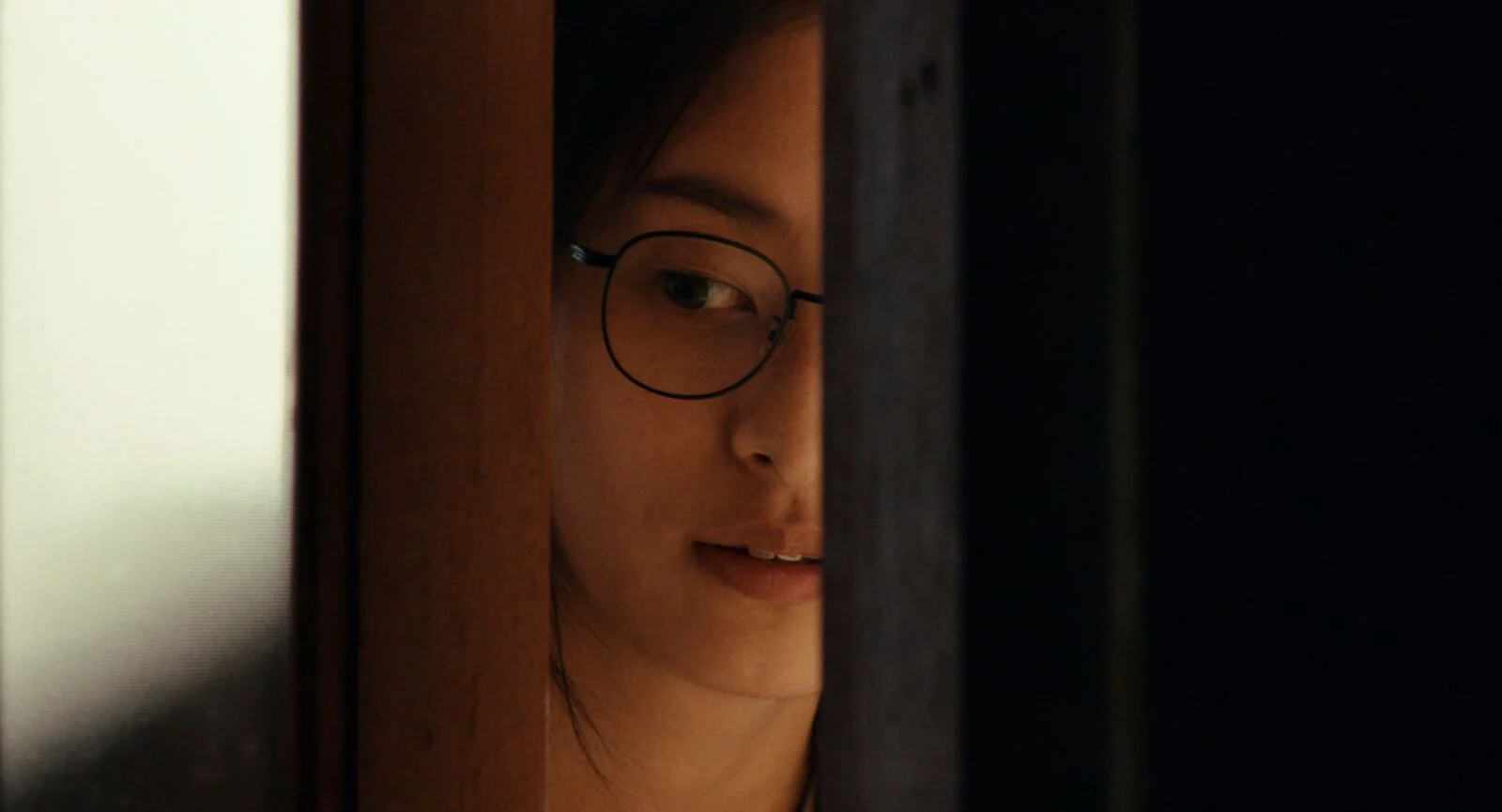
Soo-Ha (Bella Kim) is so fascinated by the new guest that she starts secretly watching him.
Soo-Ha (Bella Kim) works in a small guesthouse. Since she is the only employee who speaks French, she is supposed to look after the new guest Yan Kerrand (Roschdy Zem). The gruff man also sparks interest in her that goes beyond her professional life. Through a Google search she finds out that the guest is a well-known comic artist. The older man even catches her attention so much that she secretly observes him through a hole in the window cover – which she wouldn't have expected at all.
Like the young woman, we as viewers will soon want to know more about the eternally driven man. It quickly becomes clear that Soo-Ha sees more in the striking man than just a potential father replacement, that for her Kerrand also embodies a desire for an escape and a new beginning…
Longing for escape
The eponymous Sokcho, which is also popular because of its good connections to Seoul, is a medium-sized coastal city in Gangwon Province in northeastern South Korea, which is primarily used by tourists as a starting point for a trip to the nearby Seoraksan National Park. A classic place of passage that is hardly frequented in winter and therefore appears empty and lonely, which Kamura captures in sometimes oppressive images permeated by pale light. It's no wonder that Kerrand's appearance seems like a small explosion in the gray everyday life of young Soo-Ha.
The frozen landscape also has a symbolic relationship to the social environment: the protagonist's mother (Park Mi-Hyeon), a fugu specialist who can fillet the infamous fish without the deadly poison getting into the flesh, absolutely wants her daughter to get married as quickly as possible. Soo-ha's boyfriend Jun-Oh (Doyu Gong) seems a bit more modern at first glance, even wants to pursue a modeling career, but then demands that she undergo cosmetic surgery like him. With the justification that everyone in the city would do that, he isn't that far removed from his mother's provincial mentality.

A quiet connection develops between Soo-Ha and the much older Yan Kerrand (Roschdy Zem).
The individualistic Kerrand is of course out of the ordinary; he seems to live his life the way he wants. But the connection between the two remains untempered, as cool as the winter landscape in which the film takes place. In the end, Kerrand remains just a guest who comes and goes. Nothing happens, as perhaps nothing will ever happen in Sokcho. However, the film does not fall into bitterness, at least a small new beginning is imminent, the guesthouse is being renovated and made ready for the future – and Soo-Ha doesn't stop dreaming either.
Conclusion: A quiet but all the more powerful story of a fleeting encounter that triggers a whirlwind of emotions in the young employee of a small guesthouse. “Winter in Sokcho” flirts a little with clichés, but it lets expectations go nowhere, which makes the film even more resonant.