
An ARD correspondent was vehemently attacked for the completely harmless remark that October 7, 2023 had a historical prehistory – with the sentence she in no way wanted to trivialize the Hamas massacre of around 1,200 Israelis, but rather just pointed out that history does not happen in a vacuum.
Given such heated reactions, one can guess how the historical drama “Palestine 36” will be received in Germany. The Palestinian-American director Annemarie Jacir tells a crucial episode in Palestinian history from a Palestinian perspective. This is sometimes one-sided; parallels to the present day of the Israeli occupation often seem too strenuous – but at the same time the film develops great emotional power, and in Germany in particular it could help to sharpen the view of the Middle East.
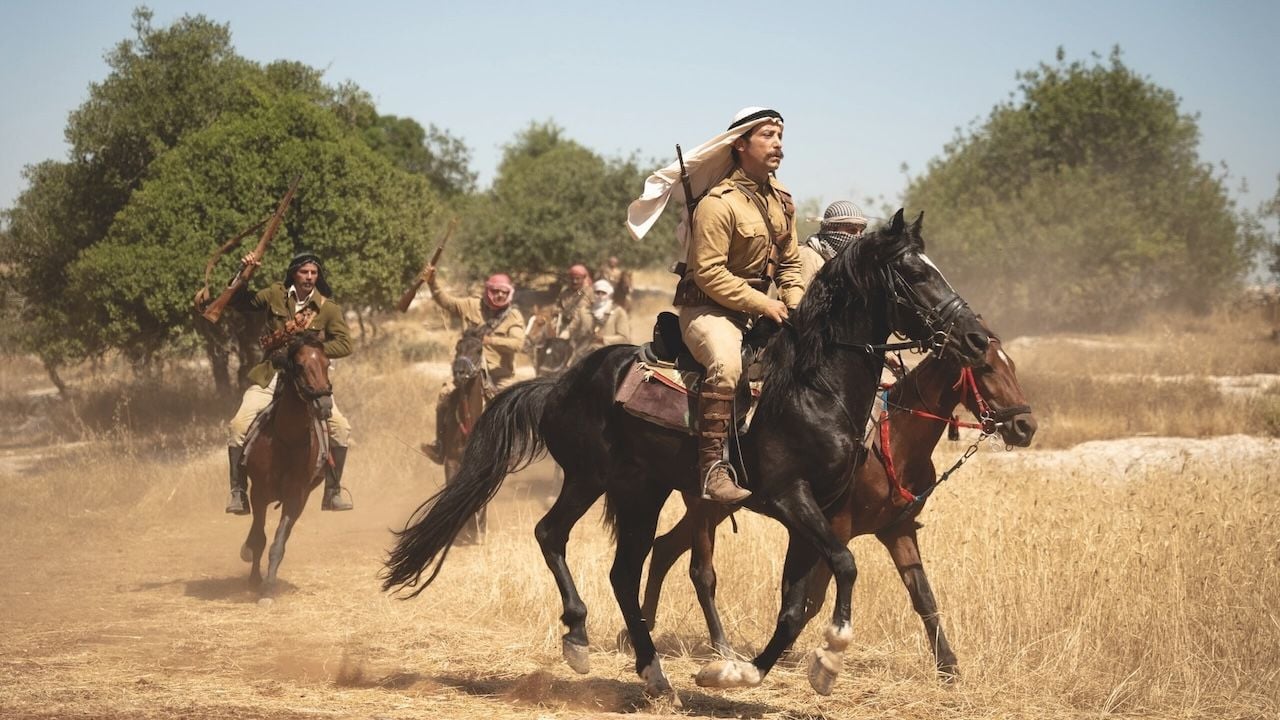
Resistance against the British colonial administration is forming in the Mandatory Palestine.
Palestine, 1936: The British colonial administration rules the region between the Jordan and the Mediterranean. The young Yusuf (Karim Daoud Anaya) comes from the small village of Al Bassa, where people struggle to survive, but also works in Jerusalem. He is the chauffeur for an intellectual couple – the radical journalist Khouloud (Yasmine Al Massri), who can only publish her texts under a male pseudonym, and her husband, the publisher Amir (Dhafer L'Abidine), who is primarily interested in maintaining his social status.
While the farmers of Al Bassa feel threatened by the growing number of Jewish kibbutzim, the British administration is actually supposed to mediate between the population groups. But the high commissioner of the colonial administration, Wauchope (Jeremy Irons), always sides with the Jewish settlers when in doubt. The anger of the Palestinian population grows ever greater and finally erupts in a nationwide general strike, which is seen as the beginning of the Arab uprising in Palestine.
Who owns the land?
In 1936 the Middle East was still firmly in the hands of the colonial powers. The British ruled Mandatory Palestine; the population was largely Palestinian, but the Jewish population was steadily increasing. Growing anti-Semitism in Europe led to a rapid increase in migration, and the demographic shift resulted in a loss of settlement and arable land – especially since the question of who actually owned the land was often regulated by treaties from the Ottoman period, which now proved to be insufficient.
Even 90 years ago, the Middle East was about land, about the question of who has the right to cultivate it, to live on it, to call it home. The director Annemarie Jacir, who was born in Bethlehem, tries her best to process the complicated background of this story in a way that is suitable for a feature film. She shortens some things and tells things too schematically, but one has to give her credit for not shying away from showing that it was often wealthy Palestinian landowners who voluntarily sold their land to Zionist settlers. However, these settlers in “Palestine 36” appear surprisingly briefly, representing little more than peripheral figures, while the actual antagonist is the British occupying power.
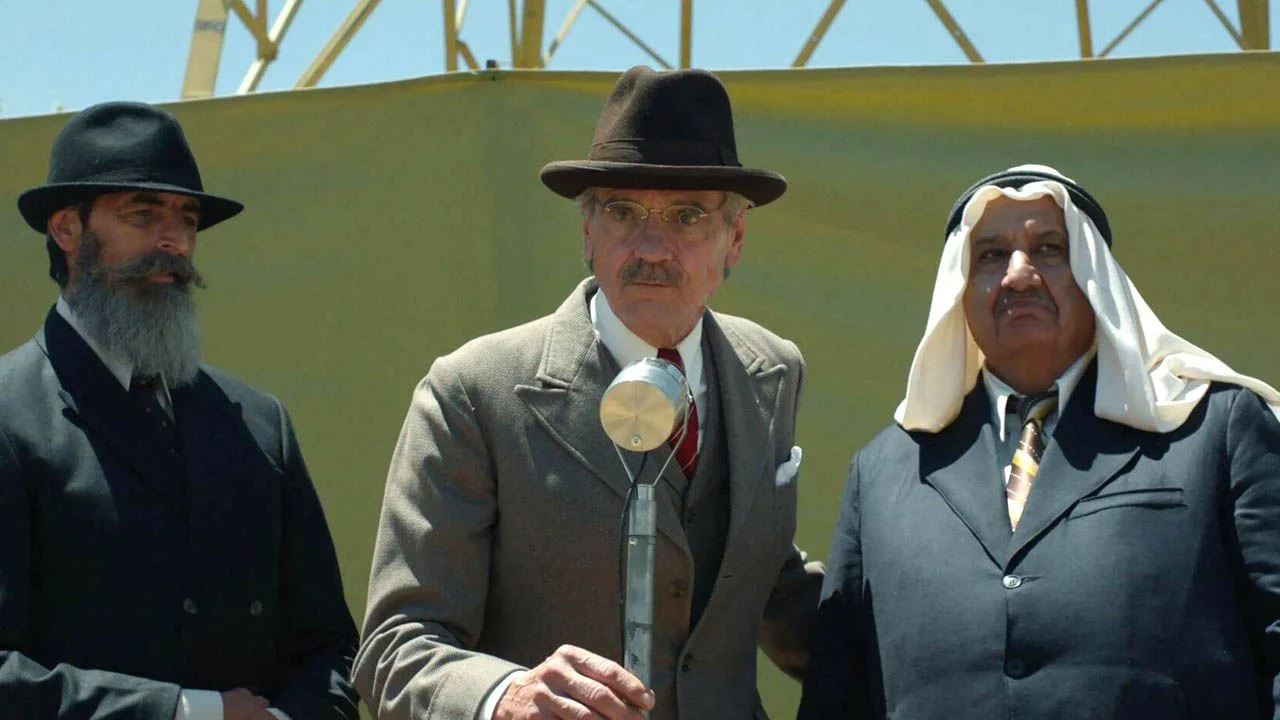
Jeremy Irons (center), who plays Wauchope, the high commissioner of the colonial administration, is a real British acting great in “Palestine 36”.
The British had actually promised through the Balfour Declaration of 1917 that they would work to establish a “national home for the Jewish people in Palestine” (i.e. what would become the State of Israel a few years later), but also assured that this would not be done at the expense of the region's non-Jewish population. A promise that was notoriously unfulfilled and is the cause of the region's tragic history. Jacir tells this story in her emotional film, which repeatedly tries to create parallels between history and the present: there is talk, for example, of a wall between the enemy territories, of attacks by settlers on Palestinians, of arbitrary murders and other forms of oppression.
Jacir tells this story in an emphatically one-sided way, stylizing British soldiers as latent sadistic types who now implement the methods they learned in India and other colonial areas to oppress the local population in Palestine. She repeatedly inserts documentary material that suggests, in a not entirely unproblematic way, that the staged scenes also tell the pure truth, presses the tear duct, shows suffering and displacement.
The Oscar chances are good
But who can blame her, especially since something like a Palestinian film industry has only recently existed and with it the opportunity to tell your own stories and give your own perspective visibility. So it's no wonder that “Palestine 36” was nominated by Palestine for the Oscar for Best International Film, where it has a good chance of going far because of its cinematic qualities, but especially given the current political climate.
Conclusion: It is often said that history is written by the victors. In this sense, “Palestine 36” can be understood as a necessary counter-narrative, in which a historical episode that is decisive for the Middle East conflict is told and the Palestinian view of things is decidedly taken. Yes, that's one-sided – but the perspective is legitimate, and the result is sometimes of great emotional power.
We have “Palestine 36“ seen as part of the Red Sea International Film Festival in the Saudi city of Jeddah.