
Saudi Arabia no longer wants to live solely from oil exports and is therefore diversifying its economy. One of the goals is to develop the local film industry while also attracting international productions. One of the first prestige projects was “Desert Warrior,” which was the most expensive film ever shot in Saudi Arabia with an estimated budget of $150 million. “Planet of the Apes: Prevolution” mastermind Rupert Wyatt was hired as director, and Anthony Mackie (formerly Falcon, now Captain America) plays one of the main roles. However, it will never be entirely clear whether the Marvel star embodies the desert warrior of the title, as large-scale production encountered considerable difficulties during the long-term production process. The result is a story that is more bumpy than exciting for a long time, until at the end Wyatt manages to bring a visually stunning desert adventure to the screen.
Arabia, 1,500 years ago: In mythical times, the tribes of the Arabian Peninsula were not yet united and had to fend off the invasion plans of the Sassanid Empire. Its ruler Kisra (Ben Kingsley) demands that each tribe send a woman to its harem. Princess Hind (Aiysha Hart) is also supposed to be brought to him. But their father, King Numan (Ghassan Massoud), refuses to comply with the order. With the help of a nameless warrior (Anthony Mackie), father and daughter manage to escape into the desert, but the brutal mercenary Jalabzeen (Sharlto Copley) is hot on their heels. Little by little, Hind succeeds in uniting the scattered, often hostile tribes of Arabia in order to stand up to the Sassanids together. The decisive battle is about to take place at a remote oasis…

Whether the nameless warrior (Anthony Mackie) or the courageous Princess Hind (Aiysha Hart) is the eponymous “Desert Warrior” is never entirely clear over the course of the film.
In English, “Desert Warrior” is a gender-neutral term; it cannot be immediately said whether it refers to a man or a woman. When development of the production, financed entirely with Saudi money, began in 2020, the original script reportedly still focused on Anthony Mackie's unnamed warrior. However, later versions of the script shifted the focus and made Princess Hind an emancipated figure who brings the tribes together. In 2021, filming finally took place in the spectacularly scenic Saudi desert. The fact that it took four whole years until the film was finally presented to the public indicates how problematic the post-production was and how much struggle there was to find the right sound during editing. In the meantime, director Rupert Wyatt had even said goodbye to the project. Ultimately, however, he returned and created a final version, although its problematic origins were noted for a long time.
“Bumpy” is probably the best description for the plot: Mackie's warrior appears sporadically every now and then, saves the princess, but then disappears again for a long time – wherever, the desert is wide after all. The attempt to turn the princess into a revolutionary figure who would unite the Arab tribes, however, often seems a bit intentional: What exactly sets the princess apart and why she is suitable as a leader? You can only guess. In combination with the always breathtaking desert landscapes, she often seems like a Mary Sue of Arabia, a figure who appears to be deliberately emancipated rather than narratively convincing, not to mention historical authenticity.
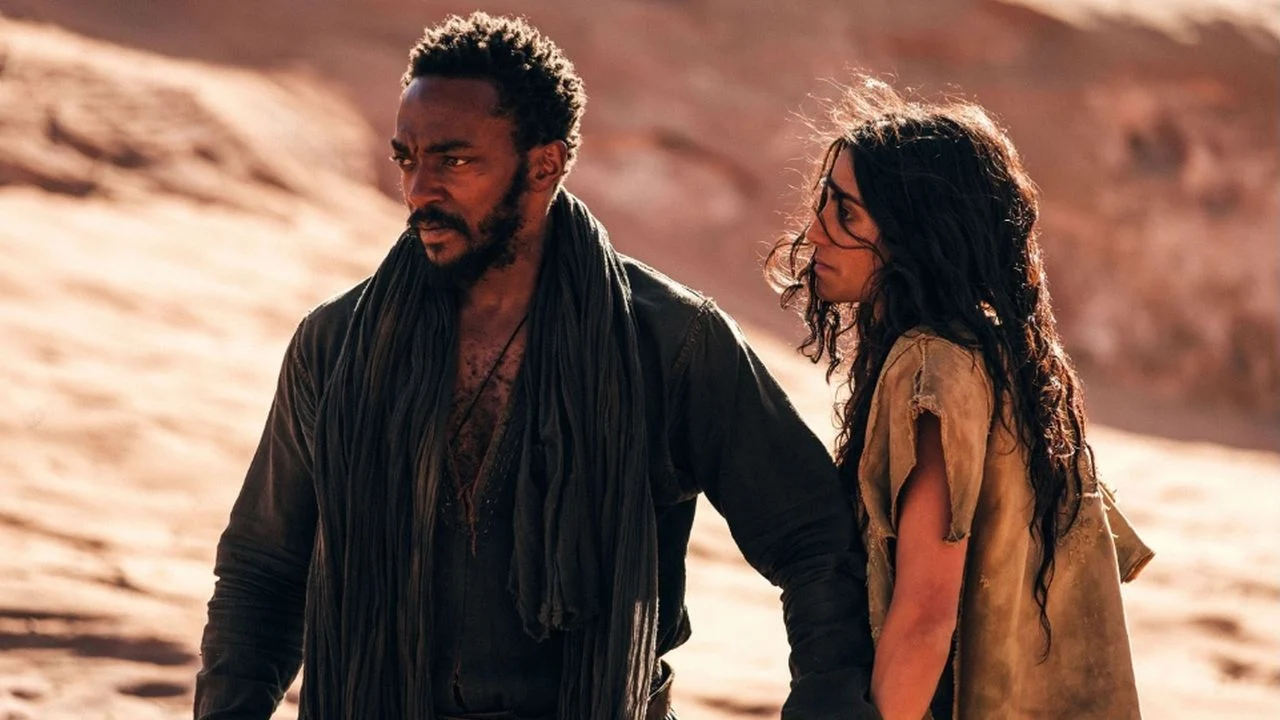
It takes a while, but by the finale at the latest, “Desert Warrior” will achieve its desired epic size!
“Desert Warrior” achieves impressive epic grandeur precisely when it doesn't take the real history of the region too seriously, but drifts into areas of fantasy and mythology: When Ben Kingsley, in his only, brief appearance as the sadistic king of the Sassanids, sits on his throne in the capital Ctesiphon and orders a gruesome execution, it seems more like a scene from “Mad Max” – but it's a lot of fun! Like the wild quotes from “Play me the Song of Death” to “Lawrence of Arabia” – or the appearances of the South African Sharlto Copley (“District 9”), who brings the necessary camp to the events as a brutal mercenary and has cronies with Scottish (!) accents.
Especially in the last act, when the meandering plot finally brings all the characters together and allows them to collide in a final battle, “Desert Warrior” develops into the exuberant desert epic that it wanted to be all along. There were spectacular landscapes to see before, but in the end you finally see where all that money was wasted. This is not yet a great Saudi epic, but it hints at what can be expected in the next few years if the Saudi sovereign wealth funds open the budget floodgates even further. In any case, there are plenty of impressive locations that are worth putting as much effort into showcasing as possible.
Conclusion: “Desert Warrior” is more than loosely based on historical events from early Saudi history, which Hollywood director Rupert Wyatt shapes into a somewhat artificial feminist story. Especially in the last third, the visually stunning desert adventure reaches an epic size and is still convincing as an impressive adventure film, at least in the last few meters.
We saw “Desert Warrior” as part of the Red Sea International Film Festival in the Saudi city of Jeddah.