
The title of the Slovenian Oscar candidate for Best International Film 2026 is based on Sonic Youth's song “Little Trouble Girl,” which plays from the protagonist's headphones at the end. Otherwise, Urška Djukić's debut film, which is interspersed with sensual images of nature, is dominated by church chorales – it tells of a girl's first sexual awakening in a strictly religious environment. “Little Trouble Girls” knows how to inspire with a successful audiovisual concept. But unfortunately the film increasingly gets lost in any random story development.
Shortly before a school choir weekend in a monastery in Cividale del Friuli near Trieste, the introverted 16-year-old Lucija (Jara Sofija Ostan) befriends the self-confident Ana-Marija (Mina Švajger). During the trip, the summer atmosphere and the rigid set of rules give rise to new feelings and inner conflicts in the previously completely inexperienced young person. While the demanding choir director (Saša Tabaković) expects full concentration from the girls, Lucija begins to perceive her awakening sexuality and question her faith for the first time.

Lucija (Jara Sofija Ostan) and Ana-Marija (Mina Švajger) get closer to each other at the school choir weekend.
“Little Trouble Girls” finds beautiful, but also overused, metaphors for inner desires and Christian limitations: crosses, the kiss of a marble figure of the Virgin Mary or flowers pollinated by bees. Djukić's debut isn't exactly subtle. To do this, he consistently translates the protagonist's heightened sensory perception into his form. Not only does the image level convey the visual feelings of the young people struggling with their feelings, the soundtrack also reflects the volatility and restlessness of Lucija's inner life.
This sometimes follows the choir director and then a fly or suddenly lets us hear the sounds of a stream or the whispering of Lucija's choir mates in an exaggeratedly loud manner. Meanwhile, cameraman Lev Predan focuses attention on the summer beauty of nature and the omnipresent Christian cultural monuments. He also empathizes with the gaze of the young protagonist, who for the first time allows herself to develop sensual, even lustful thoughts as she runs her eyes along her friend's lips or stomach or the muscular bodies of the craftsmen busy renovating the convent.
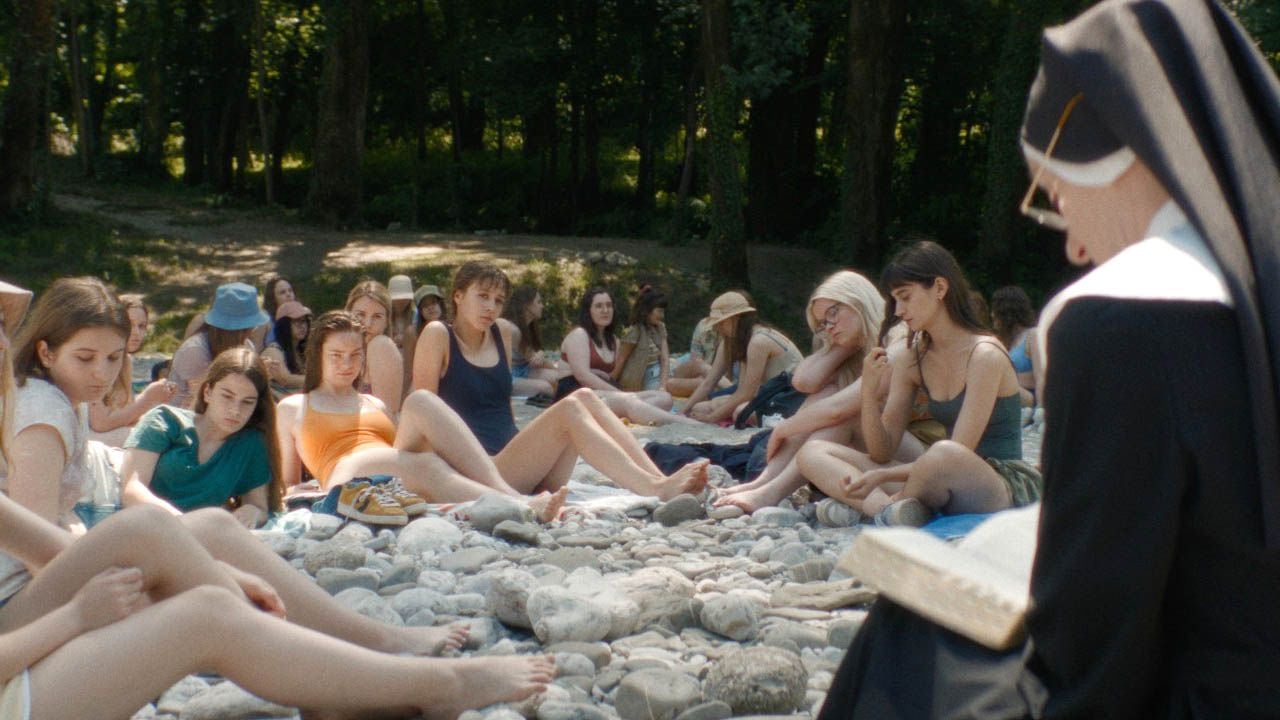
The summery, relaxed atmosphere is deceptive – the girls are under constant observation.
Ultimately, Lucija, portrayed with great curiosity and naivety by Jara Sofija Ostan, remains trapped in the corset of social norms and only experiences the first flicker of longing. Fortunately, because of her late awakening sexuality and her complete inexperience, she is not teased or ostracized by the other girls. Rather, she finds a friend in the already experienced Ana-Marija, who pulls her along and apparently makes it her mission to accompany Lucija on her path to self-discovery – especially since Lucija herself admits while spinning the bottle at night that she doesn't yet know exactly what she's actually longing for.
Her tentative glances are aimed at both sexes; Whether this means pure interest, admiration or genuine attraction is left open. Lucija is always very aware that these new longings contradict the omnipresent Christian values. In stark contrast, Ana-Marija is portrayed as a flirtatious teenager who knows exactly how she affects others. In contrast to the inexperienced protagonist, Ana-Marija appears almost like a provocative seductress – an exaggeration that makes her figure drawing appear somewhat schematic at times.
Another film did it better
Apart from the audiovisual approach described, sexual awakening is treated in a more traditional narrative manner. “Los Domingos”, which also captures the first experiences at a Christian school and the rehearsals of a church choir and was awarded the Golden Shell in San Sebastián in the same year, offers a more exciting approach – precisely because the protagonist here does not simply want to rebel against Christian ideas, but on the contrary joins a convent of her own accord at the age of 17 and is even met with incomprehension from her own family.
As much as “Little Trouble Girls” focuses on the protagonist’s emotional level, the production is not interested in actually exploring possible courses of action. Neither a developing love between students, nor a more intensive confrontation with the choir director, nor an approach to the craftsmen are narratively deepened. The summer days in the Italian monastery pass by without much drama and are only charged with a formative force in Lucija's perception, constantly oscillating between the desire to try things out and chaste reserve. Against this background, her surprisingly direct question to a nun – how she copes with a life without intimacy – already seems like a radical moment of questioning the Christian agenda.
Conclusion: Urška Djukić's feature film debut captures the sexual awakening of a sixteen-year-old on a summer school choir weekend. While the audiovisual realization of the young people's restless world of thoughts is excellent, the story, with its exaggerated visual metaphors, is a bit too aimless to really stand out in the coming-of-age genre.
We saw Little Trouble Girls at the Seville Film Festival.