
“We believe you”, the debut film by the Belgian directing duo Charlotte Devillers and Arnaud Dufeys, which celebrated its world premiere at the Berlinale 2025, really gets the most out of its radically reduced concept! The court drama focuses on an hour-long hearing before a family judge in real time – without flashbacks, without music, without narrative digressions. The consequence of this formal rigor opens up a view of a legal dispute that has been going on for two years and a tragic family history that unfolds layer by layer with each further statement. The chamber play is supported by an excellent ensemble…
… above all Myriem Akheddiou (“Two Days, One Night”) as the mother struggling to keep herself together, fighting for sole custody and against the father’s visitation rights. So it's no wonder that “We Believe You” won several awards at the European Film Festival in Seville: with the Women in Focus Award, the awards for best actress and best screenplay, as well as the festival's main prize, the Giraldillo de Oro. “We believe you” doesn't let you go long after it's over; the impact of the legal ordeal and the family trauma that comes to light during the trial is too great, while as a viewer you literally feel like you're in the room.
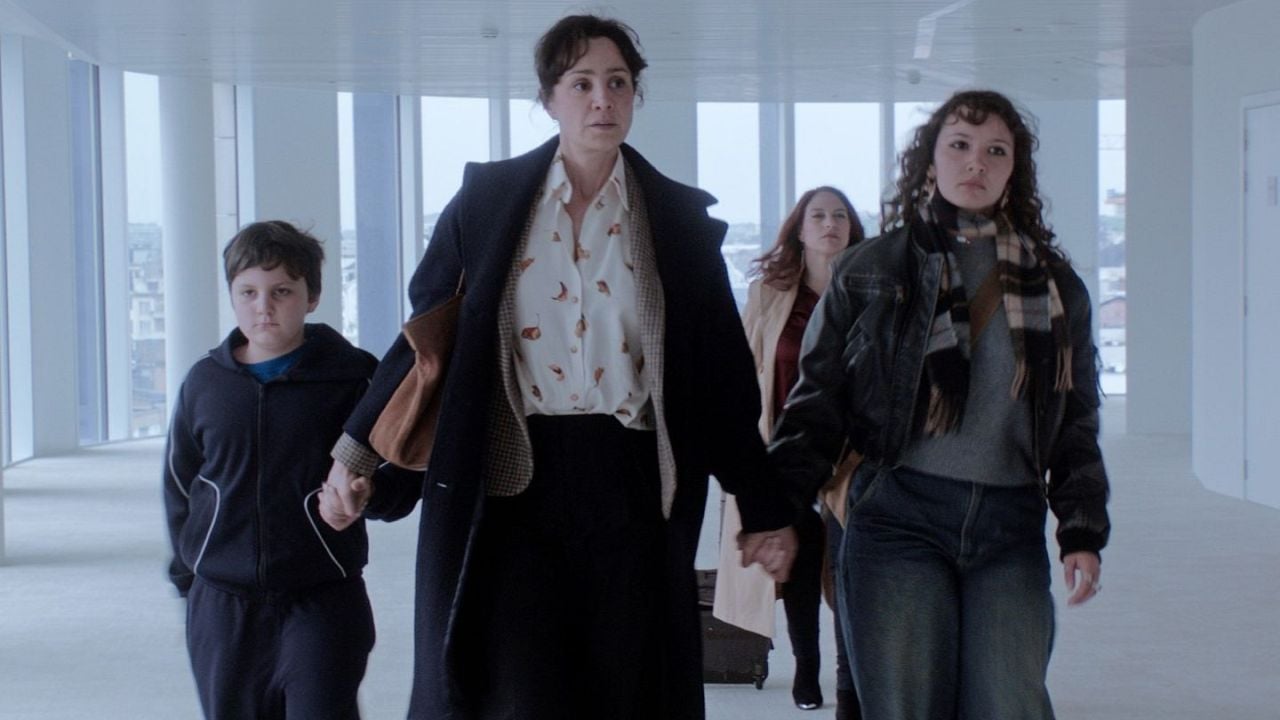
Alice (Myriem Akheddiou) makes it to the court date with her children just in time.
Etienne (Ulysse Goffin) throws himself to the ground screaming while his mother Alice (Myriem Akheddiou) desperately tries to pull him onto the tram. They have to arrive on time for the hearing, which their teenage daughter Lila (Adele Pinckears) also comes with. The absent father (Laurent Capelluto), against whom criminal proceedings are ongoing at the same time, has applied for access rights. Although the boy had asked the family judge in writing not to have to meet his father, he suddenly found himself sitting in the waiting room with his lawyer. This finally escalates the already fragile situation. The following emotional outburst initially seems excessive, almost hysterical.
But as the plot progresses, it becomes clear how deep the psychological injuries run. After the children have spoken to the lawyer appointed by the court, everyone involved – in addition to the parents, the respective lawyers and the children's legal representative – are called into the brightly lit, glass meeting room. The judge asks each of the five people present to present their point of view one after the other and, if possible, without interruptions from the others. What follows is a gradually unfolding horror scenario that has been going on for two years…
Like under the magnifying glass
The camera remains almost exclusively in the hearing room. In their production, the directing duo refuses any visualization of the allegations or experiences. Instead, the story unfolds almost exclusively through long, precisely written monologues. The audience's head cinema takes over the image work, the sterile meeting room acts like a hermetically sealed magnifying glass – not only for the words, but also the looks and body language of the people present, which are often focused on for minutes. The camera not only observes those who are speaking, but also those who have to remain silent – and shows shame, fear, anger, repression and incomprehension on their faces.
The ensemble carries this understated production with impressive unity. With the exception of the judge played by Natali Broods and the actors playing the parents, the other participants are real lawyers who played out the almost hour-long hearing in a single pass and in real time in front of three cameras. The nervousness and tense concentration in the room become almost physically tangible. How Myriem Akheddiou specifically holds back her tears, suppresses her disgust at certain statements, how her body oscillates between defense and collapse is captivating. When the desperate mother finally gets the floor herself and delivers her statement with increasing urgency, finally feeling that she has perhaps opened herself up too much in front of the judge, this is the climax of an already outstanding performance.

“We believe in you,” which is only 78 minutes long, impresses above all with its staging rigor, which ignores everything superfluous.
The concentrated, reduced concept is certainly not entirely new, but rarely has a courtroom been used so consistently as a psychological resonance box. Another clever trick that prevents the audience from taking sides too early is that the two children in question are only really given screen time after the hearing, when all other perspectives have been heard. The statements of the two young people are initially only filtered through the children's representative appointed by the court, who previously interviewed them together without their parents in a separate room about the situation and their wishes and expectations.
As little as possible should be revealed in advance about the actual content of the statements and the slowly unraveling family drama that will be discussed at the court hearing. Ultimately, the film thrives on the fact that the moral and emotional complexity is only revealed through the perspectives that are revealed one after the other. This would certainly also be ideal for a theater stage. Ultimately, it is the strict framework that proves to be the film's great strength: the limitation to the words and looks of five people in a single room does not limit the narrative here, but rather makes it appear all the more intense.
Conclusion: Concentrated, excellently played and painfully oppressive towards the end: “We believe you” is an outstanding family court game that tells the story of family wounds and the powerlessness of the justice system in almost real time. A film that overwhelms and resonates with the power of its words and actors.
We saw “We Believe You” at the Seville Film Festival.