
For most people, coming to terms with their own mortality is not a particularly fun activity. Despite this – or perhaps precisely because of this – the question of whether there is such a thing as life after death and what exactly that might actually look like has inspired numerous comedies. In most of them, the characters first end up in a kind of intermediate realm before it is finally decided where they are going – to heaven or hell. The sobering realization: Even after the very last breath, the burdens of earthly existence continue – further existential decisions have to be made, long-forgotten actions from the past are examined very carefully for their sinful content.
For example, the womanizer in Ernst Lubitsch's “A Heavenly Sinner” (1943) has to make a lengthy confession of his life in the antechamber of hell in order to, with a bit of luck, escape purgatory. In the Powell/Pressburger masterpiece “Errtum im Jenbeis” (1946), a pilot becomes the victim of a heavenly administrative error – and, after suffering a fatal accident, fights for a second chance in the afterlife court. In “Rendezvous in the Afterlife” (1991), Albert Brooks and Meryl Streep fall in love after their death in a transit zone that is very eloquently known as “Judgment City”. “Eternity” now follows a very similar line, in which director David Freyne imposes even greater hurdles on his departed staff.

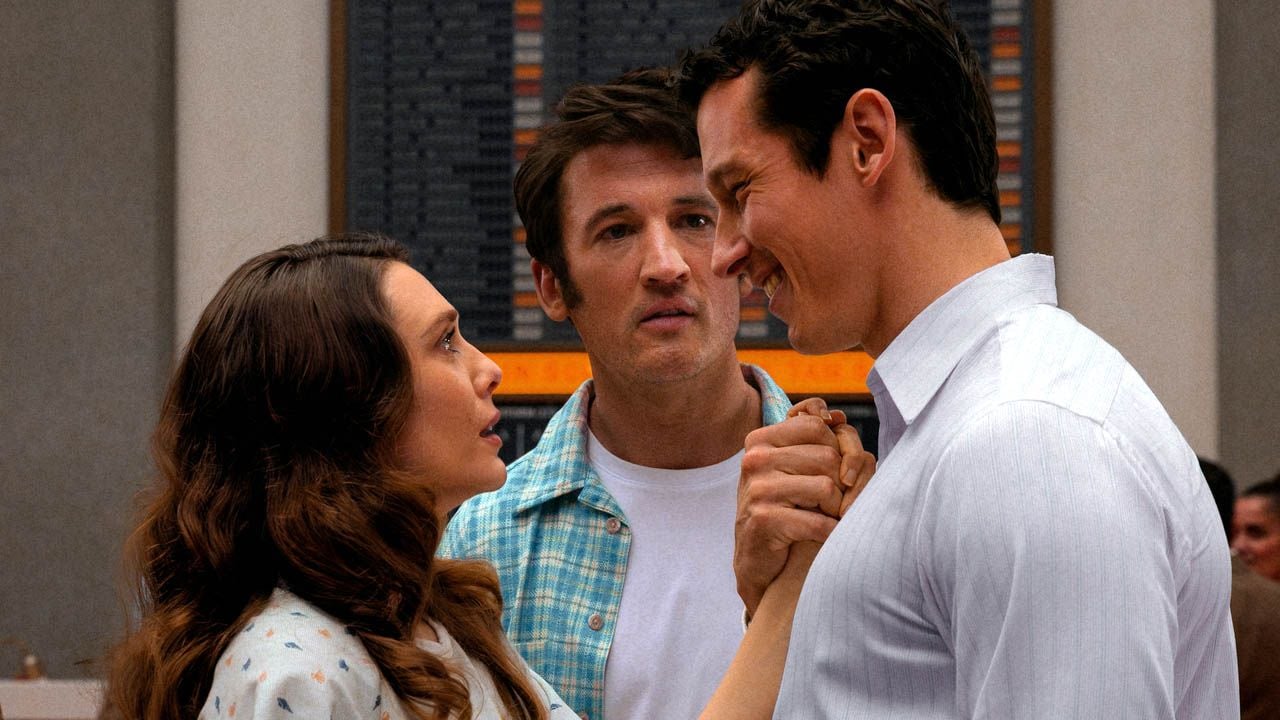
Having just died, Joan (Elizabeth Olsen) is faced with a dilemma: Should she stay with Larry (Miles Teller) forever – or try again with first husband Luke (Callum Turner)?
At the beginning, Joan (Betty Buckley) and Larry (Barry Primus), a married couple in their late 80s, pass the car ride to their grandson's gender reveal party with quarrels that are clearly old-fashioned. Arriving at the party, Larry is confronted with an old photo of Joan and her first husband Luke (Callam Turner), who died in the war – and then fatally chokes on a pretzel. When he opens his eyes again, Larry initially finds it difficult to grasp what has actually happened to him: he is wandering – in the body of a man in his mid-thirties (Miles Teller), because in the afterlife everyone returns to the person they were in their happiest moment – through a pastel-colored hall somewhere between the station lobby and the waiting area of an authority.
Only the encounter with Anna (Da'Vine Joy Randolph), who introduces herself as the afterlife coordinator responsible for him, gradually brings something like clarity: Larry is actually dead – and now has the task of choosing between a variety of possible afterlife options. The crux of the matter: once you have decided in which world you want to spend your personal eternity, there is no going back. Soon Joan (Elizabeth Olsen), who is also rejuvenated, stands in front of him, but only a short time later she succumbed to cancer. But the relief at the unexpected reunion only lasts for a short time: The nice bartender who has just prepared Larry a drink turns out to be none other than Luke, who has been waiting for his wife to arrive since his death in the Korean War 65 years ago…
Memories of Pixar come back
In the first half, director David Freyne spends a lot of time and energy establishing the rules of his afterlife and having fun with their possibilities. Like a hidden object picture, he hides more details, gags and references in the controlled chaos of the metaphysical reception hall than one can absorb at first glance. The causes of death of many of the other newcomers can be seen from their appearance – and the realities of the afterlife advertised on billboards range from hospital soaps to a Weimar world (“Now with 100 percent fewer Nazis”) to a capitalist eternity (which differs exactly from our real world?). Even if the quality of the jokes fluctuates and “Eternity” exposes its ideas, some of which are no longer entirely fresh, a little too much, it is reminiscent of the love of storytelling of better Pixar productions – especially the thematically related, if somewhat more abstract-loving “Soul” (2020).
The triangle rom-com also works excellently for a long time because Freyne stages it in a pleasantly classic way and trusts in the chemistry of his three main actors. You understand only too well the dilemma Joan finds herself in: with Larry it's funny, easy, familiar; with Luke fresh, exciting, full of erotic promise – both pairings deserve their own film. At one point, something even seems to arise between the rival men, but “Eternity” doesn't dare to go so far as to at least seriously think about a form of relationship outside of the heterosexual two-way constellation – just as it isn't particularly interested in the rest of the tricky potential of the dilemma it has raised itself, beyond the obvious.
It could be like that forever – but maybe living forever with Larry on the beach isn't the right thing in the long run.
Ultimately, the film touches on complicated questions with its what-if scenario: Is love ultimately always replaceable? Is a relationship worth pursuing, even if it will always be a second-best option? How is closeness constituted and how do you deal with conflicting needs when only one of them can actually be fulfilled? “Eternity” chooses the easy path by steering its complicated web of love towards rather simple truths – it is precisely its finitude that makes life worth living, and when in doubt, it is best at home.
Before that happens, the tone of the film turns into a melodrama, which sometimes weighs up the pros and cons of every conceivable outcome in a somewhat heavy-handed way – and therefore doesn't want to find an end. Nevertheless, this thoroughly ambitious draft of a fantasy rom-com that playfully conceals its budget limits is fun for a long time by reflecting on timeless screwball virtues that don't find their way onto the screen so confidently anymore.
Conclusion: “Eternity” falls into two halves: the lively screwball comedy in the afterlife is replaced by a somewhat drawn-out melodrama that ultimately makes things a bit too easy for itself. You can still have fun with this colorful and playful triangle rom-com.