
The feature film debut by Jaume Claret Muxart grows from the movement. The Catalan director begins with pictures of a forest passing by. Branches, trunks and leaves rush blurry along the camera. Muxart's figures run through the world, sometimes on foot, but above all by bike. Traveling around gives “Strange River” its structure. However, this Spanish-German co-production is less concerned with a clear linear story, but rather a loose constellation. It shows growing up as a summer odyssey, which lets the eyes wander here and there and is looking for an ambiguous one. A decelerated cinema that captures a youthful attitude to life about repeated change and standstill. It learns how the world opens in all its possibilities, while it is still afraid to hardly get off the spot and in the end to lose itself.
“Strange River” tells of a teenager named Dídac (Jan Monter), who takes a bike tour along the Danube with his family. There are the father and the siblings and Dídac's mother, an actress who is preparing for her role in a staging of Hölderlin's “Death of the Empedocles”. Meanwhile, Dídac herself revolves around his first romantic and erotic experiences. And then he sees a strange young man who suddenly swims out of nowhere in the river …
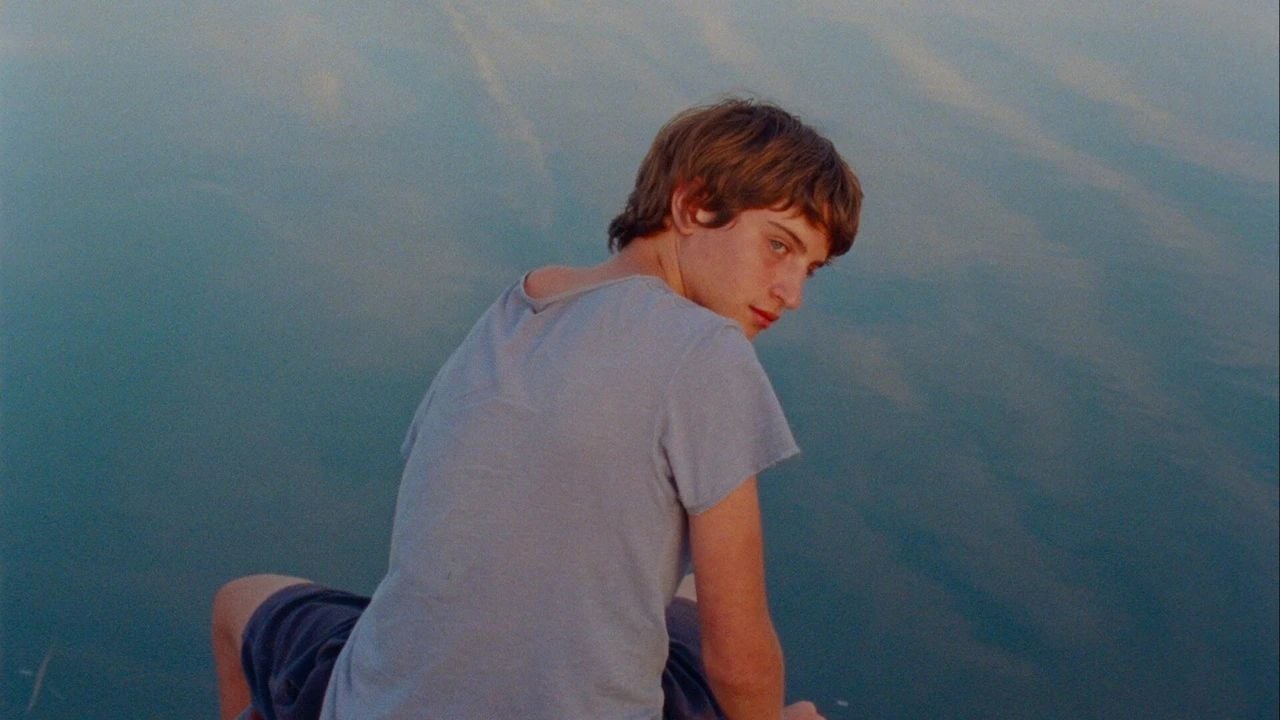
Teenager Didac (Jan Monter) experience his romantic and erotic awakening on a bike tour along the Danube.
From the beginning, a magical realism runs through this film. Or at least something unreal, dreamwalking. The appearance of the stranger initially resembles a natural violence as if there was a mythical creature, a male nymph perhaps, the water originated. It could also be mere imagination. Later, “Strange River” from the repeated up and down of this figure developed the echoes of a romance that seems to bridge space and time.
Is that a recent, an image, or the encounter with the stranger per se? Who is he and where does he come from? What does Dídac's mother have to do with him? With this figure, Muxart primarily creates a personified desire that follows the main character at every turn and keeps having going over again. It is like a enigmatic ghost, can never be grasped, has disappeared as quickly as it appeared.
A teenager discovers his feelings
In general, the desire determines the mood of “Strange River”. Sometimes she only sulky, sometimes she is provided with melancholy, oppressive heaviness, then she lends herself uninhibitedly. They are the small formal and technical gadgets that make the film look so beguiling. In one of the most impressive scenes, the young person merges with nature. Dídac masturbates on the river, while the music continues to swing up and the landscape gradually overlaps the ecstatic body as if it were dissolved in air. The first heartache and the first exploring of your own shoots are portrayed here as an almost overwhelming event. It develops such a force that puberty and all their conflicts the family suffer like a symbolic storm.
When the children will finally grow up, the parents think in the tent at night when they hear again how the boys bang together again. Apparently the maturity cannot come fast enough to finally be able to live more easily. At the same time, you can feel the alienation process between the generations that goes hand in hand with it. “Strange River” sneaks back and forth between his figures and perspectives, gradually working out individual dynamics between the characters in small vignettes. However, many backgrounds remain unspoken until the end.
Queerness as normality
This dances positively when it comes to the question of sexual orientation. In “Strange River” this is not up for discussion. It is also surprisingly quickly dissolved in the dialogue between father and son, even if the understanding of one another reaches its limits. The queer trains of the Dídac figure are not the central conflict of the film, but a lived normality. Now one could ask: what is the conflict of the film anyway? Is there one? And here “Strange River” interprets various tracks, whether it is simply about the question of self-discovery and shame in front of your own feelings, the ambivalent relationship with the parents and their crises or the very general foreign and lost in the world. In its final on a boat, the film condenses all the threat that can also go hand in hand with young emancipation.
If you are honest: you have to bring a certain joy in latency and openness and appreciate it as aesthetic potential. And maybe the film remains vaguely regarding its characters when it would do its narrative scope. This film loves its empty spaces. Precisely because “Strange River” is primarily trying to capture a disoriented state. He oscillates between emotions and moods. He lives from his atmosphere and the omissions that directly set a question mark behind every emotion and observation. Muxart trusts that his audience realizes that very universal conflicts between the generations and around puberty can be seen.

Jaume Claret Muxart's “Strange River” captures the beauty and sensuality of the landscapes in beguiling 16mm images.
If you get involved in this indulgent process, scabbing and curious about, then you will be rewarded with an immense sensuality and beauty in the 16mm recordings. Because “Strange River” is primarily a film about landscapes, about which pictures, but also their sounds and noises. Muxart tries to aesthetically capture the summer. The sunlight, swimming in the cool river, but also the pounding rain and storm. It is fascinated by foggy forests, the rustling of the leaves and the sparkling water surfaces, which can take the canvas in their abstract light formations. Muxart's cinema is not a discursive one, but watches, smells, smells, tastes, listens, feels with the camera. And it only rubs your eyes briefly at the end of his vacation trip.
Conclusion: In “Strange River”, puberty, self -discovery and the first love in all of their ambivalent feelings become an elliptical travel cinema. This is not too original in his observations and might have been able to tolerate one or two more concrete clues and impulses. Nevertheless, Jaume Claret Muxart is an impressively stylish debut and a sometimes beautiful, sensual summer film.
We saw “Strange River” at the Venice Film Festival 2025, where he celebrated his world premiere in the Orizzonti series.