
Lucrecia Martel, one of the most important directors of Argentina, tried a real mammoth project. After she has been responsible for the Oscar contribution “Zama” (2017) in recent years, which has dealt with colonialism, Martel is now returning on this topic. For years, the director worked on her first full -length documentary. “Landmarks” (in the original: “Nuestra Tierra”) is his concise title, for which Martel filtered and edited a wealth of material.
The Argentinian has made a real crime from the province of Tucumán, the processing and documentation of which suddenly reveals a huge network of structural violence that runs across history. At first glance, “Landmarks” sometimes appears very simply knitted, but the content burst almost from all the seams. The starting point is the murder of human rights activists Javier Chocobar in 2009. Chocobar was part of the indigenous people in the Chuschugasta settlement. Almost ten years passed before the perpetrators were sentenced to a prison sentence. According to interview statements, Lucrecia Martel started accompanying the case in film in 2010. A two -hour documentary has now emerged from the material, which wants to convey an impression of the dimensions (post) colonial devastation in Argentina and all of Latin America.
Several films in one
You can understand this project from a feeling of overwhelming. At least see after the first. “Landmarks” is a densely narrated piece of contemporary history, the portrait of a region, the portrait of a population group, both a piece of crime and a piece of national history. An interview- a court film and a landscape study at the same time. And Martel suddenly throws her audience into this tricky constellation and all of her cinematic layers, which she matters on impressive, but also frustratingly excessive and fragile ways.
“Landmarks” quickly makes it clear that he does not want to adapt to the audience. He does not want to please, not be digestible, but confront and shake up. It is not about starting with the original mucus and taking people by hand in the sense of a supervised vision. Martel provokes listening, discovering your own and ultimately researching. To what extent this is ignited individually in the audience. Martel puts the most important background and cornerstones of the crime in order to then listen to different people, to search through documents and to associate filmically.
Documents of violence
It is not always easy to follow the whole. Not least because this film, as indicated, does not expose in the classic sense. Martel's protagonist appear less than tangible characters than as a representative and parts of an overall picture, in which one is still at the beginning of a gigantic processing process. Numerous observations and faults, colonialism, exploitation, displacement and land robbery are responsible for the murder of chocobar. It is about how entire groups of people are silent, how their experiences are wiped out and hushed up. Martel tells of the struggle of indigenous peoples around the country and voice. And a dispute over a piece of land is also preceded by the murder of chocol.
Martel shows a video recording of the crime early in the film. Shots fall, it is shouted and called. The camera falls to the ground or does it roll down a slope? It is difficult to see that in the pixelated pictures. And Martel shows these pixels so close and large that another level is opened here, which not least thinks about the media of photography and film. “Landmarks” is also inevitably a meta-film about how to approach such crimes and all the political backgrounds that can be approached. How can the cinematic form itself become a counter -narrative and rebellious?
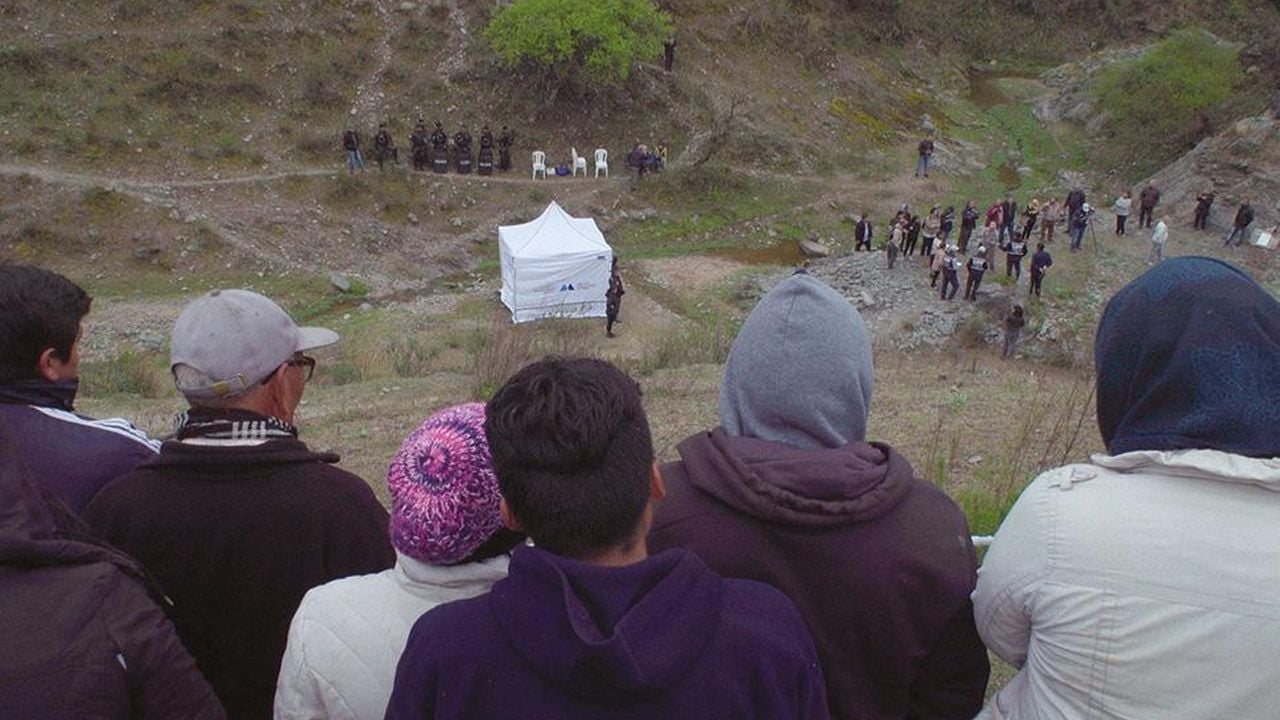
Again and again “Landmarks” attributes to the place of killing the indigenous human rights activist Javier Chocobar – in the form of pixelated video recordings, reenactments or drone images.
The rebellious often does not even result from the way Martel films individual people or situations, but rather from their very own tricky assembly. Martel sewes recordings of the place and the region around the crime scene, the controversial land train, with voices and experiences of the indigenous people. Image and sound don't always have to go together. It is precisely the gaps and breaks that Martel is looking for. Here trauma, anger and frustration are partly audible in memories and explanations, while the landscape itself only shows inconspicuous things.
So what stories do these pictures tell? Which can you tell? A few horses trudge across the meadow. Later, vehicles with headlights move through the dark and bump into a few cows. Nature is indifferent to the foreground of the people and this born does not seem to end. Even the text boards in the credits deliver the next deep blow.
Play with the head cinema
“Landmarks” also draws from a lush arsenal how people reconstruct crimes. The film shows reenactments, attempts to add the crime. Then it goes to court where Martel's camera looks over shoulders and hangs on lips. In addition, the director traces photographs to spread people on tables to tell stories whose roots go back several centuries. “This is the oldest photo”: Again and again the film shows show the most showing of people, and then you get to speak and think. Martel shows many of the photos in canvas -filling format. She gives her audience time and opportunity to study these old recordings and let look at their material.
Sometimes you stick to the disturbances and wear, the traces. Knicke in the pictures, scratches or the individual blobs of the color. In this respect, this film, which initially appears so brittle and confusing, gets its very own media sensuality. At the latest when the unmoved picture is suddenly accompanied with noises, so that it seems to be alive in the spiritual eye. Martel's film refers to the limits and possibilities of his own medium at the same time. Cinema and head cinema enter into interesting connections here.
A film that wants to disturb
In general, you have to emphasize the concept of the disorder again. Martel's film wants to disturb. And he wants to cross politically, even if this happens in very calm, sometimes dry, sober way. This is a committed filmmaking, which always explicitly exhibits its central messages and complaints, but, conversely, creates the urgency and ongoing relevance of the debates for a division, refusal to dismiss and exclude to the extinction of indigenous cultures and life realities. It is also about the question of mediation. Or just: the lack of teaching and conveying indigenous history. The supposed world history, whatever that should be, is said to have priority.
“Landmarks” is not a didactic lesson, rather a trim, a disparate arrangement of small sensitors and extracts. One can get annoyed that the director lets you fall a little in the dark with regard to many personalities and specific cultural and sociopolitical relationships. Last but not least, this includes the question for whom this film was made, which knowledge can or must assume. But you can simply appreciate it as a suggestion. And so the disorder succeeds: “Landmarks” ends a look away, even if only for a short time. The film itself knows that it has to inevitably encounter barriers of the conveyable in two hours of term.
A breakdown becomes the climax
Therefore, the most curious moment fits into this work: when the camera climbs into the sky again on a drone to see the landscape. Suddenly a bang, a tumbling, a fall. A bird flew against the camera. Other filmmakers would have this breakdown if you want to call it that, possibly cut out. In the curious experimenting aesthetics by Lucrecia Martel, this symbolic impact becomes a climax.
Conclusion: Lucrecia Martel provides for land robbery and the trauma of indigenous population groups in Argentina in “Landmarks” and, based on a crime, pretends to discrimination and violence. This made her an impressive game with photography and film, although without prior knowledge it is often difficult to keep up with all the reports and shown.
We saw “Landmarks” at the Venice Film Festival 2025, where he celebrated his world premiere in the official program except competition.