
With Anders Thomas Jensen (“Adams apples”) everything stayed the same. If the Dane turns a tragicomedy, you can now assume that it will be extremely macabre and dark. So also in “The Last Viking”, for whom the director again gathered Mads Mikkelsen and some other of his recurring actors in front of the camera. He also relies on familiar elements in style and narrative. In this respect, one could now anticipate the conclusion and say: “The last Viking” is a film for the director's fans. However, whether this is so contemporary and clever is on a different sheet.
Anker (Nikolaj Lie Kaas) sat in prison for 15 years and is now coming home where his brother Manfred (Mads Mikkelsen) received him. Manfred lives with a dissociative personality disorder. This means that his identity cannot be understood as a constant. He just thinks he was John Lennon from the Beatles and he forgot where he buried ankers robbed money at the time. Together they go in search of the treasure that they are not alone …
Is that going too far?
In the films by Anders Thomas Jensen, trauma, loss experiences and physical and mental disabilities have always been on objects of black humor. The author filmmaker has repeatedly exploited what you supposedly not laugh at and turned it into coarse gags. Tastelessness and provocation are parts of the concept. Jensen is looking for moments when the audience gets laughing in their throats and repeatedly and explicitly raises them to the subject of talks. So wanting him to attack him alone would be too short.
But this comedy cinema cannot completely deny the impression of the one who has fallen from time. From the first few minutes, when Mads Mikkelsen plays the intellectual disability and sets several attempted suicide several times, the nasty, abysmal humor lights up in a well -tried way. Especially because you often don't see the punch lines with Jensen. This filmmaker continues to master the surprises and the suddenness as a stylistic device with flying colors. At the same time, the absurd spectacle creates a fall height that the film later can only cover with naive eyewiping. The good approaches also use little.
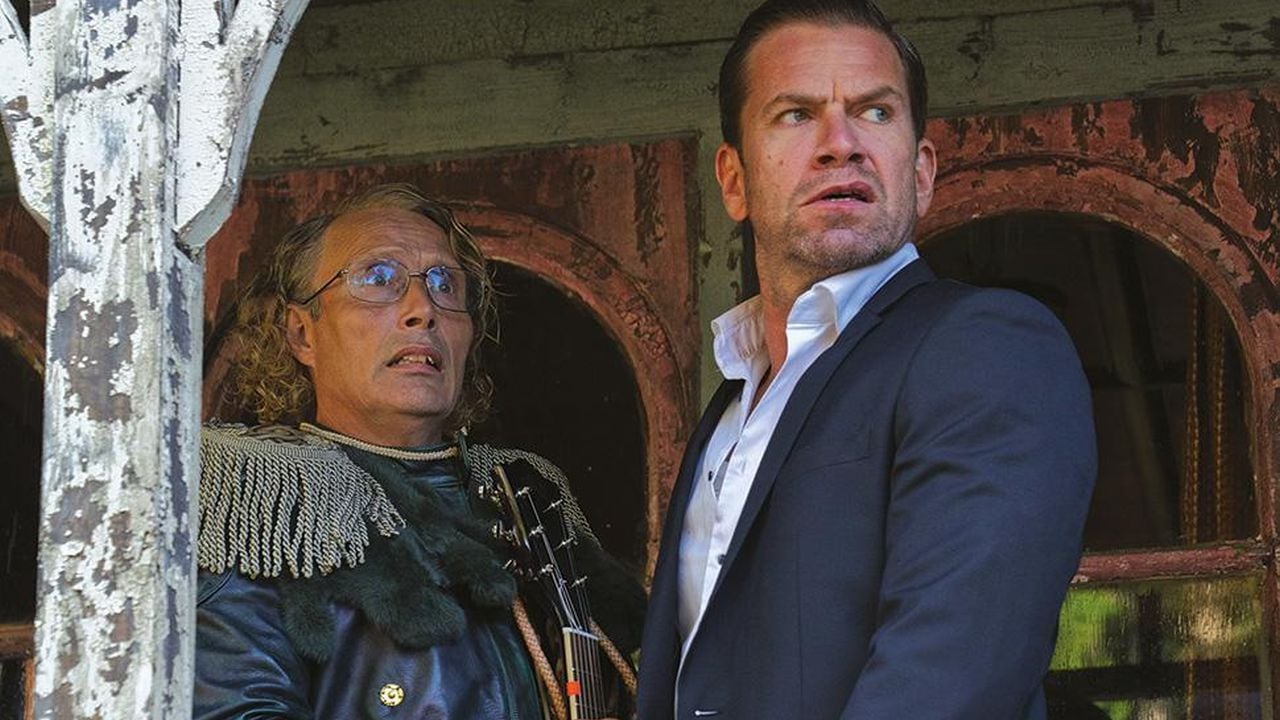
Go on treasure hunt together: the anchor (Nikolaj Lie Kaas), who was freshly released from prison and his brother Manfred (Mads Mikkelsen) living with a dissociative personality disorder.
Jensen confronts a majority and dominance culture with its own construction and lying. This level is also clearly laid out in “The Last Viking”. A majority society is usually not affected by disabilities, for example. They are not part of their practiced practice and the idea of normality, which leads to the exclusion and stigmatization of affected people. At the same time, you take a certain taboos of how you (not) have to be talked about or laughing about certain people without actually helping them. This is exactly where Jensen tries to expose a hypocrisy.
Whether this act of exposure and demonstration can be separated from reproducing certain clichés and ways of thinking at the same time is the controversy, narrow line, on which “the last Viking” is changing. At the latest when he gathers other people like Mads Mikkelsen's figure in which similar shared personalities are slumbering. If the planned comeback of the Beatles virtually becomes a comeback from ABBA, this ensures all kinds of situation comedy. But ultimately, this does not always lose something to blind in the pure malfunction and curiosity?
Pure heap cinema
“The last Viking” is, like various films by the director, Haudraufkino in the truest sense of the word. Jensen's image of man is one that is shaped by violence. You keep going to the throats. You hit each other and worse. When Nicolas Bro appears as a gangster and, if necessary, tortures and murders about the coveted money, this black comedy sometimes becomes extremely hard and bloodthirsty. But what does violence follow? What is the basis for her and how can you escape her? With these questions, Jensen knows that you look at his filmography, sometimes more and less clever answers.
His latest work is stirring from one chaotic scene to the next. Laughing, horror and thoughtful moments alternate in a hair -raising manner. In the end, Jensen wants to concentrate all of this in a discourse on identity. Thinking about disabilities, illnesses or in general about how we see ourselves and others is also intertwined with a brooding about artistic spectacle. Here the film becomes thematically interesting! Because Jensen shows that the final nor the tongue of the scales, but generally the momentum of a public, is neither a certificate nor be the tongue, the confrontation with other people.
Looking for reconciliation
Identity as part of a social role -playing game, says this film, requires belief and trust in something. And it requires a context that is artificially produced to create a credibility. Only then can she smuggles in her performance. But who determines the conditions for this? Jensen opens very large, very theoretical thoughts and fields of meaning in his dialogues. Unfortunately only to get lost in triumphal conclusions.
The second half of “The Last Viking” is touching, but also badly cobbled together. And this is not about the question of how tasteless or exaggerated this is, but how the tastelessness and crossing border are captured again. The thriller elements are first blown up and then cut off at no time. Surmitting about identity and what a society considers as different is provided in a thinly knitted plot about childhood trauma. Because it quickly becomes clear that the ditch and rummage in the forest floor turns further and further into the ditch in your own past and family history.

Does the film drift a clever game with topics such as identity or does it result in pure malicious joy? This is not always clear in “The Last Viking”.
Jensen's film has the heart in the right place. You can forgive him for all kinds of missteps. He wants to convey a utopian image of inclusion despite all the pain that his characters inflict. But in order to tackle the topic of inclusion properly and adequately, he would first have to pull his head out of the family small and realize that the discrimination from which he tells are sometimes so inconspicuous and structurally anchored in everyday life that his extreme examples and enemy images only act like straw man arguments.
This is an attached conciliatory that the cinema has been pouring over the audience for decades, but actually hardly comes from the spot. Jensen's film is therefore a needy wounds of associations that fall off again immediately in the next little movement.
Conclusion: Anders Thomas Jensen continues in “The Last Viking” where films such as “Adams apples”, “Men & Chicken” and “Heroes of probability” have stopped: with a lot of black humor and tastelessness, where everyone can still love each other. In his consideration of outsider figures and social structures, Jensen's cinema has meanwhile set a lot of dust.
We saw “The Last Viking” at the Venice Film Festival 2025, where he celebrated his world premiere in the official program.