
Have you ever heard of Lusatia? Probably the level of awareness of this region in southeastern Germany is somewhere between zero and not at all, at least in terms of the population outside the new federal states. One of the few tourist hotspots is the Spreewald on the northern edge of Lusatia. The rest of the region is slowly recovering from the rejection of the turning time. There is not much left of the former coal mining and industrial settlements today. For most people, structural change brought far -reaching changes: long phases of unemployment, sometimes multiple professional reorientation. Those who live here have gone through a lot.
One of these people is Wilma (Fritzi Haberlandt), the protagonist from “Wilma wants more“, A versatile woman in his mid -forties. She lives with her husband Alex (Thomas Gerber) in the Brandenburg Lausitz at the end of the nineties – where she is most broken: There are hardly any living between the decommissioned power plant storms and rotten industrial buildings, unless Wilmas Alpakas are again. Electrician and machine guide.

Wilma (Fritzi Haberlandt) still feels most comfortable in Blaumann.
But all of this is of no use. The hardware store in which it works has to close. Wilma loses her job, and when she comes home earlier, she catches Alex with her best friend-naked at the stove while cooking spaghetti. Wilma's reaction? She goes to Vienna, where her old friend Martin (Stephan Grossmann) now lives. For the Brandenburg native, the Austrian capital not only brings a powerful cultural shock with it, because who knows that a cheese rainer with mustard, rolls and canned beer in Viennese is called “purulent with a sharp, Bugel and sheet”? But Wilma does not give up, but keeps up with a good mood with optimism of purpose. “Allet becomes different,” she says and in it the hope of better times sounds as well as the desire to leave the past behind …
The last feature film by Maren-Kea Freese, “What I know about her”, was 20 years ago. Her cinema debut “Zoe” via a DJane in Berlin received the regret promotion award in 1999. The narrow oeuvre, apart from a certain preference for women with an unusual profession (DJane, pickpocket, craftswoman), shows hardly any clear tendencies. For her third movie, Maren-Kea Freese with the Lusatian craftswoman Wilma (again) chooses an unusual main character-and an action with discreetly feminist relationships as the basis for a self-discovery story. Wilma, this tangible Brandenburg native, who is looking for her way and does not lose her optimism or her belief in the good in humans, has a considerable bitter charm.
Craftsmanship and waltz courses
In short: Wilma is a woman with more corners and edges than most women treat herself. She is not careful about perfection – except perhaps during flush -mounted lines – and absolutely does not care about her image. It has a hard time, but it cannot be noted. Wilma does not complain, she shed a few inconspicuous tears and continues. The prime example of a patent GDR woman. Fritzi Haberlandt shines as Wilma. She celebrated her cinema debut in 1998 with “The Bride”, the last film by Egon Günther, who, like her, came from the GDR. In “Babylon Berlin” she is there from the start.
Fritzi Haberlandt played between the Thalia Theater Hamburg and the Vienna Burgtheater on all major German -language stages. Perhaps also because of her contacts to Austria, the native of Berlin became an ideal occupation for Wilma: a silent, reserved woman from the ex-DDR, who can be found in Vienna. That there is a flat share there. Live with a feminist author, fits you as well as the fact that she ends up on the so -called “craftsmanship”. Wilma is the only woman in Blaumann between the men to get a job. And finally she even gives dance lessons – Wiener Waltz for tourists.
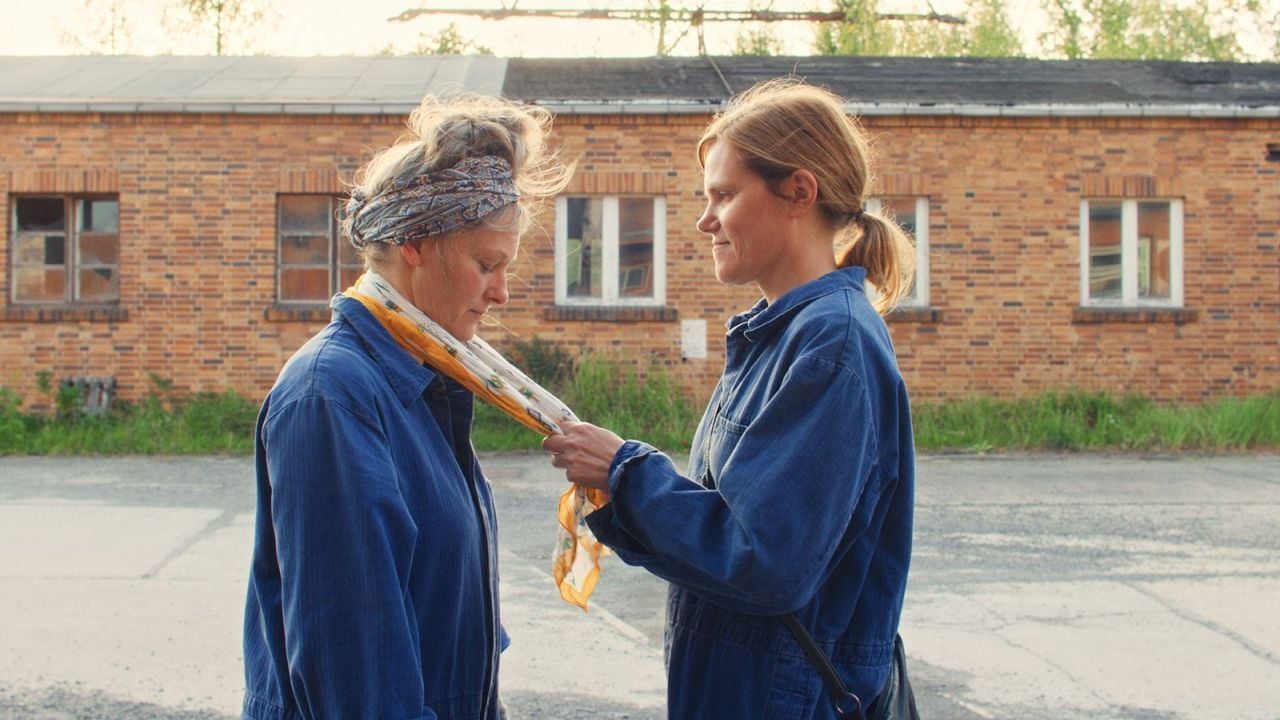
Fritzi Haberlandt is the big bright spot in a film that apparently doesn't really know what he actually wants to be.
Episoden, Maren-Kea Freese Wilma's experiences, some are funny, some touching, others again banal, all in a quiet atmosphere that only occasionally develops a pretty laconic charm. “Wilma wants more” could be a comedy, but the plot is not enough for this, and unless Wilma have no characteristics that would be necessary to produce comedy. It is quickly forgotten that the film will play at the end of the 1990s and does not matter at all. Too bad, because comedy potential was given away here too. In any case, excessive alcohol enjoyment and bagy wind jackets are not necessarily funny.
Conclusion: Fritzi Haberlandt is the biggest ray of hope in a film about a versatile woman from the former GDR who wants to build a new life in Vienna at the end of the 1990s. What a comedy could have been, unfortunately fluctuates somewhat undecided between episode film, self -discovery drama and turning story.