
Of course, the news was received in horror circles with great joy when a third part of the “28 Days Later” series was officially announced in January 2024. Especially since the original creator-director Danny Boyle and author Alex Garland-for “28 Years Later“After the first sequel” 28 Weeks Later “(2007), the Spaniard Juan Carlos Fresnadillo had taken over the reins. But the initial anticipation is a shit compared to the hype that broke off after the release of the trailer: above all a disturbing radio address – the march poem “Boots” by Rudyard Kipling, performed by the silent film star Taylor Holmes – did not get out of their heads.
No wonder that “28 Years Later” won three prizes for the 25th Golden Trailer Awards – including the cross -genre main prize “Best in Show” for the best trailer of the year. In the film itself, the “boots” poem, like many other built-in historical image and sound recordings, only prove to be one of many staged elements with which Danny Boyle gives its end-time dystopia an almost experimental note. At that time “28 Days Later” already explored the boundaries of the emerging digital technology – and 23 years later, the Oscar winner does not seem to be ready.

The ambitious Jamie (Aaron Taylor-Johnson) wants to teach his son Spike (Alfie Williams) particularly early on how to infected Killt.
According to the events from “28 Weeks Later”, the rage virus was pushed back from Europe to Great Britain, but since then the island has been under absolute quarantine. Nobody who has put one foot on her is left past the sea blockade. On the – by the way, real -existing – island of Lindis fern, which can only be reached at low tide via a narrow dam, has therefore formed a committed village community in the past 28 years: the scarce resources are available to everyone, but there are also signs everywhere to use them with carefully. This even applies to the public shower where it says in self -painted writing: “Please keep short.”
As a rule, the local children are taken to the mainland for the first time with 14 to 16 so that they can “celebrate” their first kill of an infected. However, Jamie (Aaron Taylor-Johnson) is particularly ambitious when it comes to his son, and is already hunting the twelve-year-old Spike (Alfie Williams). He has to struggle with other problems: his mother Isla (Jodie Comer) has not only suffered from severe headaches, but also worse dementia. But Dr. Kelson (Ralph Fiennes), the only doctor nearby, is considered crazy in the village community …
Blood -smeared teletubbies
In an interview with Vanity Fair, Danny Boyle explained why he and Alex Garland returned to the series after all the time: “There were two things that we absolutely wanted to install: Brexit and the Teletubbies.” Now a lot can be read into the post-apocalyptic isolation world from “28 Years Later”, because of the time proof, especially for Covid-19 pandemy. But most of all really gives the Brexit parallel, after all, the residents of Lindis ferns thrown back have only got that that so many Britishes voted in June 2016. A very cynical view of things that …
… But still not half as nasty as the integration of the teletubbies: In the opening flashback, in which it is described how the young Jamie experienced the day of the virus outbreak, a group of children is parked in front of a television, where Tinky-Winky, Dipsy, Laa-Laa and Po are showing their funny dances. But in the rest of the apartment, the adults do not celebrate a party, instead on the other side of the door, the pure panic seems to rule, which increases more and more to the children, regardless of how bravely they try to continue watching their aggressive and happy TV favorites-and then the blood, which stands out particularly clearly from the neon-colored world of teletubbies.
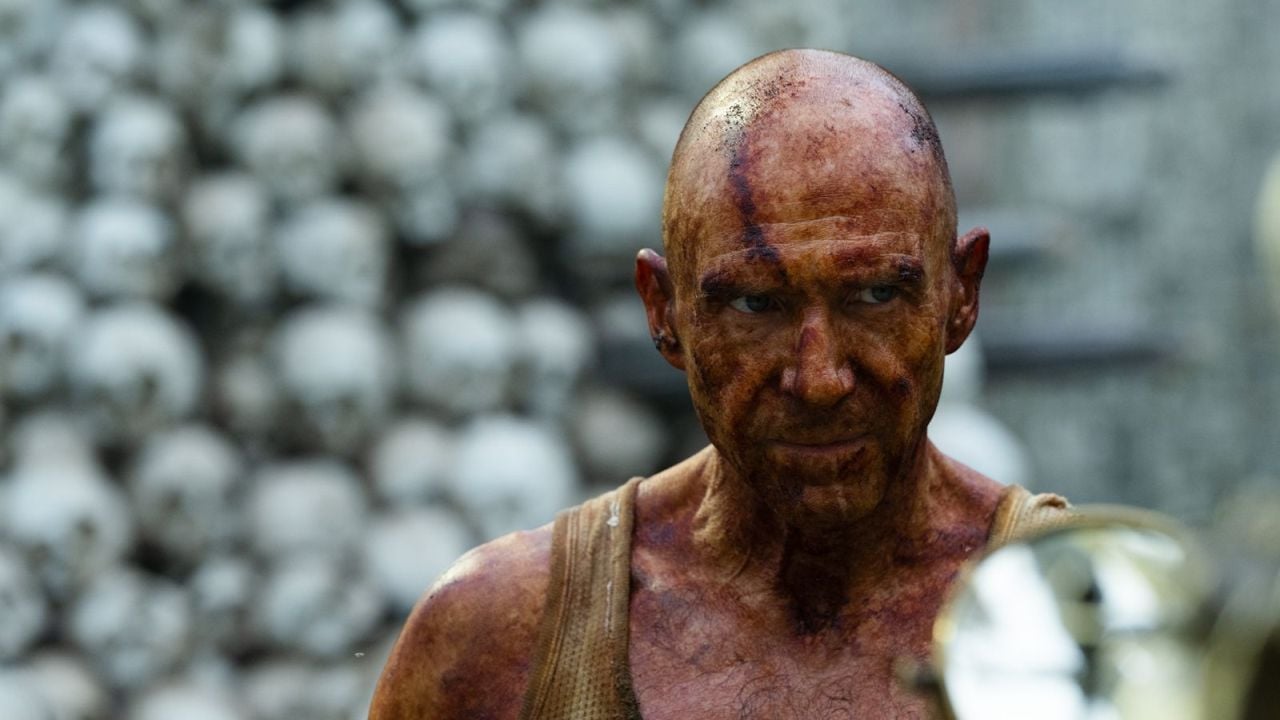
Dr. Kelson (Ralph Fiennes) built the bone temple monument, after which the sequel “28 Years Later: The Bone Temple” is named.
Danny Boyle (“Slumdog Millionaire”) and Alex Garland (“Ex Machina”) definitely make no prisoners when it comes to using violence – after the first five minutes, this is as clear as Kloßbrühe. But what becomes also clear as quickly: Even when it comes to staging, even the director who is enthusiastic about experimentation does not make any compromises! Where “28 Days Later” was at the forefront of digital technology 23 years ago, Boyle has now largely made the new film – despite a rumored budget of a proud $ 75 million – to large parts with iPhone 15 per Max devices. In extreme 2.76: 1 format, up to 20 iPhones were used at the same time to achieve an inexpensive bullet time effect in the kill scenes.
Thanks to this do-it-yourself variant of the legendary “Matrix” sequence, the bullets (mostly arrows, sometimes balls) can be admired from all perspectives. “28 Years Later” is full of such small and large sparrow-and since the trailer has just walked through the ceiling, it will be exciting to see how a wide mainstream audience will react to this deliberately used low-budget aesthetics. Although there are also some attitudes that are really beyond every taste and doubt-especially a nightly scene when Spike and Jamie flee on the half-sunken dam in front of an alpha zombie (yes, I know, strictly speaking, it is “infected”), while they seem to swallow the universe in the form of the northern lights through the starry sky in the background.
On the whole you know all of this, but the details are fresh
Since the film is aimed at adult spectators alone because of its FSK release, it is gratifying that “28 Years Later” does not sell its audience for stupid: the first zombies we get to know are so fat that they have developed into crawling pigs. They eat earthworms and squeak like piglets when they hire an arrow in the throat. Much later, when Zombies Spike and Isla surprise the same way, but they do not immediately bite into the meat, but nibble around at the laces. Why is that brilliant? Think about it yourself.
Meanwhile, the story of “28 Years Later” disintegrates a little in half: Spike first pulls off with his father and then with his mother-and then there is the usual encounters with other survivors or various zombie types, as is used to be used to the end-time genre. Despite the now quite exhausted scenario, Alex Garland-from a zombie baby to the spectacular bone temple-then came up with enough fascinating details to make “28 Years Later” even appeared to be amazingly fresh away from the gaudy staging.
Conclusion: “28 Years Later” does not add anything to the end-time zombie genre in terms of content, but the film-especially with its staging ingenuity and a consistent Gore level-makes you really desire for more. Especially since the last five minutes are already very promising Anteasers, like the entire key in “28 Years Later: The Bone Temple“(Heavy of the cinema: January 2026, directed by Nia Dacosta) could once again radically switch over.