
The most beautiful and lovable of all films that play in Rome, and the grandmother of all modern romantic comedies, should still be “a heart and a crown” – the story of a princess who escapes her strict court ceremony for 24 hours and discovers together with a newspaper reporter Rome and love. In the end, there is a mutual waiver: the princess renounced her love from a sense of duty, and the reporter refrains from publishing his sensational history.
As a princess, Audrey Hepburn was famous in her first big film role with one fell swoop and was rewarded with the Oscar as the best leading actress. At her side, Gregory Peck embodies the reporter after Cary Grant rejected. But the third leading role played the city of Rome itself – the film was shot at original locations, which was still very unusual at the time (1953), but ultimately makes a large part of the fascination of the film.
There is a lack of Roman lightness
Now it would have been desirable if this was also about the relationship drama, which was also largely playing in Rome, “Bella Roma – love in Italian“Say. But the film by Niclas Bendixen (” Familie Like Our – only with you “) quotes a lot of motifs from the large model – from the Vespa to the famous” Bocca della verità “(the” mouth of the truth “) to Engelsburg in the background.
But as far as the story and the general atmosphere are concerned, the Danish film cannot accommodate it with William Wyler's sovereign staging lightness. That may be due to the Scandinavian background of history. Lars from Trier and Danish Dogma past have not even left their sometimes so uninteresting traces-because Manuel Alberto Claro's hand camera is especially exquisite. The biggest problem, however, is the script, which only really gets into driving in the last 30 minutes, but then it is almost too late.

Gerda (Bodil Jørgensen) has loved Rome since she studied art many years ago.
At the beginning, a predictable story is told in a friendly manner: an older couple has just ended up in Rome, the vacation is a gift from the daughter on the 40th wedding anniversary. Kristoffer (Kristian Halken) misses his suitcase, he hates flying anyway. But Gerda (Bodil Jørgensen) does not listen to him at all, but looks at the teeming big city life with a smile and longing. The fronts are quickly clarified: Kristoffer is a bores who prefers to talk about his various zipper little, especially digestion! Gerda, on the other hand, is his adventurous woman, who once studied art in Rome and is still fluent Italian. The gap between them is getting deeper and deeper, because Kristoffer turns out to be a unpleasant, cultural -free banausen tourist – and because he has already fallen asleep, Gerda starts alone.
At the latest when Gerda meets her former teacher Johannes (Rolf Lassgârd), Kristoffer realizes that his wife has kept some secrets from her Roman period. This applies not only to her artistic work, but above all to her relationship with the Swedish art professor, who seems to be the opposite of Kristoffer: a cultivated gentleman who, with a smart wink, describes operas as the best music. Initially, however, the two men are buzzing, with the red wine serving well as a binder. But when Gerda dances with Johannes, Kristoffer even understands that the two combine more than a fleeting acquaintance between student and art teacher. This is how the drama takes its course, but the comedy is already running a bit …
Far too much history
The story is as clear as usual, so in principle nothing new at first: The formerly talented, fun -loving artist Gerda chose the safe side of life at the time. Instead of the women's hero Johannes, she chose the well -behaved postman of Kristoffer, and she became the publisher's secretary instead of painter. After so many years, the planned romantic roma for two becomes unintentionally a settlement with the past including the unveiling of various relationship secrets – a large -scale cleaning for everyone involved with possible fatal consequences. “Who is driving it to the executioner on the wedding day with another?” Castle roars deeply injured. “And then also with a Swede!”
This initiates the gratifying last third of the film. This unexpectedly spirited development after a felt 60-minute introduction is a nice idea, which, however, could suffer from the fact that some may already have fallen asleep or went to the audience before it is finally interesting. But this actually happens reasonably unexpectedly, because the slightly tölpic crestoffer actually understands that he has to fight for his wife's love if he wants to hold her. Not only several tank charges of Grappa and Red wine help him, but also some locals, including a disguised Roman Zenturio, who poses for tourists in front of the pantheon and turns out to be a true philosopher.
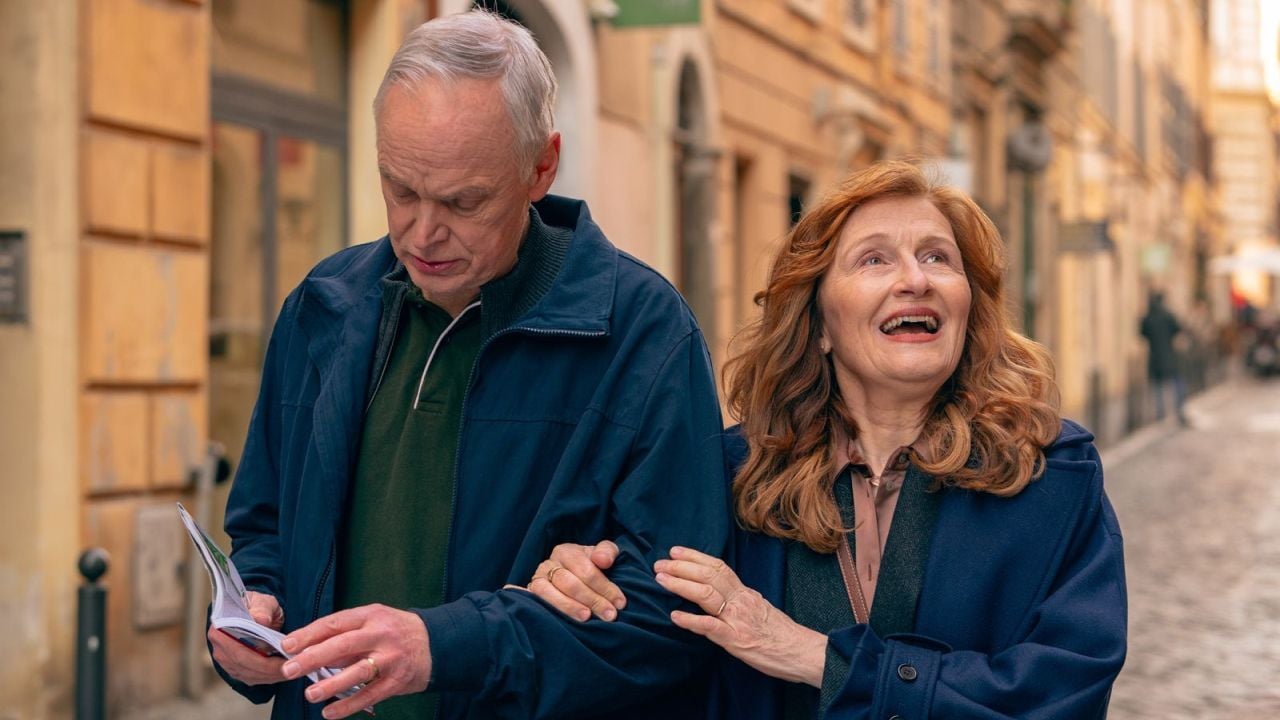
Kristoffer (Kristian Halken) takes far too long to understand that he has to fight for his wife.
Now the atmosphere is finally right: the plot gets more and more pace, swing and drive, and the local color also fits better and better. Kristoffer does not become a maniac, but at least he raps himself in such a way that as a 70-year-old Danish version of Dustin Hoffmans Benjamin, he could go through in “The matriculation examination” if he could go through the loudspeaker system of the Roman main station Stazione Termini “Gerda!” roar. And Kristoffer's terrible faux pas in the Fontana di Trevi becomes a really strange running gag.
The main roles are well staffed: Bodil Jørgensen (“idiots”) plays Gerda as an older lady with much lovable longing and without false emotions. Kristian Hallen (“The Angel Maker”) turns Kristoffer an old zausel, who may be developing their own initiative for the first time in life – a nice role: from the bumper to the fighter. And the experienced Rolf Lassgârd (“A man named Ove”) plays the artistic Johannes as a hiker between the worlds: one who has chosen the lust for life instead of the age of age. Not the worst idea when you live in Rome.
Conclusion: Unfortunately, much too late, the relationship comedy develops its qualities. Until then, predictable developments dominate. However, neither the very good acting performance nor the quite inspired camera work, but an undecided script, which is for far too long with preliminary plans and explanations are responsible for the late bureau.