
In 2023 the documentary “Pictures of Ghosts”, in which the Brazilian director Kleber Mendonça Filho (“Aquarius”) Recife explores the history of his hometown – by visiting the places of the sometimes no longer existing cinemas, in which he spent a not inconsiderable part of his childhood. It was also about the role of the metropolis of millions in the northeast of the country during the military dictatorship in the 1970s. Mendonça Filho and his team have carried out extensive research for this-and from some of them particularly exciting for him, he finally has his very personal, but still difficult to reach political thriller “The Secret Agent“, Who not only has visually parallels to Quentin Tarantino.
As Mendonça Filho repeatedly returns to Recife in his works, the protagonist of the film during the carnival season of 1977 is just on the way back to his hometown. Only this does not quite voluntarily happen in the case of the engineering professor Marcelo (Wagner Moura)-which can already be seen from the fact that he checks in under a false name in an apartment house in which only a few of the residents use their actual names. But whether this secret nesting is already making him the title of “Secret Agent” is only one of many secrets in addition to the origin of a human leg in the stomach of a shark, which is often revealed in the next two and a half hours – at a mostly very leisurely pace.
The Fiat 147 Marcelo (Wagner Moura) already has this iconic seventies yellow, which is now most likely connected to Uma Thurman's suit from “Kill Bill”.
Before he arrives in Recife and the first chapter begins, Marcelo stops at a petrol station in nowhere. In front of the door there is a body in a laugh, only covered with cardboard boxes. No reason to worry, says the gas station attorney, the police have long been informed, but has been long in coming for several days. When a rickety car rolls off the state violence, the civil servants, (also because of a blood stain on the chest), have no interest in the body, but only in Marcello – in a vehicle control, they look for the smallest little thing to be able to put a criminal slip on, and at least ask for a “donation” for the police.
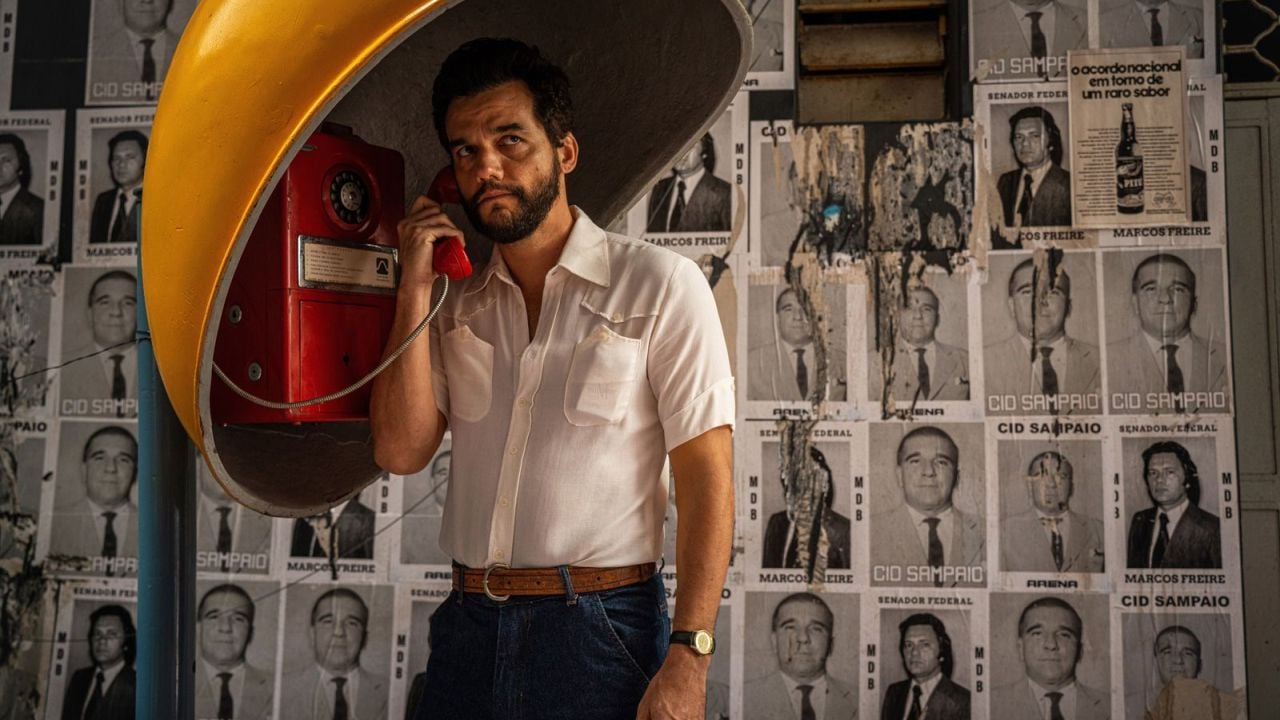
What the military dictatorship is in great superiority seeps through to the smallest corners of the province: the Brazil of the seventies is thoroughly corrupt-and how bad it really is, this tarantin-like prologue in sunny cinemascope images only offers a first careful impression. It certainly does not lack a certain irony that Marcelo in Reclife – under a false name – is a job in the archive of the identity institute (almost the residents' registration office). Who or what Marcelo flees and whether he only has underhable in Reclife or has to do a task remains nebulous for a long time. Without a clear common thread, Mendonça Filho designs a moral painting populated with a large number of figures, which focuses on a kind of civilian aid work for persecuted.
Everything just research?
And as if that weren't already complex and excessive enough, Mendonça Filho finally breaks down the narrative by suddenly cutting into the present and we learn that everything we have just seen has grown up from a conversation between two students who listen to old cassettes with the statements by Marcelo and other participants. If you are familiar with this premise, you may think of the Argentine favorite of critics “Trenque Lauquen”.
Although the director obviously is very important to the director of this era, he is not afraid of the absurd, the comic, the pulp. In a winking gore scene, not only is the torn human leg pulled out of the belly of the shark, at the same time we also learn that Marcello cannot wait to see Steven Spielberg's “The White Hai” in the cinema in which his grandfather works as a demonstrator.

How much in the film remains vague until the end, whether Marcelo is actually the title -giving “Secret Agent” or not.
Nevertheless, “The Secret Agent” is not a coming-of-age biopic à la “Belfast” or “The Fabelmans”. Instead of deeper over the power of cinema and the pictures, Mendonça Filho takes us on a wild slasher trip, in which a strongly hairy, disembodied leg murmurs at a sex meeting point-at least until this pulp episode is a visualized conversation of a group of women who turns out to be over the sensational press coverage in a murder make fun. For the duration that Filho deliberately indulges in the framework, we briefly deal with a story in a story in a story. Mendonça Filho takes out all the freedom.
In this respect, it is not surprising that the character work here is not necessarily in the foreground despite a period of two and a half hours. This means that striking spaces remain over (even if that could be explained that the corresponding points on the cassettes of the students are simply not addressed). Mendonça Filho itself seems to be well aware of this problem and tries to reconcile in a kind of epilogue that told and reconcile the narrative level. And as beneficial as this encounter is in a blood bench, the feeling remains that it would not have taken 145 minutes for this to get to this admittedly beautiful end.
Conclusion: “The Secret Agent” sounds like an exciting thriller cinema, especially since Kleber Mendonça Filho also-starting with the bright retro yellow of the Fiat 147-uses the visual language of a Quentin Tarantino. However, the artistically nested story, which is always space for humor, is also so intended that even as an atmospheric corruption mosaic, it is only partially convincing-especially despite the grandiose sun-drenched images, many empty spaces remain open in the character work.
We saw “The Secret Agent” at the Cannes Film Festival 2025, where he celebrated its world premiere as part of the official competition.