
Who does not know that: in your Facebook timeline you suddenly get an advertisement on a topic that you have not yet searched for online, but spoke to someone a few days beforehand. Something overwhelmes your own cell phone? Of course not, all the tech companies in unison claim, of course we respect privacy. If you still doubt it, you quickly look paranoid. But can we really be sure? With this growing feeling of uncertainty, especially in view of the increasingly unlimited possibilities of modern technologies, Yann Gozlan plays in his AI thriller “Dalloway“.
Cécile de France (“High Tension”) plays the writer Clarissa, who used to be successful with young-adult novels and is now trying to get her life and work under control after a difficult stroke of fate. A scholarship in a fully supported by AI support artist residence in Paris seems to be the perfect opportunity for it. But soon Clarissa has doubts about the intentions of the possibly not so art -loving donors. Especially since the foundation also calls itself “Ludovico Foundation”-and by chance (?) Just like that means the thoughts controlling anti-violation in “clockwork orange”.

Clarissa (Cécile de France) initially believes that she was very lucky to get a place in the highly exclusive and super -modern artist residence …
This is how it can be used to live: a modern apartment in an architecturally spectacular high -rise on a hill with a view of all of Paris. In addition, an advanced AI that wakes up with wave noises in the morning, prepared the coffee, answers emails-and even offers you productive tips for creative work. For Clarissa, writing has become agony after her son's suicide, and her marriage also failed.
But now she has actually received this work scholarship in the artist residence. Their director Dewinter (Anna Mouglalis) looks jovially, but also similarly controlling as the AI, which Clarissa keeps an eye on around the clock. Only the undeniable Matthias (Lars Mikkelsen), a composer, cannot be completely lulled by the beautiful new AI world-and asks questions that are increasingly conjuring up in Clarissa that something is not going on here …
In the event of risks and side effects …
Much has been written about the rapid developments of AI in recent years. Between warnings that a potentially existential threat to mankind arises, up to appeasement that the chances would of course outweigh the risks, the discussion usually runs. However, Yann Gozlan occupies a clear position in “Dalloway”. Understandable, because for sci-fi-paranoia thrillers it would also be somewhat unspectacular if a AI would behave really peacefully and did not develop a disturbing own dynamic at some point.
This concept has been known since “2001: Odyssey in space”. And recently, a horror film like “Companion” also played through what could happen if Android is too lifelike. In doing so, these films always start to describe the possibilities of technology positively: that a AI independently orders foods that drones deliver drones directly on the doorstep, you no longer have to take care of many annoying things of everyday life – who could have something against it? But we pay a price for these amenities. And it no longer only consists of our data, but also includes our deepest feelings, most intimate secrets, most stuck trauma, as in “Dalloway”.
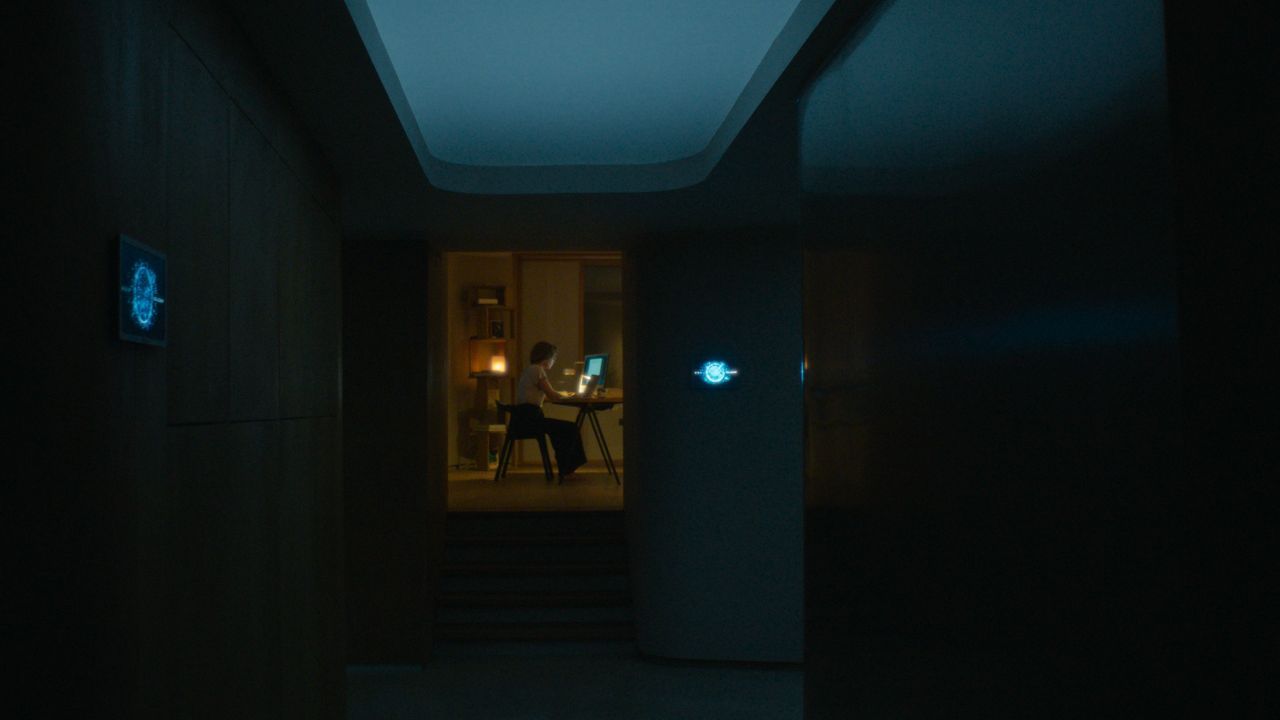
At some point the blue-glowing Ki lights no longer seem harmless everywhere …
Will man possibly be completely replaced in the end? “Dalloway” at least indicates how the AI, which is tailored to Clarissa personally becomes more useful, get to know her better, soon not only asks practical questions, but also psychological. Anyone who ultimately determines the writing process whether Clarissa is drawn out of her memories or is the AI that gains the upper hand more and more is becoming more and more difficult to assess. The great strength of the film lies in how close it stays with reality: “Dalloway” plays in an indefinite future, in which extreme heat waves burden health and make a new pandemic necessary.
Overall, however, it almost looks like our present. (Hyper-) modern, but not much differently-except the ubiquitous AI with her monitors, take the whole walls, plus advanced tests with a cotton bar right after getting up in your own bathroom. Futuristic, yes, but it can be assumed that in the Silicon Valley it is already considerably considered the future, much more extreme methods of monitoring are considered. “Dalloway” also seems so disturbing because you can hardly get rid of the idea that all of this (or at least a lot of it) could not lurk far in the future, but around the next corner.
Highly topical, but also highly conventionally
However, these discussions about the possibilities and dangers of AI only form the subtext of “Dalloway”, which is essentially a somewhat conventional paranoia thriller, which is mainly guided by the question of whether Clarissa is in the process of looking behind the facade of a big plotting or maybe simply not taking her tablets. As I said, the name of the company Ludovico Foundation is delivered as a hint – but nobody else in the audience will also doubt where the matter (at least) is going. Nevertheless, Yann Gozlan still keeps some surprises ready in his AI thriller, especially one ending that would not be expected in this disillusioning consequence in a Hollywood film with a similar topic.
Conclusion: Yann Gozlan's sci-fi film “Dalloway” looks high-and that is precisely that screws the degree of disturbance of the Ki-Paranoia thrillers more than its very conventional dramaturgy and design.
We saw “Dalloway” at the Cannes Film Festival 2025.