
Not one, but two great fears, are served by this film. “”The Rule of Jenny Pen“On the one hand, summarizes the fear of scary dolls. In this case, it is a small baby hand doll made of plastic that should teach the audience that fears. On the other hand, this is about the fear of aging that is still much more widespread-and in this regard, the new film by director James Ashcroft unfolds its greatest strength. After“ Coming Home ”, the New Zauseländer has another short story of the writer Owen Marshall adapted and lets two seniors go to each other bitterly.
Judge Stefan Mortensen (Geoffrey Rush) suffers a stroke in the middle of the verdict. From then on he is dependent on outside help and therefore ends up in an old -age residence. It is all the worse that he is not only confronted with his own transience and physical ailments, but also with an obviously psychopathic Dave Crealy (John Lithgow), who can at least move a little better than the rest and take advantage of this certain more in mobility to harass, humiliate and misuse the other roommates with a hand doll …

The venerable judge Stefan Mortensen (Geoffrey Rush) had imagined his stay in the nursing home much less fiery …
“The Rule of Jenny Pen” is extremely beneficial that he can rely on two such great character actors as Geoffrey Rush (Oscar for “Shine”) and John Lithgow (“Conclave”). The entire conflict of the film unfolds in the area of tension of their intense looks full of frustration, pain, but also toxicity and later unadorned aggression. The inhibitions of the figures fall faster and faster. And the search for something like autonomy and dignity in a state of helplessness becomes a grueling, almost exhilarating.
Ashcroft's film works less with spectacular horror, but with a creeping psychological thrill. There are horror elements, undoubtedly! Scenes in which reality and nightmare seem to merge. Moments when horror and bad laugh are closely together, for example when an elderly gentleman in a wheelchair accidentally catches fire. At the same time, the staging of James Ashcroft hardly deals with classic shock and scary effects. The more traditional genre elements, when he lets his mad puppet player off his leash and the violence screws up, are even the weaker passages of the film.
Between sadistic horror and black humor
The horror of aging mentioned at the beginning is much more terrifying in “The Rule of Jenny Pen”. And it is sometimes staged in an inconspicuous way. Sometimes only short settings are enough. A look at the naked body, which is scrubbed by a caregiver in the shower, deprived everyone privacy. At night someone suddenly slows into the room through the door gap. A life under permanent observation. If you weather danger and therefore reactively react, then you are declared crazy. Every rationality is agreed and the film wants to pull its terror out of this fainting.
The sadness always sneaks into the deceptive bright pictures. The camera hangs most of the time on the stroke of Geoffrey Rush and thus translates the world loss of his figure into claustrophobically narrow images. The loss of mobility and the exposure to violence that abuses and aims against others is therefore looking for strong intimacy, immediacy. At first Stefan still thinks that it is only a long time in the home. But with every minute the realization grows that he has to spend his retirement here, and the rooms appear more and more depressing.
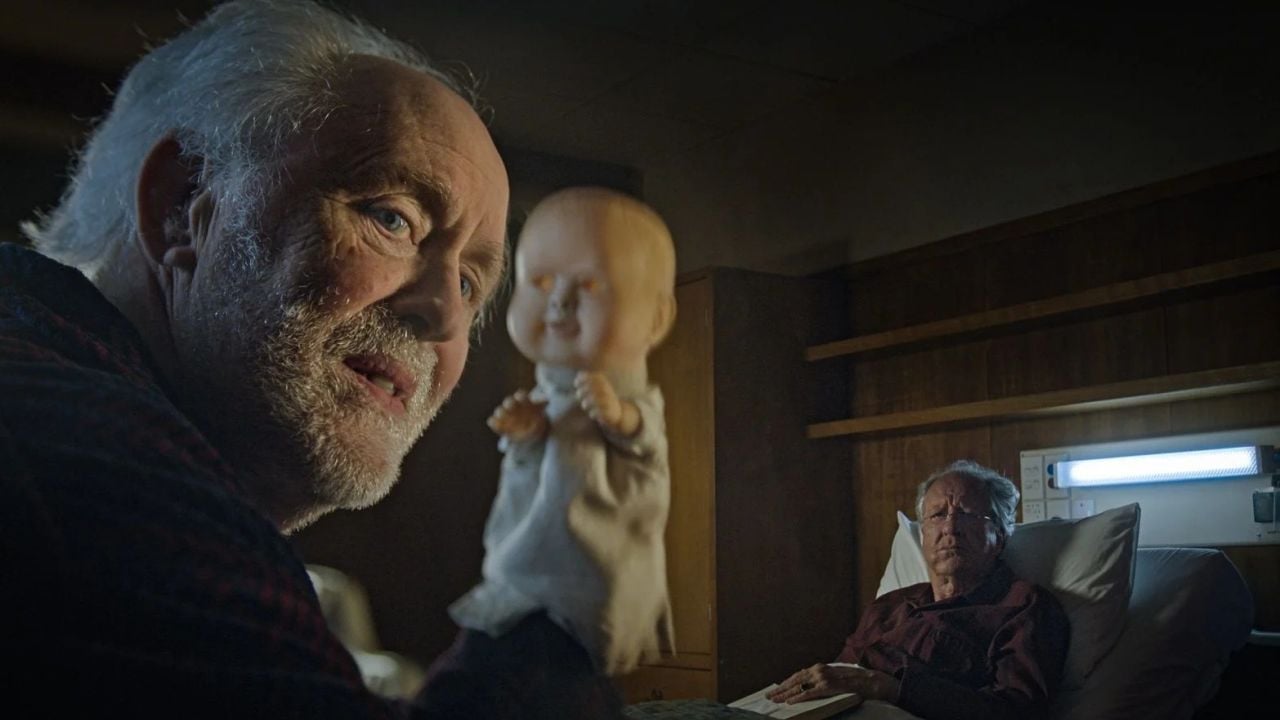
The fact that John Lithgow can play psychos like no other, has already proven with his grandiose role as a serial killer in “Dexter”!
But despite the rousing approaches, “The Rule of Jenny Pen” remains behind his possibilities. It never unfolds the emotional force that is actually designed in its topic. The main reason for this is that his abuse study is full of abysmal observations, but remains too undecided in terms of stylistically in order to make it appear deeper as such. Genrekino is usually particularly interesting where it blows up the too familiar formula and tonality. But in this case, the result ends up a little too strikingly between all fronts.
“The Rule of Jenny Pen” is too serious to go through as a black comedy. Too bizarre to function as a mature social criticism. Too tame to shake sustainably as a thriller or horror film. In this regard, dealing with the doll, which is supposed to form the heart of the film. Various approaches are offered on how to read the puppet show: as an expression of loneliness, as a split off a cruel personality. Or as a parody of the amusements with which one tries to embellish the senior citizen in the home. It is also about the longing for power and superiority in order to push your own fear aside.
What does the doll stand for?
It is also not uninteresting how the film the figure of the perpetrator and his sadistic jokes will eventually put into the spotlight. But it is disappointingly limited and lukewarm in its escalation and in the staging means with which one could reflect the brutality with the doll with the doll. Rather, there is a single grotesque picture that is still disturbed at first glance, but then fizzles out when you break it down to such a conventional spiral of violence in order to drive the confrontation of the two men.
Unfortunately, exactly this confrontational spiral of violence takes up so much space in the film that he later almost lost a look for the essentials. In addition to the horror of aging already described, this also means the horror of the institution of the nursing home itself. And at first he has nothing to do with psychopaths, nightmare visions and scary dolls with shining eyes. It includes the idea of everyday routines that are to be lived there and probably nobody is really prepared for the emotional challenge and overwhelming.
Conclusion: “The Rule of Jenny Pen” is a strongly played psycho -duels that make some touching and uncomfortable observations on the loss of autonomy that age can bring. As a genre film, however, all of this remains a bit confused and half -cooked in use and breaking its different formulas and motifs.